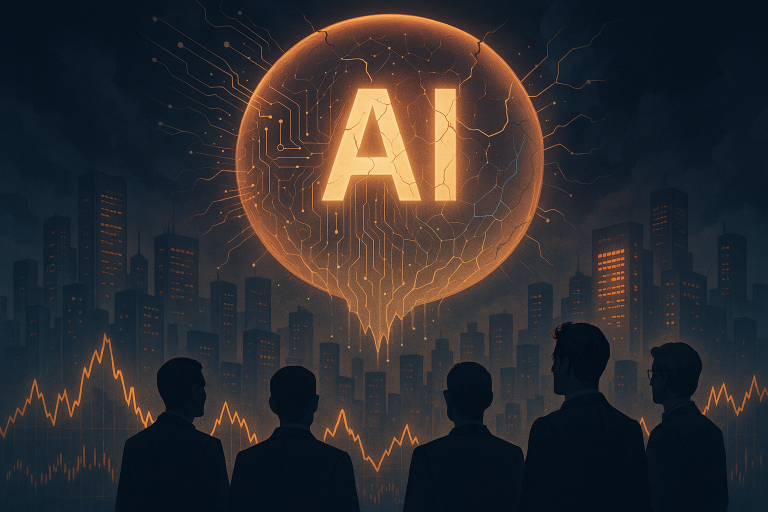
The excitement around AI has been almost unprecedented this century, but in recent months the mood has begun to sour.
Investors and executives of some of the biggest AI companies have openly questioned if current investment levels can really be justified, given the future revenue projections of the industry.
Google Chief Executive Sundar Pichai was one of the most notable figures to raise concerns, speaking about the “irrationality” of many investors, while OpenAI boss Sam Altman has stated in no uncertain terms that he believes the industry is likely now in a bubble, comparing it to the dot-com boom and bust.
Last week, Amazon’s AWS cloud service announced a series of infrastructure and compute investments, including a new AI-optimized chip called Trainium3.
Meanwhile, global stocks are slowing down and in some cases, even reversing, as investors start to show their nerves.
In the last few months, there has been incessant talk of a bubble and the possibility of a market crash that some analysts say could leave the economy reeling for years to come.
But bubbles in the tech industry are nothing new. We’ve seen some pretty big ones over the years, with the dot-com disaster being the most significant, and also some smaller ones, such as the surge in popularity of certain tech platforms (such as video communication tools like Zoom during the Coronavirus pandemic), which later flattened out.
However, in each case, the technological revolution inflating the bubble was very real.
The dot-com boom was driven by the emergence of the internet, which has utterly transformed society and made the world a much smaller and more connected place.
But the market entered into bubble territory anyway, because excitement over the internet’s potential ran ahead of its real world revenue impact.
The rampant growth of AI bears many of the same hallmarks.
Chatbots like ChatGPT and coding agents such as GitHub’s Copilot are extremely impressive and can do some amazing things, but it’s still unclear how they can generate the billions of dollars in profits needed to justify what’s been spent on developing and powering them.
The AI bubble will inevitably pop
Former Wall Street analyst Kirk Yang, now a professor of finance at National Taiwan University, said in an interview that he believes AI’s bubble will ultimately burst, but he’s not certain when.
He believes things could keep ticking over for another year or two, because AI infrastructure builds are still expanding.
“Every company is building their AI capabilities, data centres, components, everything,” he said, adding that this is likely to sustain Nvidia’s revenue for a while longer and bolster the market’s enthusiasm.
However, once the infrastructure is in place and these build-outs decelerate, that’s when enthusiasm may start to fade, he said.
Lightricks co-founder and CEO Zeev Farbman echoed the concerns of many of his peers, telling CNBC in a recent interview that he believes the industry is entering dangerous territory.
“If you define a bubble as expectations that are backed up by capital that aren’t going to meet reality anytime soon, then we are clearly there,” he said.
Lightricks develops its own open-source video AI models, and the company has also partnered with Google to run the startup’s video model processing – and to distribute the Big Tech firm’s Veo models through the LTX Platform.
“It’s challenging for some [investors] to see it, because AI is a magical, transformative piece of technology that is going to have a huge impact on everything,” Farbman continued, “but it’s similar to what happened in the late 1990s, where the internet was also a magical piece of tech.”
How bad will it be?
Once the enthusiasm for AI wanes, the first thing we’ll see is the money tap drying up.
Venture capitalists and institutional investors will become a lot less frivolous and push for more profits.
They’ll walk away from marginal deals, and that will cause AI startups that depend on external funding to cover their infrastructure costs to struggle.
In a blog post, Bill Hartzer of Hartzer Consulting said this will result in a lot of fledgling AI startups going under or being acquired by larger competitors.
“With the funding spigot turned down, burn-heavy companies will face immediate cash pressure, driving shutdowns, down-rounds and quick sales to strong platforms,” he predicted.
But that’s not to say it’ll bring down the broader economy, or even the technology industry.
While the enormous sums being spent on AI at the moment seem almost ungodly, most of the money comes out of pocket from so-called “hyperscalers” such as Google, Microsoft, Amazon and Meta, which are among the richest companies in the world, using their eye-watering cash flows to support it.
These companies already generate billions of dollars per year in revenue, and even if AI totally disappeared – which it won’t – it wouldn’t cause those existing, massive income streams to dry up.
If the Big Tech companies survive, then so should everyone else.
As Brian Phillips wrote recently in The Ringer, it doesn’t matter much to the average person if Mark Zuckerberg decides to spend billions of dollars to build a new “Superintelligence Lab” in rural Idaho.
That may boost the numbers and make Idaho’s real estate market look healthy, but it has limited impact on economic conditions outside of the AI industry.
AI might be on fire, but the rest of the economy isn’t.
“Groceries are getting more expensive. Utilities are getting more expensive. Thanks to the Trump tariffs, almost everything we buy is getting more expensive. None of that is offset by AI investment,” Phillips said.
AI to emerge stronger, more useful
As the AI industry consolidates and the broader economy rumbles on, Hartzer says the most visible change will be a shift in perception about what AI is actually good for.
AI is not going to go away, even if many companies around now do disappear, because the technology itself will always be extremely powerful, when it’s used properly. And that will be the key, going forward, he believes.
Companies will start asking tougher questions about what kind of return on investment they can expect and focus on factors that can make a difference, such as data quality.
“Boards and CFOs would slow procurement, extend pilots and demand clear productivity gains before expansion,” he said.
“Hype cools, scrutiny rises and the vendors that survive will show measurable outcomes, not demos.”
The surviving AI developers will also see benefits from the glut of underutilized AI infrastructure that follows any bubble.
If the likes of Google and Amazon’s multibillion-dollar data centers are sitting idle, they’ll respond by slashing their prices dramatically to try and get more customers.
By giving AI developers access to cheaper compute resources, they’ll trigger a fresh wave of experimentation that leads to more innovative, thoughtful, value-generating AI products.
According to Farbman, the value will come once the industry begins to fully understand AI’s capabilities, and more importantly, its limitations.
It might take a bubble to help us figure out the technology’s limits, but once that happens, we devise ways to get around them.
“What’s going to happen is that people are going to start to create products that are going to overcome the limitations of the technology with human interaction,” he said. “That’s where the value is going to be.”
The post The AI bubble may burst, but it won’t be as bad as many think appeared first on Invezz