Category

Latest News

Category

Four years into Russia’s full-scale invasion, the war in Ukraine has settled into a grinding conflict defined by high casualties and incremental territorial shifts. Russia still controls roughly one-fifth of Ukrainian territory, while Kyiv has recently clawed back limited ground in counteroffensives. Military estimates put Russian losses at about 1.2 million casualties since 2022, with Ukrainian losses between 500,000 and 600,000, underscoring the scale of attrition on both sides.

Diplomacy has intensified alongside the fighting. President Donald Trump met Russian President Vladimir Putin in Alaska last August for high-stakes talks aimed at advancing negotiations. Ukrainian President Volodymyr Zelenskyy has traveled to Washington multiple times since Trump returned to office, including a contentious Oval Office meeting in Feb. 2025 and a follow-up visit later in the year.

The most recent U.S. engagement with both sides came during trilateral negotiations in Abu Dhabi earlier this year and more taking place in Geneva on Feb. 17–18, where special envoy Steve Witkoff met with Russian and Ukrainian delegations as part of ongoing efforts to broker a settlement.

As the war enters its fifth year, former officials and analysts say the next phase could unfold along three possible paths: prolonged stalemate, shifting Ukrainian momentum, or a dangerous erosion of Western resolve.

Scenario one: Prolonged stalemate

The most immediate trajectory is continuation. The war remains defined by attrition, with neither side delivering a decisive blow and negotiations producing little progress.

Ret. U.S. Air Force Gen. Philip Breedlove, former NATO supreme allied commander of Europe, said Moscow is not winning despite its territorial hold, ‘There isn’t a winner right now.’

‘Russia, supposedly a world superpower with one of the world’s probably top three world armies and top four world air forces, in 12 years has gained about 20% of Ukraine. And they have lost some, say, over 1.2 million in the conflict so far. It’s a conflict that Ukraine is working hard to manage. It’s also a conflict that Russia is not, I repeat, not winning,’ he said.

Scenario two: Ukrainian momentum reshapes diplomacy

Recent battlefield developments suggest another possibility. Breedlove pointed to rapid Ukrainian gains following disruptions in Russia’s command-and-control systems.

‘In the last three or four days, because of the loss of the Starlink command and control system, Ukraine launched an offensive, and they have snatched back months of Russian gains in three days, three-pronged push, hundreds of square miles regained, and Russia is backing up in several places right now.’

Carrie Filipetti, executive director of the Vandenberg Coalition, said such advances could shift leverage at the negotiating table. ‘Ukraine’s recent advances to recapture its territory is yet another signal that Putin’s war machine is continuing to atrophy as the world marks the fourth year of Russia’s full-scale invasion. Russia’s latest territorial losses shows that far from being invincible, Putin and his army are beginning to experience real failures in terms of capability and resources.’

She added that momentum matters. ‘Not only is this the most significant Ukrainian advance on the battlefield in more than two years, its importance may be felt even more concretely at the diplomatic table. Finding a lasting and equitable peace deal through negotiation is often about momentum – and right now the Ukrainians have it.’

If sustained, such gains could alter Moscow’s calculations and give Kyiv a stronger footing in negotiations as long as Ukraine has strong U.S. support, Breedlove argues, ‘The first thing and the most important thing Ukraine needs is a declaratory statement by the West and specifically by the United States that we are not going to allow Russia to win in Ukraine, and we will give Ukraine what it needs to stop Russia… where Putin hears it loud and clear and where the people of Russia hear it loud and clear that is a game changer. And I think that’s when Mr. Putin is going to have to make some tough decisions.’

Scenario three: Escalation or Western fatigue

A third path worries some Western strategists: that inconsistent support could prolong or tilt the conflict in Russia’s favor.

Heather Nauert, who served as spokesperson for the U.S. Department of State from 2017 to 2019, framed the war as more than a territorial dispute. ‘As we now enter the fifth year of Putin’s war in Ukraine, we’re reminded that this conflict has never been only about territory — it’s about identity, faith, and the future of a free nation. Russia has destroyed more than 600 churches, persecuted millions of Ukrainian Christians under occupation, and abducted more than 19,000 children in an effort to break Ukraine’s spirit. President Trump’s push for a lasting peace must be backed by strength and accountability – one that protects innocent lives, defends religious freedom and brings stolen children home.’

Ret. Lt. Gen. Richard Newton said deterrence remains central. ‘Four years into this horrific war, the fundamental lesson remains unchanged: Peace is only possible when strength shapes the terms. Putin will continue to savagely test our resolve until the costs of his aggression outweigh any possible gain.’

‘What Ukraine needs isn’t gestures from the world, but instead, unwavering support from the U.S. and Europe that convinces Moscow further advances carry unacceptable consequences,’ he argued. ‘Russia must not prevail against Ukraine and the West. What are needed are credible security guarantees, robust offensive and defensive capabilities and a unified, long-term commitment by the West to ensure deterrence isn’t an elusive goal, but a lasting reality.’

Breedlove warned that negotiations alone will not shift the balance. ‘The most dangerous scenario is that we do not do what we should do in Ukraine and Russia takes over Ukraine because they’re not done.We have a policy of peace through strength and we’re using it in Iran. We’ve used it in Venezuela. We’re using it with oil tankers around the world… But when it comes to Putin and Ukraine, we are peace through weakness.’

‘Mr. Putin is making a point that he’s in charge in Ukraine, not the West and certainly not America. And so we need to change that dynamic. You got good guys and you got bad guys. And right now the bad guys have told America to take a hike. So now, rather than telling them what to do, we are going to the good guys and saying, you have to give up more because the bad guys are not playing well in the sandbox. That’s peace through weakness, not peace through strength,’ Breedlove concluded.

Related Article

Zelenskyy announces next round of talks with US, Russia as Ukraine seeks ‘real and dignified end to the war’
This post appeared first on FOX NEWS

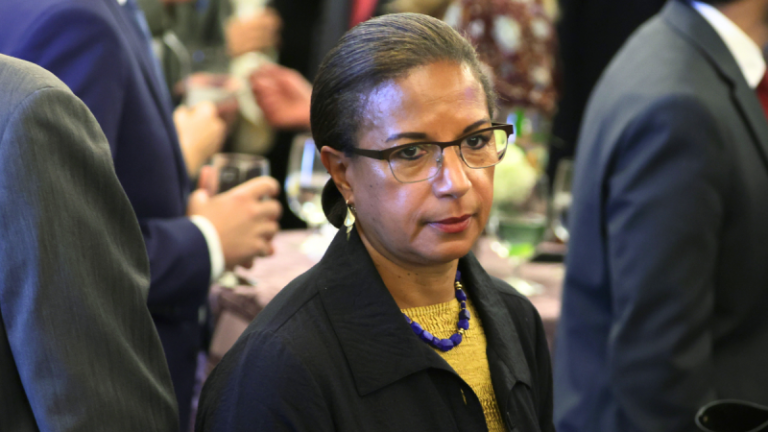
President Donald Trump called on Netflix to fire board member Susan Rice immediately or ‘pay the consequences.’

Trump’s comments followed remarks Rice made Thursday on the ‘Stay Tuned with Preet’ podcast, hosted by former U.S. Attorney Preet Bharara. 

During the interview, Rice warned that corporations she said had ‘taken a knee’ to Republican pressure should not expect forgiveness from Democrats if they return to power.

‘This is not going to be an instance of forgive and forget. The damage that these people are doing is too severe to the American people and our national interest,’ Rice said.

It was not immediately clear what specific actions the Trump administration might pursue.

Netflix did not immediately respond to a Fox News Digital request for comment.

Rice made the remarks while discussing what she described as corporate retreats from diversity and governance commitments amid pressure from Republican lawmakers.

‘If these corporations think that the Democrats, when they come back into power, are going to, you know, play by the old rules, and, you know, say, ‘Oh, never mind. We’ll forgive you for all the people you fired, all the policies and principles you’ve violated, all, you know, the laws you’ve skirted.’ I think they’ve got another thing coming,’ Rice added.

Rice, a former U.S. ambassador to the United Nations, predicted an ‘accountability agenda’ awaited those entities, forecasting an electoral shift in the upcoming midterm elections. 

She also pointed to waning public approval for Trump’s economic and immigration policies in making her case.

This post appeared first on FOX NEWS

Iran’s Islamic Revolutionary Guard Corps (IRGC) has tightened control over Hezbollah in the Middle East amid looming prospects of potential U.S. strikes, according to reports.

According to the Jerusalem Post, the tactical shift comes as Hezbollah and Iran prepare for military confrontation in the region, with analysts warning that if Washington specifically strikes the regime, Hezbollah is ready to be ‘activated.’

‘If the regime in Tehran feels threatened, the likelihood of unleashing Hezbollah against Israel and U.S. regional assets increases substantially,’ Ross Harrison, a senior fellow at the Middle East Institute, told Fox News Digital.

‘Hezbollah would not be activated right away, unless the attack immediately targets the leadership of the Islamic Republic. But as part of a graduated response, Hezbollah will likely be seen as an asset,’ he said.

‘If it faces an existential risk, then Iran may throw caution to the wind and try to deploy Hezbollah to the maximum,’ Harrison explained.

President Donald Trump previously gave Iran a deadline of 10 to 15 days to respond to a deal, raising questions about what steps Washington could take if Tehran fails to comply.

A new round of talks is now scheduled for Thursday in Geneva and expected to focus on Iran’s nuclear program, including uranium enrichment levels and sanctions relief.

‘The decision-making circle in the White House is very small regarding Iran, with the president keeping a close hand on it all,’ Harrison explained.

He added that any decision to directly target the Iranian regime would likely rest within Trump’s inner circle of advisers.

‘Normally there is input from the National Security Council and the wider intelligence community,’ Harrison said. ‘Since the decision-making process in the White House is opaque, it is hard to know how much of this is getting through.’

‘If the U.S. is engaging with the Saudis and Emiratis, they are getting warnings about the possibility of this war spreading to the broader region, which would be deleterious to the U.S. and its allies,’ he added.

Harrirson also warned that there was ‘potential for attacks to spread across the region, to Israel through direct Iranian ballistic attacks and via Hezbollah, and to the Gulf Arab states through Iran directly and possibly via the Houthis from Yemen.’

Regional media reports also suggest Iran’s ties with Hezbollah are strengthening. Sources told Al Arabiya and Al Hadath that IRGC officers have been rebuilding Hezbollah’s military infrastructure and managing strategic war plans.

The coordination follows changes within Hezbollah’s leadership, Harrison explained.

‘Since the killing by Israel of Hezbollah leader Hassan Nasrallah last year, ties and operational coordination have to some degree been reestablished,’ he said.

‘The IRGC has supported Hezbollah in Lebanon for decades,’ he said, adding that efforts to reestablish ties appear to be occurring ‘particularly in light of the destruction of Iran’s nuclear sites last June.’

‘Iran is trying to resurrect lost assets, such as its missile program and its connections to Hezbollah,’ Harrison said.

‘Hezbollah has been seen for decades by Iran as a deterrence asset against an Israeli or American attack. Since Hezbollah has its own interests, connected to but separate from Iran, whether its leadership will go all the way for Tehran is unknown,’ he concluded.

The developments surrounding Hezbollah and the IRGC came as Supreme Leader Ayatollah Ali Khamenei has appointed close ally Ali Larijani as the country’s de facto leader, according to reports.

Fox News Digital has reached out to the White House for comment.

This post appeared first on FOX NEWS

A government shutdown, big or small, is usually a front-and-center issue for lawmakers — but the most recent partial closure could be put on the back burner as Congress returns to several issues in Washington.

Senate Democrats and the White House are still at odds over funding the Department of Homeland Security (DHS), as the shutdown dragged into its 10th day. Neither side is budging, with the most recent concrete action coming early last week.

Trump, who proved pivotal in striking a funding truce with Senate Minority Leader Chuck Schumer, D-N.Y., in January, was not directly involved in recent negotiations. 

Trump has not had any ‘direct conversations or correspondence’ with congressional Democrats recently, White House press secretary Karoline Leavitt said, noting that the White House and its representatives have been handling the dialogue.

‘But, of course, Democrats are the reason that the Department of Homeland Security is currently shut down,’ she said. ‘They have chosen to act against the American people for political reasons.’ 

Senate Democrats offered a counter to the White House’s own counterproposal, which quickly was rejected as ‘unserious’ by Leavitt. It’s a peculiar instance, given that this is the third shutdown during Trump’s second term, and neither side appears to be in a particular rush to end it.

Senate Majority Leader John Thune, R-S.D., told Fox News Digital that there’s ‘some room for give and take’ in the negotiations, but remained firm in the GOP’s positioning against requiring Immigration and Customs Enforcement (ICE) agents from getting judicial warrants, unmasking or other reforms sought by Democrats that could increase risks for agents in the field.  

‘I felt like, you know, the last offer the White House put out there was a really — it was a good faith one, and it was clear to me that they’re attempting, in every way, to try and land this thing so we can get DHS funded,’ Thune said. 

Funding the agency will be a top priority for the upper chamber, but they’ll be delayed because of winter storms descending on the East Coast. The weather has caused the Senate to delay a vote on the original DHS spending bill until Tuesday night, ahead of Trump’s State of the Union address.

There are other issues that could get in the way of hashing out a deal, including a possible conflict with Iran and Trump’s desire to move ahead with tariffs without congressional approval.

Trump told reporters Friday that he was ‘considering’ a limited military strike against Iran, which already has riled up some in Congress, who are demanding that lawmakers get a say on whether the U.S. strikes.

Sen. Tim Kaine, D-Va., said in a statement that he has a war powers resolution to block an attack on Iran filed and ready, and challenged his colleagues to vote against it.

‘If some of my colleagues support war, then they should have the guts to vote for the war and to be held accountable by their constituents, rather than hiding under their desks,’ Kaine said.

On the heels of the Supreme Court’s ruling to torpedo his sweeping duties, Trump is considering bypassing Congress to move ahead with another set of global 10% tariffs.

That comes as some Republicans are quietly celebrating the end of the duties, and others are open to working with the administration on a path forward for trade policy.

On tariffs, a Republican aide told Fox News that the GOP was ‘waiting to see what POTUS does next.’

‘The State of the Union should be interesting,’ they said.

This post appeared first on FOX NEWS

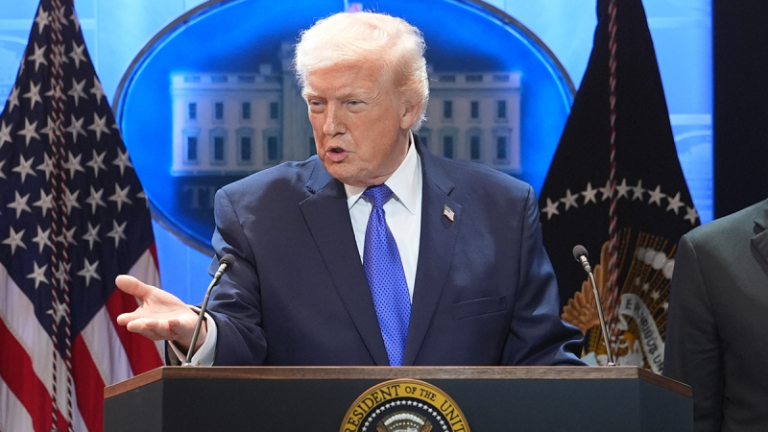
President Donald Trump will deliver his first official State of the Union address of his second term Tuesday night before a joint session of Congress at the Capitol, as viewers watch for viral moments and headline-grabbing exchanges like those that have defined past speeches.

Here are the top five moments from past State of the Union addresses.

1. Reagan surprises the crowd with first-ever acknowledgment of a guest in the audience

It’s become commonplace in recent years for presidents to acknowledge guests in the audience during SotU addresses, but President Ronald Reagan’s 1982 address was the first time the practice was rolled out. 

Reagan’s speech came just weeks after Air Florida Flight 90 crashed into Washington’s 14th Street Bridge over the Potomac River shortly after taking off in an accident that killed 78 people. 

Three people survived the crash thanks to civilians on the ground who rushed to their aid, including Congressional Budget Office assistant Lenny Skutnik, who stripped off his shoes and clothes and dove into the frigid waters.

Reagan honored Skutnik in his speech, which made honoring people in the crowd a common theme in the years to come. 

‘Just two weeks ago, in the midst of a terrible tragedy on the Potomac, we saw again the spirit of American heroism at its finest — the heroism of dedicated rescue workers saving crash victims from icy waters,’ Reagan said. ‘And we saw the heroism of one of our young government employees, Lenny Skutnik, who, when he saw a woman lose her grip on the helicopter line, dived into the water and dragged her to safety.’

2. Speaker Pelosi tears up Trump’s 2020 speech

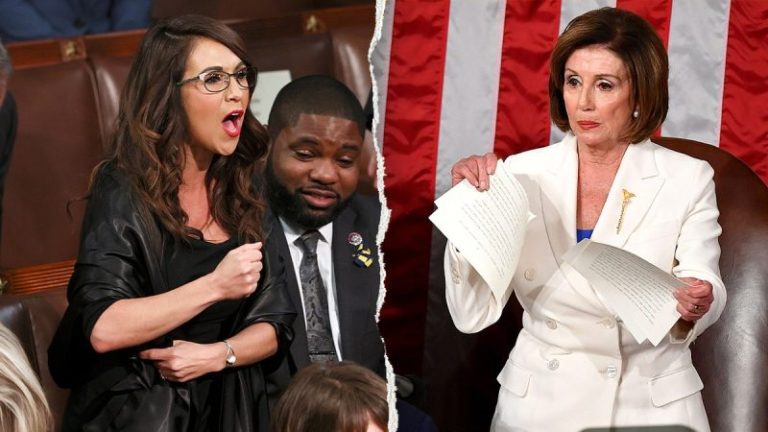
Democratic House Speaker Nancy Pelosi sparked a social media firestorm and cemented herself in State of the Union infamy in February 2020 when she stood up and tore Trump’s speech into pieces after he had finished.

When Fox News asked Pelosi afterward why she did it, she responded, ‘Because it was the courteous thing to do considering the alternatives.’ She added, ‘I tore it up. I was trying to find one page with truth on it. I couldn’t.’

Pelosi’s outburst came on the heels of Trump’s first impeachment trial, which ended in a Senate acquittal the day after the speech.

‘Speaker Pelosi just ripped up: One of our last surviving Tuskegee Airmen. The survival of a child born at 21 weeks. The mourning families of Rocky Jones and Kayla Mueller. A service member’s reunion with his family. That’s her legacy,’ the White House tweeted after Pelosi tore up the speech, referencing individuals who Trump mentioned during his address.

3. Rep. Joe Wilson ‘You lie!’ outburst at President Obama

One of the most remembered moments from a State of the Union address came in 2009 when South Carolina Republican Rep. Joe Wilson interrupted President Barack Obama’s address, which at the time was far less common than it later became. 

‘There are also those who claim that our reform effort will insure illegal immigrants,’ Obama said, talking about his controversial Obamacare plan. ‘This, too, is false. The reforms I’m proposing would not apply to those who are here illegally.’

‘You lie!’ Wilson shouted from his seat on the Republican side of the chamber, causing widespread yelling from other members in the audience.

Wilson later apologized to Obama’s chief of staff, Rahm Emanuel. 

‘This evening, I let my emotions get the best of me when listening to the president’s remarks regarding the coverage of illegal immigrants in the health care bill,’ Wilson said in a written statement. ‘While I disagree with the president’s statement, my comments were inappropriate and regrettable. I extend sincere apologies to the president for this lack of civility.’

4. Rep. Boebert heckles Biden over Afghanistan withdrawal during 2022 address

‘You put them in, 13 of them,’ GOP Rep. Lauren Boebert shouted at Biden as he talked about Afghanistan veterans who ended up in caskets due to exposure to toxic burn pits. Boebert was referencing the 13 U.S. service members killed during Biden’s chaotic withdrawal from Afghanistan in 2021. 

Boebert was wearing an outfit that said ‘Drill Baby Drill’ in opposition to Biden’s energy policies and her outburst drew some boos from the audience.

At another point, Boebert and Greene started chanting ‘build the wall’ when Biden was talking about immigration. 

5. President Biden blasts GOP lawmakers in 2023 address, prompting jeers from Republicans in the crowd

‘Some of my Republican friends want to take the economy hostage — I get it — unless I agree to their economic plans,’ Biden said to Congress, prompting a shake of the head from then-GOP House Speaker Kevin McCarthy in the background and shouts from the crowd and shots of other Republicans shaking their heads. 

‘Instead of making the wealthy pay their fair share, some Republicans, some Republicans, want Medicare and Social Security to sunset,’ Biden continued, which caused an even more pronounced shake of the head from McCarthy, who mouthed ‘no’ as Republicans continued to jeer. 

‘I’m not saying it’s the majority,’ Biden continued, which resulted in even more boos from the raucous crowd. 

‘Let me give you — anybody who doubts it, contact my office. I’ll give you a copy — I’ll give you a copy of the proposal,’ Biden continued to say over increasingly louder shouting from the crowd. 

‘That means Congress doesn’t vote — I’m glad to see — no, I tell you, I enjoy conversion,’ Biden said, apparently meaning to say ‘conversation.’

Biden’s speech continued to devolve from there as Republican outrage interrupted him on multiple occasions. 

This post appeared first on FOX NEWS

The Department of Homeland Security (DHS) will suspend TSA PreCheck and Global Entry beginning Sunday as a partial government shutdown continues.

Homeland Security Secretary Kristi Noem on Saturday blamed Democrats for shutting down the government, saying they were causing ‘serious real world consequences.’

‘This is the third time that Democrat politicians have shut down this department during the 119th Congress,’ Noem said in a statement provided to Fox News Digital. ‘Shutdowns have serious real world consequences, not just for the men and women of DHS and their families who go without a paycheck, but it endangers our national security.’

The suspension of the programs, which allow some travelers to quickly get through airport security, was first reported by The Washington Post, which noted the changes would begin Sunday at 6 a.m. EST.

Noem said the department was making ‘tough but necessary workforce and resource decisions to mitigate the damage inflicted by these politicians.’

She said TSA and U.S. Customs and Border Protection (CBP) would be ‘prioritizing the general traveling population at our airports and ports of entry and suspending courtesy and special privilege escorts.’ The Federal Emergency Management Agency (FEMA), she added, will halt all non-disaster-related response to prioritize disasters.

Noem noted the suspension comes as a major storm is expected to hit the Mid-Atlantic and Northeast.

Rep. Bennie Thompson, D-Miss., ranking member of the House Homeland Security Committee, criticized the Trump administration for ‘idiotically’ shutting down the programs ‘to punish the American people.’

‘This is Trump and Kristi Noem purposely punishing the American people and using them as pawns for their sadistic political games,’ he said in a statement. ‘TSA PreCheck and Global Entry REDUCE airport lines and ease the burden on DHS staff who are working without pay because of Trump’s abuse of the Department and killing of American citizens.’

He called on the administration to immediately reverse the decision.

The third government shutdown in under half a year began on Feb. 14 after Democrats and Republicans were at an impasse on reaching a deal regarding President Donald Trump’s immigration crackdown.

DHS was the only department left without federal funding after Democrats walked away from a bipartisan plan released last month in response to the deaths of two U.S. citizens at the hands of federal law enforcement agents in Minneapolis during anti-ICE demonstrations.

DHS is the third-largest Cabinet agency with nearly 272,000 employees. Roughly 90% of DHS workers were expected to continue working, many without pay, according to the department’s Sept. 2025 government shutdown plan.

DHS has jurisdiction over numerous agencies and offices, including CBP, TSA, FEMA, Immigration and Customs Enforcement (ICE), the U.S. Coast Guard, and the U.S. Secret Service.

Fox News Digital’s Elizabeth Elkind and Alex Miller contributed to this report.

This post appeared first on FOX NEWS

Most U.S. data breach disclosures explain what information was leaked and any protective steps available to consumers.

At the federal level, the Federal Trade Commission advises that after a breach involving sensitive personal information, consumers may consider placing a credit freeze to help prevent new credit accounts from being opened in their name.

Many people place that credit freeze and assume they’re protected. But a credit freeze is not a comprehensive block against identity theft. It stops most new credit applications, but it doesn’t prevent the misuse of your Social Security number or account takeovers.

Get my best tech tips, urgent security alerts and exclusive deals delivered straight to your inbox. Plus, you’ll get instant access to my Ultimate Scam Survival Guide — free when you join my CYBERGUY.COM newsletter.

What a credit freeze actually does

A credit freeze, also called a security freeze, limits access to your credit report at Equifax, Experian, and TransUnion. Under federal law, placing a freeze is free. When a freeze is in place, most lenders can’t access your credit file to evaluate applications for new credit cards or lines of credit. If a creditor can’t see your credit report, the application will usually be denied.

You can manage your credit freeze with each bureau individually. With Experian, for example, you sign in to your free online account at Experian’s credit freeze page and then place, lift, or schedule a thaw; you can also call Experian’s toll-free number (888-397-3742). If you plan to apply for credit, you must lift the freeze beforehand.

A credit freeze blocks most new accounts that require a credit check. It does not extend beyond your credit file.

Some identity protection services offer a credit lock feature that allows you to restrict access to your credit file through a mobile app. Like a freeze, it can limit new credit checks. The main difference is convenience, as you can typically turn it on or off quickly without logging into a bureau’s website or calling by phone.

Credit freezes can’t stop every form of identity theft

A credit freeze blocks new credit accounts, but it does not stop many common forms of identity theft that do not require a credit check.

  • Account takeovers: If someone has access to an existing credit card or bank account, they don’t need to open a new line of credit. They can change the email address, phone number, or mailing address tied to the account and begin making charges.
  • Tax identity theft: A fraudulent federal tax return does not need a credit check. If someone files a return using your SSN before you do, the IRS may reject your legitimate filing.
  • Employment fraud: If your SSN is used for employment, it will not appear as a credit inquiry. Instead, the earnings may be recorded under your Social Security record.
  • Government benefits fraud: Unemployment insurance and other state-administered benefits do not require a traditional credit check.
  • Medical identity theft: A stolen identity can be used to get medical treatment. Bills may not appear until the provider sends the account to collections.

What happens when the fraud doesn’t involve a credit inquiry?

When identity theft happens outside the credit approval process, there is no automatic reversal. Each category of fraud is handled by a different agency or company.

  • If a fraudulent tax return is filed, you must work directly with the IRS and submit Form 14039, Identity Theft Affidavit. The IRS may require identity verification before releasing a refund.
  • If your SSN is used for employment, you must contact the Social Security Administration to correct your earnings record.
  • If government benefits are fraudulently claimed in your name, the state agency is involved. There is no federal clearinghouse.
  • If medical debt appears in collections, you must dispute it with both the provider and the collection agency, often in writing.

There is no single agency coordinating these corrections. You’re responsible for identifying the fraud, filing the appropriate reports, and tracking responses across agencies.

If a freeze isn’t the end, what is?

A credit freeze addresses risks tied to new credit applications. Identity theft often goes beyond that. Comprehensive identity protection typically includes credit monitoring across all three major bureaus, alerts for new inquiries or accounts, and monitoring for exposed personal information such as Social Security numbers, driver’s license numbers, passport details, email addresses, and passwords.

Some services also monitor public records, address changes, identity verification activity, and even suspicious financial transactions when accounts are linked. Early alerts can help you spot fraud before it spreads.

If identity theft does occur, recovery can be complicated. Some identity protection plans provide access to fraud resolution specialists who help contact creditors, place fraud alerts, dispute unauthorized accounts, and prepare required documentation. Many also include identity theft insurance to help cover eligible recovery expenses, such as lost wages or legal fees.

No service can prevent every form of identity theft. But layered monitoring, fast alerts, and guided recovery support can make the damage easier to contain and resolve.

See my tips and best picks on Best Identity Theft Protection at Cyberguy.com.

Kurt’s key takeaways

A credit freeze is a smart move after a data breach, but it is only one layer of protection. Many forms of identity theft do not involve a credit check, which means they can happen quietly and take time to fix. Real protection comes from understanding the gaps, monitoring your accounts, and acting quickly if something looks wrong. The more proactive you are, the easier recovery becomes.

Have you placed a credit freeze, and did you know it does not protect against every type of identity theft? Let us know your thoughts by writing to us at Cyberguy.com.

Get my best tech tips, urgent security alerts and exclusive deals delivered straight to your inbox. Plus, you’ll get instant access to my Ultimate Scam Survival Guide — free when you join my CYBERGUY.COM newsletter.

Copyright 2026 CyberGuy.com.  All rights reserved.

This post appeared first on FOX NEWS

The CIA on Friday said that director John Ratcliffe had ordered the retraction or ‘substantive revision’ of 19 intelligence assessments over the past decade that were deemed to be politically biased.

In a release, the CIA included three redacted assessments from between 2015 and 2021 that related to White women’s extremist radicalization, attacks on LGBT activists in the Middle East and Africa, and the COVID-19 pandemic limiting access to birth control in developing countries.

‘The intelligence products we released to the American people today — produced before my tenure as DCIA — fall short of the high standards of impartiality that CIA must uphold and do not reflect the expertise for which our analysts are renowned,’ Ratcliffe said in a statement.

He added, ‘There is absolutely no room for bias in our work and when we identify instances where analytic rigor has been compromised, we have a responsibility to correct the record. These actions underscore our commitment to transparency, accountability, and objective intelligence analysis. Our recent successes in Operation ABSOLUTE RESOLVE and Operation MIDNIGHT HAMMER exemplify our dedication to analytic excellence.’

The CIA release said the assessments were identified by the President’s Intelligence Advisory Board, which did an independent review on hundreds of reports from the last decade, adding that the assessments ‘did not meet CIA and IC analytic tradecraft standards and failed to be independent of political consideration.’

The agency said an internal review led by Deputy Director Michael Ellis ‘agreed that they did not meet the high standards the American people expect from CIA’s elite analytic workforce.’

The first of the three reports included in the release was titled ‘Women Advancing White Racially and Ethnically Motivated Violent Extremist Radicalization and Recruitment,’ and was published in October 2021, in the first year of the Biden administration.

It focused on women in groups overseas ‘that incite, facilitate or conduct violence because they believe that their perception of an idealized, white European ethnic identity is under attack from people who embody and support multiculturalism and globalization.’

The second report was titled ‘Middle East-North AfricaLGBT Activists Under Pressure, and was released near the end of the Obama administration.

That assessment claimed that ‘The tough stance taken against the lesbian, gay, bisexual, and transgender (LGBT) community by governments in the Middle East probably is driven by conservative public opinion and domestic political competition from Islamists, and is hindering US initiatives in support of LGBT rights.’

The last declassified report included in the CIA release was titled ‘Worldwide: Pandemic-Related Contraceptive Shortfalls Threaten Economic Development, and was published in July 2020, nearly the end of President Donald Trump’s first term.

‘The COVID-19 pandemic is limiting contraceptive access in the developing world and will probably undermine efforts to address population pressures there that are hindering economic development,’ it stated.

A senior administration official who spoke to The New York Times on condition of anonymity said that most of the rest of the flagged assessments dealt with diversity, equity and inclusion.

The Times added that former officials it spoke to both questioned the decision to declassify the three documents and the claims that the assessments were flawed, believing they just showed the policy priorities of past administrations.

This post appeared first on FOX NEWS

For more than a month, Michal Weits has kept suitcases packed by the front door of her house in Tel Aviv.

‘We have our bags ready for weeks,’ she said. ‘Three weeks ago, there were rumors that it was the night the U.S. would attack Iran. At midnight, we pulled the kids out of their beds and drove to the north, where it is supposed to be safer.’

Weits, the artistic director of the international documentary film festival Docaviv, is speaking from her own traumatic experience. During the 12-day war, an Iranian missile struck her Tel Aviv home. She, her husband, and their two young children were inside the safe room when it collapsed on her.

‘After an Iranian missile hit our home and we lost everything we had, we also lost the feeling of ‘it won’t happen to me,’’ she said. ‘We are prepared, as much as it’s really possible.’

Weits remembers the surreal contrast of those days. Four days after being injured in the missile strike, while still in the hospital, she was told she had won an Emmy Award for the documentary she produced about the Nova massacre on Oct. 7.

‘Four days earlier an 800-kilogram explosive missile fell on our home and I was injured, and four days later I woke up on my birthday to news that I had won an Emmy,’ she said. ‘It can’t be more surreal than this. That is the experience of being Israeli, from zero to one hundred.’

She says Israelis have learned to live inside that swing. ‘Inside all of this, life continues,’ she said. ‘Kids go to school, you go to the supermarket, Purim arrives and you prepare, and you don’t know if any of it will actually happen. We didn’t make plans for this weekend because we don’t know what will happen.’

That gap — between visible routine and private fear — defines this moment. The fear she describes is now part of the national atmosphere.

On the surface, Israel looks normal. The beaches are crowded in the warm weather. Cafés are full. The Tel Aviv Stock Exchange has risen in recent days. Children go to school as Israelis prepare for the Jewish holiday of Purim and costumes are being prepared.

But inside homes and across local news broadcasts, one question dominates: when will it happen? When will President Donald Trump decide whether to strike Iran — and what will that mean for Israel?

Prime Minister Benjamin Netanyahu has instructed the Home Front Command and emergency services to prepare for possible escalation, with Israeli media reporting a state of ‘maximum alert’ across security bodies.

Speaking at an officer graduation ceremony this week, Netanyahu warned Tehran: ‘If the ayatollahs make a mistake and attack us, they will face a response they cannot even imagine.’ He added that Israel is ‘prepared for any scenario.’

The military message was echoed by the IDF. ‘We are monitoring regional developments and are aware of the public discourse regarding Iran,’ IDF Spokesperson Brig. Gen. Effie Defrin said. ‘The IDF remains vigilant in defense, our eyes are open in every direction and our readiness in response to any change in the operational reality is greater than ever.’

Yet the psychological shift inside Israel goes deeper than official statements.

For years, Israelis lived with rockets from Hamas. The Iranian strikes felt different.

‘The level of destruction from Iran was something Israelis had not experienced before,’ said Israeli Iran expert Benny Sabti. ‘People are used to rockets from Gaza. This was a different scale of damage. It created real anxiety.’

Iron Dome, long seen as nearly impenetrable, was less effective against heavier Iranian missiles. Buildings collapsed. Entire neighborhoods were damaged.

‘People are still traumatized,’ Sabti said. ‘They are living on the edge for a long time now.’

At the same time, he stressed that the country is better prepared today.

‘There are feelings, and there are facts,’ Sabti said. ‘The facts are that Israel is better prepared now. The military level is doing serious preparation. They learned from the last round.’

The earlier wave of protests inside Iran had sparked hope in Israel that internal pressure might weaken or topple the regime. Weits told Fox News Digital, ‘I am angry at the Iranian government, not the Iranian people. I will be the first to travel there when it’s possible. I hope they will be able to be free — that all of us will be able to be free.’

Despite losing her home and suffering hearing damage from the blast, she says the greater loss was psychological. ‘There is no more complacency,’ she said. ‘The ‘it won’t happen to me’ feeling is gone.’

Across Israel, that sentiment resonates.

This post appeared first on FOX NEWS

A leading domestic energy advocacy group praised EPA Administrator Lee Zeldin’s announcement that his agency would undo recent additions to the federal ‘mercury and air-toxics standards’ (MATS) for coal-fired power plants.

Zeldin said removing the restrictions allows the already ‘robust’ MATS standards to remain in effect, ensuring both public health and the health of America’s coal industry amid a push for U.S. energy dominance.

‘The Biden-Harris Administration’s anti-coal regulations sought to regulate out of existence this vital sector of our energy economy. If implemented, these actions would have destroyed reliable American energy,’ Zeldin said, adding that protecting the environment and supporting industry and baseload power is not a ‘binary choice.’

In response, Power the Future founder Daniel Turner told Fox News Digital the move is a significant step toward revitalizing the American coal industry and, in turn, fueling economies in economically depressed industrial communities throughout Appalachia and beyond.

‘Since the war on coal, we have weakened our grid, driven electricity prices through the roof, outsourced major industries to Mexico and China, but most of all driven tens of thousands of Americans into ruin because of a globalist agenda,’ Turner said Friday, adding that the costs of a crippled coal industry went far beyond shuttered infrastructure.

‘The cruel Obama-led war on coal ruined numerous towns across rural America, drove families into poverty, caused alcoholism, opioid addiction, domestic violence, and suicide to skyrocket.

‘Power The Future started because of coal miners, the acceptable casualties in the globalist climate change agenda,’ added Turner, whose group is based in coal-heavy Virginia.

‘Restoring America’s coal dominance is good for our national security and economy, and it restores the dignity of small-town coal workers whose labor is vital to America’s survival.’

Many of America’s poorest counties are in what were once very wealthy coal communities, including McDowell and Mingo counties in West Virginia and Bell, Letcher, McCreary and Breathitt counties in Kentucky, where Vice President JD Vance’s family is from.

During much of the 20th century, McDowell County — and its seat, Welch — was the No. 1 coal-producing county in the U.S. and home to 100,000 people — a population boom some credit with spurring construction of what became the nation’s first parking deck, which is still standing today in Welch.

Now, about one-quarter of McDowell residents live in poverty while the median income is around $30,000.

Turner alluded to those conditions in comments to Fox News Digital, saying people must ‘never forget or forgive the drivers of the war on coal for their cruel attacks on a vital industry found only in rural America.

‘[Anti-coal politicians] fly private jets to attend global climate summits while they orchestrated an evil attack on the coal miner making America weaker and China richer.’

Turner quipped that any ‘anti-coal activist’ is invited to join him in visiting coal-producing communities but may be unhappy to get dirt on their clothing and find lodging not up to ‘Four Seasons’ standards.

‘We need coal. There is not one product around you right now that was not touched by coal, and to lower prices, bring market stability and ensure economic growth, we need to dominate the coal industry,’ Turner said.

‘Sadly, the liberal elite who launched the war on coal are too ignorant or too indifferent to know this. The ignorant can be educated, and that’s what I try to do at Power The Future. But the indifferent must be defeated, as they are a threat to our liberty, property and prosperity. I will never stop until I defeat them all,’ he said, calling President Donald Trump the ‘greatest coal president in history.’

Former EPA Administrator Gina McCarthy fired back at the policy change, telling the AP that ‘by weakening pollution limits and monitoring for brain-damaging mercury and other pollutants, they are actively undermining any attempt to make America — and our children — healthy.’

This post appeared first on FOX NEWS