Category

Latest News

Category

Senate Republicans and Democrats locked in an agreement to move forward with a behemoth funding package, smashing through resistance on both sides of the aisle. 

Senate Majority Leader John Thune, R-S.D., teed up the final vote for the package Friday after hours of quelling resistance among Senate Republicans. Lawmakers will plow through several amendments before voting on the package, which is expected to pass and head to the House. 

That also means that, despite their best efforts, a government shutdown is all but guaranteed given that the deadline to fund the government is midnight Friday. 

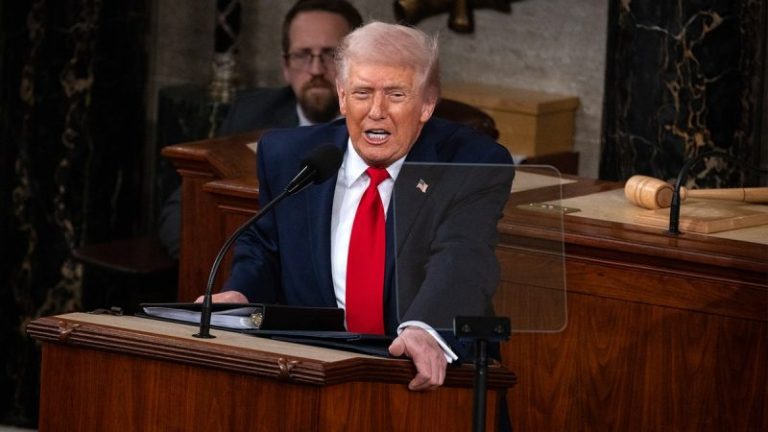
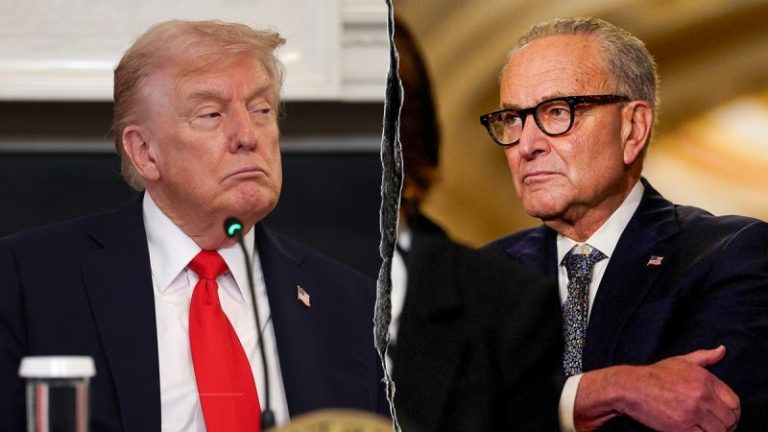
The move came after President Donald Trump intervened to strike a deal with Senate Minority Leader Chuck Schumer, D-N.Y., Thursday, which will strip out the controversial Department of Homeland Security funding bill and tee up a two-week funding extension to keep the agency afloat. 

Trump urged Senate Republicans to support the plan in a post on Truth Social, where he argued that the only thing ‘that can slow our Country down is another long and damaging Government Shutdown’

‘I am working hard with Congress to ensure that we are able to fully fund the Government, without delay,’ Trump said. ‘Republicans and Democrats in Congress have come together to get the vast majority of the Government funded until September, while at the same time providing an extension to the Department of Homeland Security (including the very important Coast Guard, which we are expanding and rebuilding like never before).

‘Hopefully, both Republicans and Democrats will give a very much-needed Bipartisan ‘YES’ Vote,’ he continued.

It’s a bitter pill for Senate Republicans, who pushed onward with the original six-bill funding package despite Senate Democrats making clear that they would not support it if the DHS bill was still attached. 

Still, the successful first step virtually guarantees that the new, skinnier five-bill bundle and two-week continuing resolution (CR) will advance out of the Senate.

But it won’t prevent a partial government shutdown. 

That’s because the modification to the package, coupled with the CR for DHS, will need to be agreed to by the House, which is not in session until next week, at the earliest. From there, it is unclear how long it will take lawmakers in the lower chamber to process the bill, and resistance is mounting among angry fiscal hawks.

But Democrats aren’t walking away with everything they want, either. Before rapidly unifying behind the plan to block the DHS bill, Democratic leadership argued that a CR of any kind would effectively allow Trump to have a ‘slush fund’ for immigration operations.

Renegotiating the Homeland Security funding bill could backfire, too, given that congressional Democrats originally agreed to the restrictions baked into the current legislation and Republicans aren’t thrilled to relitigate the bill.

This post appeared first on FOX NEWS

Senate Republicans and Democrats cut through partisan rancor and sent a retooled government spending package to the House Friday evening after President Donald Trump struck a deal to sate Democrats’ demands. 

Though lawmakers were able to advance the revamped five-bill package without the controversial Department of Homeland Security (DHS) funding bill and a two-week funding extension to keep the agency afloat, a partial government shutdown is all but guaranteed after the 71-29 vote.

That’s because modifications to the package and the inclusion of a short-term continuing resolution (CR) for DHS must be approved by the House. And lawmakers in the lower chamber aren’t scheduled to return to Washington, D.C., until early next week. 

Schumer and his caucus are determined to get a series of extra reforms attached and dropped three categories of restrictions on Immigration and Customs Enforcement (ICE) on Wednesday that many Republicans have balked at.

‘These are not radical demands,’ Schumer said on the Senate floor. ‘They’re basic standards the American people already expect from law enforcement. I hope we can get voting quickly here in the Senate today so we can move forward on the important work of reining in ICE. The clock is ticking.’

Democrats argued that the tweaks were common sense and geared toward reducing further incidents during immigration operations around the country after two fatal shootings by federal agents in Minneapolis this month. 

‘This is not like some wish list,’ Sen. Tina Smith, D-Minn., said. ‘This is, like, really practical, commonsense stuff that would actually go a long way towards minimizing the harm that we’re seeing in Minnesota.’

Among the most difficult requests is the requirement of judicial warrants, rather than administrative warrants, for ICE agents to make arrests. 

Sen. Eric Schmitt, R-Mo., argued that while Republicans didn’t want to have a government shutdown, they wouldn’t legislate ‘stupid s—‘ into the DHS bill. 

‘We’re not, like, telling [ICE] they need judicial warrants when they already have administrative warrants,’ Schmitt said. ‘We’re not doing that.’

Successfully moving the bill from one chamber to the other was not an easy lift for Republicans. A cohort of Senate Republicans pushed back against the underlying, original package because of the billions in earmarked funding it included. 

And Sen. Lindsey Graham, R-S.C., was enraged over the House’s decision to include a repeal of a provision that would allow senators, like himself, to sue for up to $500,000 if they had their phone records subpoenaed by former special counsel Jack Smith as part of his Arctic Frost probe. 

‘You jammed me, Speaker Johnson. I won’t forget this,’ Graham said. ‘I got a lot of good friends in the House. If you think I’m going to give up on this, you really don’t know me.’

He demanded votes on expanding the number of people and organizations who were affected by Smith’s Arctic Frost probe who can sue, along with a vote on his legislation that would criminalize the conduct of officials who operate sanctuary cities. 

But he didn’t tee them up for an amendment vote, instead contending he’d be OK with floor action after the two-week CR lapsed. 

Moving the package through the House could be a heavier lift than expected.

House Speaker Mike Johnson, R-La., expected the earliest he could move on the package was by Monday, three days into the partial shutdown, given that lawmakers are away from Washington, D.C., until next week. 

One House GOP source suggested to Fox News Digital that passing the legislation under suspension of the rules could be a pathway to success because it would fast-track the bills past a House-wide procedural hurdle called a ‘rule vote’ that normally falls along party lines.

But that would require raising the threshold for passage from a simple majority to two-thirds, meaning a significant number of Democrats would be needed for the bills to proceed.

That does not appear to be the route House leaders are taking, however, at least for now. Two other sources told Fox News Digital Friday morning that the House Rules Committee is expected to meet for a rare Sunday hearing to consider the bill. 

The House Rules Committee is the final gatekeeper before most legislation gets a chamber-wide vote, meaning its advancement of the package Sunday could set up further action as early as Monday.

House Republican resistance to the modified package, particularly the DHS CR, has already fomented among members of the House Freedom Caucus.

House Freedom Caucus Chair Andy Harris told Fox News Digital ‘the Democrats’ desire to keep millions of illegal aliens in the United States will not suddenly disappear in a week or a month with a continuing resolution.’

‘Delaying full year funding for the Department of Homeland Security any further is a bad idea,’ Harris said. 

This post appeared first on FOX NEWS

Speaker Mike Johnson, R-La., urged House Republicans on a lawmaker-only call to rally behind President Donald Trump after the commander in chief struck a deal with Senate Democrats to avert a prolonged government shutdown, Fox News Digital was told Friday evening.

The top House Republican admitted to being ‘frustrated’ by the result, sources told Fox News Digital, but he lauded Trump’s deal-making ability and called for lawmakers to back the president’s decision.

The Senate passed a revamped government funding deal Friday that will set the federal budget through the end of the fiscal year Sept. 30, save for the Department of Homeland Security (DHS).

It comes after Democrats walked away from a bipartisan plan to fully fund the federal government over demands for stricter guardrails on Immigrations and Customs Enforcement (ICE) than what the initial House-passed package included.

Johnson told House Republicans he went to the White House Wednesday to lay out his arguments for sticking to the initial plan and warned, ‘Opening the Pandora’s Box of amending this thing could be a dangerous prospect,’ sources said.

Trump nevertheless struck an agreement with Senate Democrats. 

Fox News Digital was told that Johnson conceded, ‘The president has made a play call, and we have to support him on it.’

The initial bipartisan DHS bill included guardrails for ICE, such as mandating body-worn cameras and training for public engagement and de-escalation. But Democrats are now demanding significantly more after a second deadly shooting of a U.S. citizen by federal law enforcement during demonstrations against Trump’s immigration crackdown in Minneapolis.

The new deal struck with Democrats would only extend current DHS funding levels for two weeks to keep other critical agencies under the department’s purview funded while new bipartisan negotiations on immigration enforcement play out.

Multiple Republican lawmakers have both publicly and privately expressed concern about the deal, arguing it could potentially give Democrats more ability to constrain the administration. 

One House Republican voiced such concerns on the lawmaker-only call on Friday, Fox News Digital was told. Johnson, according to sources, agreed he was ‘frustrated … but I’ve got to tip my hat to the president. He knows the art of the deal.’

Johnson told House Republicans that Trump now needed their support to ‘navigate the next two weeks’ of deal-making with Democrats.

Trump said on Truth Social of his deal with Democrats, ‘I am working hard with Congress to ensure that we are able to fully fund the Government, without delay. Republicans and Democrats in Congress have come together to get the vast majority of the Government funded until September, while at the same time providing an extension to the Department of Homeland Security (including the very important Coast Guard, which we are expanding and rebuilding like never before).’

Sources said the speaker did sound optimistic about Republicans still having leverage in the talks, however. Johnson noted that ICE had already been funded under Trump’s ‘big, beautiful bill’ and that it would be offices like the Transportation Security Administration (TSA) and Federal Emergency Management Agency (FEMA) that would run low on funds.

Sources said Johnson said of Democrats, ‘We can hang that on their necks.’

The House is expected to take up the legislation by Monday evening.

This post appeared first on FOX NEWS

A Panamanian court has voided a port contract held by a Hong Kong subsidiary, prompting assurances from President José Raúl Mulino that canal traffic will not be disrupted.

The court ruled Thursday that the port concession granted to Panama Ports Company — a subsidiary of Hong Kong’s CK Hutchison Holdings — was unconstitutional. 

The decision was welcomed by the U.S. and criticized by Beijing, according to The Associated Press.

‘Beijing plays rough. Trump plays rougher,’ China expert Gordon Chang told Fox News Digital in an email. ‘The American president just showed the Chinese who’s boss in the Western Hemisphere.

‘President Trump, by extracting Nicolás Maduro and his wife from Caracas, ended Chinese influence in Venezuela,’ Chang added. ‘With the termination of the Hutchison port concessions in Panama, countries are getting the message that Trump is determined to drive China out of the region and that they should get on board with the American president.’

Mulino said Friday that port operations at both ends of the canal will continue as the ruling is carried out, adding that Panama’s Maritime Authority will work with Panama Ports Company to keep the ports running, the AP reported.

Once the concession is formally terminated, Mulino said, a local subsidiary of Danish shipping giant A.P. Moller-Maersk will temporarily operate the ports while the government opens a new bidding process for a long-term concession.

The court decision followed an audit by Panama’s comptroller that identified irregularities in a 25-year extension of the concession granted in 2021, according to the AP.

The ruling aligns with long-standing U.S. concerns over China’s presence near the Panama Canal. 

Limiting Beijing’s influence in the region has been a priority of the Trump administration, and Panama was the first overseas stop this year for U.S. Secretary of State Marco Rubio, the AP reported.

‘The United States is encouraged by the recent Panamanian Supreme Court’s decision to rule port concessions to China unconstitutional,’ Rubio posted to X on Friday.

Panama Ports Company said it has not been formally notified of the ruling and argued it lacks legal basis, warning it could harm thousands of Panamanian families and undermine legal certainty. The Hong Kong government also rejected the ruling, according to the AP.

This post appeared first on FOX NEWS

As President Donald Trump weighs his options on a possible military strike on Iran, a senior Gulf official told Fox News Saudi Arabia will not allow the U.S. to use its airspace or bases for such an attack.

A high-ranking government figure from a Gulf Cooperation Council (GCC) state told Fox News that the ‘U.S. hasn’t shared objectives or plans’ regarding Iran with Gulf allies despite recent high-level Saudi meetings in Washington aimed at gaining clarity.

‘We said this as friends, [we] want to make sure they understand our position and our assessment in general. And we want to understand the U.S. assessment with as much clarity as possible,’ the senior official said. ‘I’d like to get full clarity, and we did not get there.’

Regarding U.S. military movements for a strike on Iran, the official said, ‘The plan is something other than using Saudi airspace.’

The official said the U.S. is welcome in Saudi Arabia, especially regarding Operation Inherent Resolve, the ongoing U.S.-led campaign against ISIS. Yet, the Saudi position now is ‘consistent’ with what it was during the 12-day conflict between Israel and Iran in April 2024, the official said.

‘Saudi Arabia wouldn’t allow airspace to be used to target Israel, Houthis, Iran. The position is the same now. Saudi Arabia wouldn’t allow airspace to be used in a war Saudi Arabia is not a part of,’ the official said.

Trump said Friday that the United States has directly communicated expectations to Iran as pressure mounts for Tehran to accept a nuclear deal, even as Iranian officials publicly signal interest in talks.

Asked whether Iran faces a deadline to make a deal, Trump suggested the timeline had been conveyed privately. 

‘Only they know for sure,’ he said when pressed that the message had been delivered directly to Iranian leaders.

Trump also tied the growing U.S. naval presence in the region explicitly to Iran, saying American warships ‘have to float someplace’ and ‘might as well float near Iran’ as Washington weighs its next steps.

Despite the president’s words that Iran wants to make a deal, the official cautioned that ‘Iran always wants to make a deal, but the question is what kind of deal? Is it acceptable to the U.S.?

‘We don’t see it coming together at this moment,’ the official said. ‘Everybody knows the U.S. is bringing capabilities to the region in general to deal not with whatever the plan is but whatever the ramification of the plan is.’

Regarding the success of future U.S. actions in Iran, the official said, ‘There is always a problem whether you make a decision or don’t. There’s a balance of … future in the Middle East. We advise the U.S. on a better outcome at the end, using all means, including diplomatic means, and advise Iranians too. … We understand that we’re all in this — the U.S., Iran and others — and we hope for better results.’

The official said that, in the Gulf allies’ assessment, the Trump administration’s strikes on Iran’s nuclear assets heavily degraded their capabilities so that they are ‘not in the same situation as before.’

That being said, they believe an ‘off ramp could be reached by Iranians doing the right thing.’

‘We want a prosperous country that supports their people. That’s what we think we should all be doing. Iran has real economic potential, energy. A lot of talent in Iran and especially abroad who live in other countries. … There’s a way to get out of it, and Iran could be a very constructive actor in the region and important actor in the region. I hope that they get there because the Iranian people deserve a lot.’ 

Though the U.S. has not shared its objectives or plans, the source said, ‘I hope that outcome is for a more stable Middle East, more prosperous.’

This post appeared first on FOX NEWS

The U.S. State Department late Friday announced it had approved two arms sales to Israel and Saudi Arabia worth $6.67 billion and $9 billion.

The sales come as the Trump administration moves forward with its peacekeeping plan in Gaza and amid the threat of U.S. military strikes in Iran.

Thirty Apache helicopters with rocket launchers make up the largest part of the sale to Israel, along with 3,250 light tactical vehicles, power packs for armored personnel carriers and a number of light utility helicopters.

The State Department said the sale would ‘enhance Israel’s capability to meet current and future threats by improving its ability to defend Israel’s borders, vital infrastructure and population centers.’

‘The United States is committed to the security of Israel, and it is vital to U.S. national interests to assist Israel to develop and maintain a strong and ready self-defense capability,’ it said.

Saudi Arabia will receive 730 Patriot missiles and related equipment that ‘will support the foreign policy and national security objectives of the United States by improving the security of a major non-NATO ally that is a force for political stability and economic progress in the Gulf Region,’ the department said.

‘This enhanced capability will protect land forces of Saudi Arabia, the United States and local allies and will significantly improve Saudi Arabia’s contribution’ to the integrated air and missile defense system in the region.

On Thursday during a Cabinet meeting, President Donald Trump and his Middle East envoy, Steve Witkoff, said they believe Hamas will disarm under a U.S.-backed Gaza ceasefire plan as it enters its second phase.

But regional analysts have warned the terror group has no intention of disarming and could even block Trump’s Gaza plan altogether.

‘Hamas will do all the possible and creative maneuvers and manipulations in order to keep its power and influence in the Gaza Strip,’ professor Kobi Michael, a senior researcher at the Institute for National Security Studies and the Misgav Institute, told Fox News Digital.

‘The Israel Defense Forces are the only entity that can disarm Hamas.’

Fox News’ Emma Bussey and the Associated Press contributed to this report. 

This post appeared first on FOX NEWS

With the future of Congress and President Donald Trump’s legislative agenda on the line in this midterm election, the Honest Elections Project is warning of critical loopholes in the voting system, including the expansion of noncitizen voting and foreign influence.

With many state legislatures convening their final sessions before the 2026 midterms, HEP believes they have ‘one last opportunity’ to pass the ‘critical reforms’ needed to close loopholes breaking down legitimacy and trust in the electoral process.

In a report shared first with Fox News Digital, HEP identified 14 key electoral integrity vulnerabilities it says must be remedied ahead of the midterms.

Among these vulnerabilities is hundreds of millions in foreign-linked money that have helped shape ballot measures in 26 states, according to HEP.

The report says that while foreign individuals are banned from donating to political candidates, bad actors have found a legal loophole by contributing both directly and indirectly to ballot measure campaigns that can include initiatives changing constitutions and election laws. The report refers to these campaigns as a ‘Trojan Horse for foreign influence,’ including from ‘hostile foreign powers like China and Russia.’

To combat this, HEP laid out model legislation called the Prohibiting Foreign Funding from Ballot Measures Act to bar direct and indirect foreign funding, including through intermediary nonprofits, of ballot initiatives. In addition to this, the legislation requires that donors and ballot committees affirm they are free of foreign money to qualify and imposes strict penalties for violations.

The report also warns of a ‘growing number’ of blue cities, including Washington, D.C., and New York that it says have been working to enfranchise noncitizens and illegal aliens. HEP said that most state constitutions grant voting rights to ‘any’ or ‘every’ citizen, open-ended language that it says allows ‘liberal activists [to] argue permits localities to authorize noncitizen and even illegal alien voting.’

According to HEP, this problem is further compounded by current federal law that allows dishonest individuals to simply check a box to claim they are citizens on the National Mail Voter Registration Form.

To push back on this, HEP urges states to amend their constitutions to explicitly permit only citizens to vote. The group said that such language was passed by wide margins in 15 states: Alabama, Arizona, Colorado, Florida, Louisiana, North Dakota, Ohio, Iowa, Idaho, Kentucky, Missouri, North Carolina, Oklahoma, South Carolina and Wisconsin.

Additionally, HEP is urging states to pass the Documentary Proof of Citizenship Act, requiring voters to provide proof of citizenship to participate in state and local elections. The bill also makes it a criminal offense for noncitizens to apply to register to vote or for election officials to register a voter without proof of citizenship or to count illegal votes. This is an approach HEP believes is ‘consistent with Federal law and serves to protect the integrity of state-level voting processes.’

HEP lays out another five pieces of model legislation: The Interstate Voter Assistance Act, the Never Resided Act, the Procedural Election Audits Act, the Uniform Election Dates Act and a bill to prohibit government entities from using donations or in-kind goods or services from a private or non-governmental entity for election administration.

Addressing the issues, HEP Executive Director Jason Snead said, ‘Many states have made tremendous strides in making it easy to vote and hard to cheat in recent years, but there is still more work to be done.

‘State lawmakers have one last opportunity to shore up their election laws ahead of the extremely important 2026 midterms,’ Snead added. ‘Honest Elections Project is proud to provide a roadmap for lawmakers to continue promoting election integrity across the country.’

This post appeared first on FOX NEWS

Senate Democrats and the White House reached a deal to fund the government, but lawmakers aren’t out of the woods yet in averting a partial shutdown. 

Senate Minority Leader Chuck Schumer, D-N.Y., and President Donald Trump labored over a deal from late night Wednesday until Thursday evening after the top Senate Democrat unleashed several funding demands and the White House accused Schumer of blocking a meeting with rank-and-file Democrats. 

‘The separation of the five bipartisan bills the Democrats asked for + the two-week DHS [continuing resolution] has been agreed to,’ Schumer said in a statement. 

Trump, in a post on Truth Social, said that the ‘only thing that can slow our Country down is another long and damaging Government Shutdown.’ 

‘I am working hard with Congress to ensure that we are able to fully fund the Government, without delay,’ Trump said. ‘Republicans and Democrats in Congress have come together to get the vast majority of the Government funded until September, while at the same time providing an extension to the Department of Homeland Security (including the very important Coast Guard, which we are expanding and rebuilding like never before).’ 

‘Hopefully, both Republicans and Democrats will give a very much-needed Bipartisan ‘YES’ Vote,’ he continued. 

The deal brokered between the two would see the Department of Homeland Security (DHS) funding bill stripped from the broader six-bill package. Schumer and Democrats have been adamant that if the bill were sidelined, they’d vote for the remaining five, which includes funding for the Pentagon. 

Their agreement also tees up a short-term funding extension, known as a continuing resolution (CR), for two weeks to keep the agency funded while lawmakers negotiate restrictions on Immigration and Customs Enforcement (ICE). 

Trump and Schumer’s bipartisan truce comes after Senate Majority Leader John Thune, R-S.D., and Senate Republicans barreled ahead with a test vote on the funding package that was ultimately torpedoed by Senate Democrats and a cohort of seven Republicans earlier in the day. 

Republicans again have the opportunity to bring the package back to the floor, but to speed up the process, they would need consent from lawmakers on both sides of the aisle.

And they are still working out the kinks on their own end through the hotline process, where the package is scrutinized by every Senate Republican before being given the go-ahead for a floor vote. 

Speedig up the process may prove tricky, given that several of the Republican defectors, including Sens. Ron Johnson, R-Wis., Rick Scott, R-Fla., and Ted Budd, R-N.C., were upset with earmarks baked into the bill. 

And Sen. Rand Paul, R-Ky., wants an amendment vote on his provision to strip the bill of millions in ‘refugee welfare money‘ and signaled that he may slow the process down if he doesn’t. 

Many Senate Republicans recognize that stripping the DHS bill is not the best outcome but contended that it was better than not funding the government and entering into yet another shutdown.

‘That’s the only way we’re going to get through this without a long government shutdown,’ Sen. Steve Daines, R-Mont., said. 

To his point, despite lawmakers reaching an agreement that will likely see the remaining bills passed and keep DHS funded for a month, the House will have to agree. They don’t return until next week, and fiscal hawks are already publicly panning the plan.

This post appeared first on FOX NEWS

Secretary of State Marco Rubio recently revoked Iranian senior officials and their family members’ privilege to travel to the U.S., citing ongoing oppression by the regime.

Iranian Supreme Leader Ayatollah Ali Khamenei’s regime is accused of killing more than 6,200 protesters since Dec. 28, with nearly 17,100 additional arrests as internet communications remain halted, according to the Human Rights Activists News Agency (HRANA).

‘As the people of Iran continue to fight for their basic rights, [Rubio] took action this week to revoke the privilege of Iranian senior officials and their family members to be in the United States,’ the State Department wrote in an X post. ‘Those who profit from the Iranian regime’s brutal oppression are not welcome to benefit from our immigration system.’

In addition to the potential civil rights violations in Iran, tensions have flared between Khamenei and President Donald Trump, as the U.S. attempts to strike a nuclear deal.

Iranian Foreign Minister Seyed Abbas Araghchi warned on Wednesday the nation’s military is ‘prepared—with their fingers on the trigger—to immediately and powerfully respond to ANY aggression against our beloved land, air, and sea.’

Araghchi claimed that Iran has ‘always welcomed’ a mutually beneficial, fair and equitable nuclear deal that would ensure Iran’s rights to peaceful nuclear technology, and guarantee no nuclear weapons.

Trump fired back on Truth Social, warning a ‘massive’ armada was heading to Iran ‘with speed and violence, if necessary.’

‘Time is running out, it is truly of the essence!’ Trump wrote in a post. ‘As I told Iran once before, MAKE A DEAL! They didn’t, and there was ‘Operation Midnight Hammer,’ a major destruction of Iran. The next attack will be far worse! Don’t make that happen again.’

The president said Thursday night it would be ‘great’ if the U.S. did not have to use the military fleet.

The State Department on Wednesday also demanded Tehran overturn the death penalty for 19-year-old Saleh Mohammadi, a decorated Iranian wrestler who was arrested while peacefully protesting against the regime earlier this month.

Fox News Digital’s Alex Nitzberg contributed to this report.

This post appeared first on FOX NEWS

U.S. appeals courts have overturned or stayed lower court rulings blocking President Donald Trump’s policy priorities at a rate far higher than during the Biden administration, a disparity Trump allies point to as evidence of the president’s strong track record in higher courts.

The contrast was highlighted by Chad Mizelle, a former senior Justice Department official, who noted that district court rulings against the Trump administration are being reversed or paused on appeal far more frequently than similar rulings issued during President Joe Biden’s time in office — even when the relief is temporary.

‘Over 4 years of the Biden administration, 9 district court rulings against the administration were later overturned on appeal,’ Mizelle said in a post on X. ‘About 2.25 per year.’

Mizelle compared that average to Trump’s first year back in office in 2025, when he said that ’32 district judges issued 133 rulings against the Trump administration that were stayed or overturned on appeal,’ adding: ‘Simplified, district judges are now issuing rulings that ultimately fail on appeal at more than 50x the rate compared to the previous presidency.’

His post comes as senior Trump officials have blasted district court judges who have blocked or paused the president’s most sweeping policy initiatives in his first year back in office, arguing that what they call ‘activist judges’ have overstepped their bounds and are intruding on the president’s executive authority.

As court watchers have previously pointed out to Fox News Digital and other outlets, the post presents a somewhat incomplete picture of the legal landscape during Trump’s second term. While Trump’s appeals court wins indeed far outpace those of his predecessors, they were also issued in response to an unprecedented surge of executive orders and actions.

Trump spent much of his first year in office signing hundreds of executive orders aimed at enacting his biggest policy priorities, including slashing government spending, cracking down on illegal immigration and eliminating many diversity and equity initiatives enacted under the Biden administration. Those actions also triggered a torrent of lawsuits seeking to block or pause his policies from taking effect, teeing up a high-stakes showdown over how far Trump can push his Article II powers before the courts can or should intervene.

Many of the early lawsuits filed sought relief by way of temporary restraining orders and universal injunctions, which paused or blocked executive action temporarily to give the court time to hear the case on its merits.

Other lawsuits sought a longer-lasting form of relief via preliminary injunctions, which require plaintiffs to satisfy a higher legal burden in court.

The Supreme Court in June narrowed the ability of district court judges to issue so-called ‘universal injunctions’ blocking a president’s policy from taking effect nationwide. The high court’s 6-3 ruling allowed district courts to issue injunctions only in limited instances.

As of this writing, 597 lawsuits have been filed against the Trump administration’s actions, according to Just Security’s litigation tracker.

Few cases have been fully adjudicated by the lower courts. Rather, the temporary rulings are almost always appealed by the Trump administration to a higher appeals court for relief — often in the form of an emergency or temporary stay.

As Fox News Digital previously reported, the Trump administration has indeed seen a record number of Supreme Court victories in the last 12 months. 

That trend is overwhelmingly due to the so-called emergency or ‘shadow docket’ challenges, which allowed the administration to appeal cases to the court’s 6-3 conservative supermajority for immediate intervention.

Mizelle concluded the post by touting Trump’s Supreme Court ‘win rate,’ which he said ‘is roughly 90%,’ though he appeared to be referring to the same practice. 

Though they are not intended to be permanent, the Supreme Court ‘shadow docket’ rulings have allowed the Trump administration to proceed with a wide range of its policies, including its ban on transgender service members in the military, its termination of millions of dollars in Education Department grants and DEI funding, among many other things.

Attorney General Pam Bondi touted similar numbers during a Cabinet meeting last month. ‘We have been sued 575 times,’ she said then. ‘More than every administration going back to Reagan combined.’ 

She also echoed similar numbers shared by Mizelle. ‘Twenty-four Supreme Court wins, President Trump,’ Bondi told the president in December. ‘A 92% success rate.’ 

This post appeared first on FOX NEWS