Wedbush Securities’ senior analyst, Dan Ives, has names top five tech stocks to own into 2026.
Notably, Nvidia – the chipmaker that has become synonymous with the artificial intelligence (AI) boom – did not find a spot on his list.
And yet, Palantir – an AI-enabled data analytics firm that’s currently infinitely more expensive to own than NVDA – somehow did.
Note that Nvidia shares are on track to finish 2025 with an exciting 100% gain versus its April low, while Palantir stock is currently up a whopping 180% versus its year-to-date low.
Why Nvidia stock isn’t in Ives’ top tech names list
Speaking with CNBC, Dan Ives argued that the next stage of the AI revolution will be defined less by the “godfather of AI” and more by firms building applications and platforms on top of them.
The Wedbush analyst confirmed that NVDA remains a “top pick”, but said the “derivatives – the second, third, fourth – are just starting, which is why we’re so bullish in tech.”
Simply put, while Nvidia remains central to AI infrastructure, Ives believes the bigger investment opportunities lie in hyperscalers, consumer-facing platforms, and enterprise software names that’ll leverage its tech.
NVIDIA’s absence from the top five reflects a strategic pivot toward diversification across AI beneficiaries, rather than concentrating in one dominant player.
Why Palantir stock still made the cut
Palantir stock – often criticized for being egregiously overvalued – still made it to Ives’ list mostly because of the firm’s expanding commercial business and potential to scale revenues significantly.
“It’s the commercial business that I believe could ultimately be two, three billion,” Ives noted – projecting that PLTR’s revenues could double over the next three to four years.
At nearly 400x forward earnings, the Wedbush analyst conceded that Palantir is a “super expensive stock today”, but said its trajectory positions it for a trillion-dollar valuation as the AI revolution accelerates.
For Ives, Palantir represents a pure-play enterprise AI story, with its software increasingly adopted across industries. That growth potential makes it a “cornerstone” of his bullish thesis heading into 2026.
What else does he recommend owning?
Alongside Palantir, Ives highlighted Microsoft, Apple, Tesla, and CrowdStrike as key holdings for 2026.
Each represents a different angle of the AI revolution: Microsoft through hyperscaler cloud dominance, Apple via consumer hardware and ecosystem integration, Tesla through autonomous driving and energy innovation, and CrowdStrike in cybersecurity.
Yet, Ives admitted that these stocks aren’t cheap, echoing his earlier remark about Palantir.
His recommendations suggest a willingness to back richly valued companies on the belief that their growth trajectories justify the premiums.
In essence, Ives is advising investors to embrace overvalued tech stocks, betting on their leadership in AI and digital transformation to deliver outsized returns in 2026 despite stretched valuations.
The post Nvidia isn’t on Dan Ives’ top tech names list for 2026 but Palantir is appeared first on Invezz
Meta Platforms has agreed to acquire Manus, a Singapore-based developer of general-purpose artificial intelligence agents, marking another major step in the social media company’s aggressive push to build a large-scale AI business.
The financial terms of the deal were not disclosed.
Manus, which launched its first AI agent earlier this year, sells subscription-based tools that can autonomously perform tasks such as market research, coding, data analysis, resume screening, and website creation.
Meta said the acquisition will help accelerate AI innovation for businesses and integrate advanced automation into its consumer and enterprise products, including its Meta AI assistant.
The companies said Manus will continue to operate its existing subscription service without disruption, while its employees will join Meta’s AI teams.
Rapid growth and global repositioning
Founded in China as part of the startup Butterfly Effect, also known as Monica.Im, Manus later spun out into a separate entity and relocated its headquarters to Singapore as it pursued global expansion.
The company reportedly laid off most of its Beijing-based staff earlier this year before shifting to Singapore.
Manus has drawn attention in the AI industry for the speed of its commercial growth.
The startup said it achieved more than $100 million in annualized average revenue just eight months after launch, with a revenue run rate exceeding $125 million earlier this year.
The firm has raised significant venture capital backing.
In April, it secured $75 million in a Series B funding round led by US venture capital firm Benchmark, at a valuation reportedly close to $500 million.
Manus is also backed by Tencent and HongShan Capital Group, formerly known as Sequoia China.
Earlier this year, Manus gained visibility after claiming its chatbot outperformed OpenAI’s DeepResearch on certain benchmarks.
The company also announced a strategic partnership with Alibaba’s Qwen AI team in March, underscoring its ongoing ties to Chinese technology firms.
Strategic fit within Meta’s AI push
Meta said the acquisition aligns with its strategy of acquiring specialized AI startups to gain talent and products that can be scaled across its ecosystem.
Chief Executive Officer Mark Zuckerberg has made AI the company’s top priority, committing tens of billions of dollars toward hiring researchers, building data centers, and developing new models, including its open-source Llama large language models.
In recent months, Meta has made several high-profile AI moves.
In June, it invested $14.3 billion in Scale AI, a deal that brought Scale founder Alexandr Wang onto Meta’s leadership team as chief AI officer.
Meta also acquired AI wearables startup Limitless as it expands into AI-enabled devices.
Manus’s technology had attracted interest from major technology companies.
Microsoft began testing Manus on Windows 11 PCs in October, allowing users to create websites from local files.
Manus claims to have processed more than 147 trillion tokens of text and data and supported over 80 million virtual computers.
Market implications and investor scrutiny
The acquisition comes as Meta faces investor scrutiny over whether its heavy AI spending will generate meaningful near-term returns.
Unlike many consumer-focused AI tools offered for free, Manus sells enterprise subscriptions, potentially providing Meta with a more immediate revenue stream.
AI agents have become a focal point for enterprise software companies, including Salesforce and ServiceNow, which are promoting autonomous agents as a more practical business application of AI than traditional chatbots.
The deal has also revived debate around US investment in AI startups with Chinese roots.
Earlier this year, Benchmark faced criticism from US lawmakers over its backing of Manus.
For Manus, the acquisition offers scale. “Joining Meta allows us to build on a stronger, more sustainable foundation without changing how Manus works or how decisions are made,” said co-founder and CEO Xiao Hong.
The post Meta acquires AI startup Manus to accelerate agent-based automation strategy appeared first on Invezz
Global markets opened Tuesday digesting a mix of defense contracts, economic data from South Korea, volatile commodity moves, and continued consolidation in the artificial intelligence sector.
From Boeing’s major fighter jet order for Israel to Meta Platforms’ acquisition of fast-growing AI startup Manus, investors are weighing geopolitical risks alongside shifting growth signals in Asia and the US.
Boeing wins major US Air Force contract for Israel
Boeing has been awarded a contract worth up to $8.58 billion from the US Air Force to build fighter jets for the Israeli Air Force, the Pentagon said on Monday.
The agreement covers the design, integration, testing, production, and delivery of 25 new F-15IA aircraft, with an option for Israel to purchase an additional 25 jets.
Work on the contract will be carried out in St. Louis, Missouri, and is expected to run through Dec. 31, 2035.
The deal includes $840 million in foreign military sales to Israel, which will be obligated at the time of the award.
Separately, Boeing also received a modification to a prior Air Force contract for depot maintenance services and supply management in Oklahoma City.
That adjustment increases the total value of the award to $4.2 billion, up from $1.5 billion previously.
South Korea data signals uneven economic momentum
Fresh data from Statistics Korea showed mixed signals from Asia’s fourth-largest economy.
Retail trade in South Korea fell 3.3% in November from the previous month, although it rose 0.8% on a year-on-year basis.
Industrial output declined 1.4% compared with November last year, reflecting weakness in manufacturing activity.
On a monthly basis, however, overall production increased 0.6% from October.
Construction activity remained subdued, falling 17.0% year-on-year, despite a 6.6% rise from the prior month.
Services provided some support, with output rising 0.7% month-on-month and 3.0% compared with a year earlier.
Asian markets slip as metals cool and tensions rise
Asian equities edged lower on Tuesday, tracking a pullback in US technology stocks and heightened geopolitical tensions.
MSCI’s broadest index of Asia-Pacific shares outside Japan gained 0.12%, remaining on track for an annual gain of 26.7%, its best performance since 2017.
Japan’s Nikkei fell 0.13% but was still up around 28% for the year, while Taiwanese shares dropped 0.36% and China’s blue-chip index gained 0.27%.
Commodity markets were volatile. Silver plunged 8.7% on Monday, its biggest one-day fall since August 2020, before rebounding 4.1% to $75 an ounce.
Gold also pulled back sharply before stabilizing. Oil prices eased after strong overnight gains, with Brent crude almost unchanged by 0.03% gain to $61.52 a barrel.
Meta acquires AI startup Manus in expansion push
Meta Platforms has agreed to acquire Manus, a Singapore-based developer of general-purpose AI agents, as it continues to ramp up investment in artificial intelligence. Financial terms of the deal were not disclosed.
Manus offers subscription-based AI tools capable of tasks such as market research, coding, data analysis, and website creation.
Founded in China as part of the startup Butterfly Effect, the company later relocated its headquarters to Singapore and reported annualized revenue exceeding $100 million within eight months of launch.
Meta said Manus will continue operating its service while its employees join Meta’s AI teams, reinforcing Chief Executive Mark Zuckerberg’s strategy to scale AI across consumer and enterprise products.
The post Morning brief: Boeing secures $8.6B fighter jet deal, Meta buys startup Manus appeared first on Invezz
The Next share price had a great performance in 2025 as its growth trajectory continued. NXT rose by 44% this year, beating the FTSE 100 Index, which jumped by ~20%. This article explains why the retailer soared and what to expect in the coming year.
Next share price jumped as growth accelerated
Next PLC is a top British company offering fashion and home items through its retail stores and e-commerce platforms. Its business has accelerated even as other companies like Asos and Boohoo have struggled in the past few years.
The stock jumped after the company released its half-year results and its trade statement recently. Next’s sales rose by 10.3% in the first half of the year to over £3.24 billion.
Most importantly, its cost discipline helped its profits to grow faster than its revenues. Its profit before taxes rose by 13.8% to £515 million, while its profit after tax jumped by 13.4% to £387 million.
The company’s growth trajectory was driven by its international business, which continued beating the domestic segment. Its international revenue rose by 28% in the year’s first half, much higher than the UK’s 8%.
The picture was much better in the third quarter as UK sales rose by 5.4%, while overseas sales rose by 38%.
The management has continued to invest its marketing budget to capture more clients from overseas. These investments are paying off as the sales trajectory has accelerated. Also, the international business is closing the gap with its British segment.
Next PLC share price jumped as the company boosted its forward guidance. It now expects that its fourth-quarter revenue growth will be between 4.5% to 7%, with its full-year profit guidance being £1.13 billion, up by £30 million from the previous estimate.
Next’s stock also jumped as the company continued rewarding its shareholders. It is doing that by repurchasing its stock. It bought shares worth over £131 million this year and has over £500 million available to distribute.
However, the company has paused its share repurchases because the stock has moved much higher than the buying limit of £121. Next’s repurchases have helped to reduce its common outstanding shares to 116.6 million from the 2021 high of 127 million.
Still, a key issue with Next is that it has become relatively overvalued, with its forward P/E ratio of 18 being higher than its historical average.
Next PLC stock price technical analysis
NXT stock chart | Source: TradingView
The daily chart shows that the Next stock price jumped from a low of 8,848p in January this year to a high of 14,550p in November. It formed an up-gap on October 28, which it has now filled.
The stock has formed a bullish flag pattern, one of the most common continuation signs in technical analysis. This pattern is made up of a vertical line and a descending channel.
Therefore, there is a likelihood that the Next share price will have a bullish breakout, potentially to the year-to-date high of 14,550p. A move above that level will point to more gains, potentially to 15,000p in 2026.
READ MORE: Next PLC share price sits at its all-time high: it’s still a bargain
The post Here’s why the Next share price jumped and beat the FTSE 100 Index in 2025 appeared first on Invezz
India’s intake of Russian crude is set to mark its weakest month in three years, reflecting how tighter US sanctions are affecting India and Russia’s oil trade.
December volumes are tracking lower despite some refiners returning to discounted barrels and expectations that purchases could rise again early next year, as per a Bloomberg report.
Data from shipping trackers and signals from refiners suggest the slowdown is concentrated around changes in procurement rather than a collapse in demand, with private and state processors responding differently to regulatory pressure and supplier availability.
Sanctions tighten supply routes
Russian crude deliveries to India are expected to average about 1.1 million barrels a day in December, according to shipping data from Kpler.
That would be the lowest level since November 2022, although still above an earlier estimate by Indian officials following the latest US clampdown on Russian energy trade.
Demand softened in recent months as buyers navigated heightened scrutiny from Washington.
Shipments fell in July, before edging higher as some refiners moved back to cheaper Russian barrels.
State-owned processors such as Indian Oil Corp. and Bharat Petroleum Corp. were among those that resumed purchases after the mid-year dip.
Refiners adjust sourcing
The biggest near-term drag came from Reliance Industries Ltd., India’s largest private refiner.
The company paused buying Russian crude after the US sanctioned Rosneft PJSC and Lukoil PJSC in late October, allowing importers a month to wind down transactions with the two suppliers.
Reliance has since restarted sourcing from non-blacklisted producers.
The crude is being processed at its Jamnagar refinery in Gujarat, supplying fuels primarily for the domestic market rather than exports.
December flows dip
At their weakest point, Russian deliveries to India fell to as little as 712,000 barrels a day in the second week of December, before recovering later in the month, according to Kpler.
According to Bloomberg, the firm estimates imports reached about 1.8 million barrels a day in November.
Indian officials had predicted daily flows of around 800,000 barrels for December.
The slowdown also reflects reduced intake at several facilities. Kpler data show lower volumes to the HPCL-Mittal Energy Ltd.
Mundra terminal and Mangalore Refinery and Petrochemicals Ltd. took no Russian barrels this month for the first time since September 2022.
Early 2026 recovery signs
Looking ahead, flows could find support from Nayara Energy Ltd., which is backed by Rosneft and sanctioned by Europe.
The company plans to postpone scheduled maintenance at its Vadinar refinery, originally slated for early next year.
That decision could allow higher processing runs and support additional Russian crude purchases once December’s disruption passes.
Together, these shifts point to a market recalibrating under sanctions rather than abandoning Russian supply altogether, with volumes likely to remain sensitive to policy moves and refinery operations.
The post Russian crude shipments to India slide to three-year low in December appeared first on Invezz
As the sun sets on 2025, the oil market is headed for its steepest annual decline since 2020, when COVID-19 had decimated demand.
Often known as the “black gold”, oil has had a difficult year among the commodity complex due to concerns about a serious glut in the coming months.
Against such a backdrop, all eyes will be on the Organization of the Petroleum Exporting Countries and allies in 2026, and the way the cartel navigates its decision-making process to balance a volatile market.
Most experts believe that OPEC+ is likely to keep oil production unchanged deep into 2026.
“OPEC would likely keep oil production levels frozen well into 2026,” Mark Temnycky, a nonresident fellow at the Atlantic Council’s Eurasia Center, told Invezz.
This strategy aims to prevent prices from falling too low by balancing supply against growing global demand.
Source: Commerzbank Research
Why supply is set to overwhelm demand?
The oil market is also facing a considerable oversupply in the coming year, which is why prices are likely to remain under pressure
OPEC+’s primary reason for significantly increasing its oil production—by 2 million barrels per day since April—was to reclaim lost market share, and this expansion of supply is the main factor contributing to the current oversupply.
Despite the recent announcement of a pause in production increases for the first quarter of 2026, OPEC+ is still expected to pursue the reversal of the remaining voluntary production cuts thereafter.
“This could bring an additional 1 million barrels per day to the market in the coming year,” Carsten Fritsch, commodity analyst at Commerzbank AG, said in a report.
Oil supply is projected to significantly outpace oil demand next year, leading to a substantial surplus.
The International Energy Agency (IEA) forecasts that demand will increase by approximately 700,000 barrels per day, a growth rate consistent with the current year.
Slower growth in China’s oil demand has significantly slowed overall demand growth in recent years. This oversupply is expected to result in rising inventories.
“The fact that commercial oil stocks in OECD countries have risen only slightly so far and remain below the five-year average is mainly due to China’s stockpiling,” Fritsch said.
OPEC+ increases output — and deepens the glut
OPEC’s strategy going into next year would depend on several factors, including the cohesion among its members.
“In 2026, OPEC will be concerned about maintaining a sense of unity among its members, since maintaining the cohesion of OPEC is more important than attempting to drive up prices quickly,” Ethan Heine, president and chief executive officer at Suntrek Solar, told Invezz.
Even if a peace agreement between Russia and Ukraine comes into effect, the group will still be cautious in their approach to the market because it is becoming increasingly difficult to predict when supply shocks may occur and there are many mixed signals coming from various parts of the world regarding demand for oil.
The most direct way to ensure the alignment of member states remains through restricting their oil production, according to Heine.
This strategy is especially critical given that global inventory levels are still vulnerable to geopolitical events and the inherent risks in oil shipping.
According to Temnycky, the cartel is likely to pause production increases beyond the first quarter of 2026.
The group is anticipating an oversupply exceeding one million barrels daily.
This surplus is mainly driven by production growth outside of OPEC, particularly from US shale oil and Guyana.
Temnycky said:
Saudi Arabia and allies hold the real leverage through voluntary cuts totaling 3.24 million barrels per day.
They will extend restraint to defend Brent above $70 unless demand surges unexpectedly.
Russia-Ukraine peace deal talks add to uncertainty
Even with increasing talks about a possible peace deal between Russia and Ukraine, the market still awaits an official confirmation.
‘My own view is that no matter how hard the Trump administration presses, (Russian President Vladimir) Putin will refuse to agree to peace,” David Morrison, senior market analyst at Trade Nation, told Invezz.
According to Morrison, if Putin resists, US President Donald Trump’s patience will run out, and the only effective strategy to counteract Moscow is to cripple the Russian economy.
You don’t do that with sanctions. You do that by driving down the oil price to $20 per barrel and keeping it there. So, that’s what I expect Trump to do, with plenty of help from OPEC, should Russia not agree to a peace deal.
The enforcement of quota discipline among OPEC member countries has both political and economic dimensions, particularly if sanctions against Russia are removed, according to Suntrek Solar’s Heine.
Russia benefits from continued OPEC participation, as it offers market credibility and pricing power. However, there is a constant risk that Russia might engage in “quiet” overproduction if the government perceives a threat to its export revenues, Heine added.
Meanwhile, the market will have to look out if a peace deal happens, and if Russia is allowed to expand oil production.
“I imagine Russia will push for production cuts from everyone else, to push up the oil price, while pleading for an exemption which they will justify as they need to rebuild their economy, and turn it away from a war footing,” Morrison said.
If OPEC falls for that then we’re heading for even more problems over the next decade.
Where could oil prices settle in 2026?
Ultimately, numerous factors are involved, but Trump’s objective is to lower oil prices.
Should Putin persist with the war in Ukraine, oil prices are likely to reach a level—around $50 per barrel—at which most major US producers can still operate profitably, Morrison noted.
Most experts believe that oil prices are expected to face downward pressure in 2026, with concerns about a serious glut.
“A Russia-Ukraine peace deal could push prices toward $60 by easing sanctions and boosting Russian exports, though Ukraine’s refinery strikes sustain some tightness if talks stall,” Temnycky said.
It is also unlikely that a deal between Russia and Ukraine will be reached anytime soon. Investors should favor diversified energy plays, such as LNG exporters, over pure upstream bets, while watching OPEC’s January decisions for volatility cues.
Meanwhile, Heine believes that Brent oil prices are likely to trade around $60 per barrel, with West Texas Intermediate slightly below.
It is anticipated that this pricing range will generate adequate revenue for national budgets while simultaneously discouraging non-OPEC producers from significantly boosting their oil production, Heine added.
Many of OPEC’s member countries are willing to accept Brent crude prices in excess of $60 for a longer period of time than would have been anticipated earlier in the year, since they place a greater emphasis on predictable revenue from oil exports than they do on potentially higher but less stable prices for oil.
Meanwhile, Morrison said that oil prices could rise to $70 per barrel and then flatten out if a peace deal is reached. However, declining demand from China would keep a lid on prices.
This should keep a cap on prices. Having said all that, and knowing my trading record, it will probably be $200 by June.
The post Oil prices in 2026: Oversupply looms as OPEC+ struggles to defend prices appeared first on Invezz
The CAC 40 Index rose by ~12% this year and by nearly 20% from its lowest level in April when Donald Trump unveiled his reciprocal tariffs. This rebound coincided with that of other global indices, which are ending the year in the green. This article explores some of the top gainers and laggards in the CAC Index.
CAC 40 Index chart | Source: TradingView
Société Générale was the top CAC 40 Index
Société Générale, a top French bank, was the best-performing company in the CAC 40 Index this year as it jumped by 152%, bringing its market capitalization to nearly $50 billion.
The surge coincided with the strong performance of the European banking industry. In France alone, banks like BNP Paribas and Credit Agricole jumped by double digits this year.
The most recent results showed that Societe Generale’s business did well this year, helped by its revenue growth and cost cuts. Its nine-month revenue rose to €20.5 billion, with its third-quarter figure coming in at €6.7 billion.
The company’s costs declined by 1.1% in the third quarter, as disposals made it more profitable. Indeed, the Return on Tangible Equity (ROTE) rose to 10.7%, higher than the previous guidance of 9%.
Still, the challenge is whether the company’s business will continue doing well now that interest rates are coming down.
ArcelorMittal stock soared despite challenges
ArcelorMittal, one of the biggest companies in the steel industry, was the second-best performer in the CAC 40 Index. It jumped by 75% this year, pushing its market cap to over $32 billion.
The rally was mostly because of the rising demand for steel, which was offset by the elevated costs. The most recent results showed that its revenue was $15.65 billion in the third quarter, up from the $15.19 billion it made last year.
However, its EBITDA dropped to $1.50 billion from the $1.58 billion it made in Q3’25. The stock also did well as the number of outstanding shares dropped from 778 million to 761 million.
Thales stock jumped amid rising defense spending
Thales, a large defense contractor, was the third-best performing company in the CAC 40 Index this year. It jumped by 65%, with its valuation soaring to $61 billion. This growth mirrored the performance of other defense contractors like Rheinmetall and BAE Systems.
The most recent results revealed that sales rose by 8.1% in the year’s first half to over €10.26 billion. Its adjusted EBIT rose by 13% to €1.248 billion, while the cash flow rose to €499 million.
Thales will likely continue doing well as European defense spending accelerates. The company also plans to continue turning its loss-making space business.
Orange stock jumped amid resilient growth
Orange, the giant telecoms company, was another top gainer in the CAC 40 Index. It was trading at €14.11 on Monday, up substantially from the year-to-date low of €8.9.
Orange’s business continued growing as the company added more customers in key markets in France, Europe, and Africa. Its new customers rose by 8.2 million in the third quarter, bringing the total figure to 300 million.
Orange’s Africa and Middle East business experienced a 12.2% revenue growth in the third quarter, while Europe grew by 8.2%.
The other top gainers in the CAC 40 Index were ENGIE, Safran, BNB Paribas, Legrand, and Credit Agricole. Kering, the embattled luxury group, rose by 26% this year, beating other companies like LVMH and Hermes.
On the other hand, the top laggards were firms like Edenred, Pernod Ricard, Dassault Systèmes, Stellantis, Renault, TP, and Publicis.
The post CAC 40 Index top gainers and laggards in 2025 revealed appeared first on Invezz
Ocado share price had another difficult performance this year as woes in its business escalated. OCDO was trading at 240p on Tuesday, down by 20% from where it started the year. It has dropped by 40% from the year-to-date high.
Ocado ends its exclusivity terms
The biggest Ocado news this year came from the United States, where Kroger, its biggest customer, announced that it would close some of its warehouses, an admission that its automated warehouses were not generating the desired return on investment.
Kroger, a major supermarket chain, has instead pivoted its business to using third-party companies like Instacart, DoorDash, and Uber Eats. By scaling down its partnership, the company announced that it would pay Ocado millions of dollars.
Ocado stock price retreated after the company announced that it ended its exclusivity arrangements to supply its automation solutions to clients. Ending this exclusivity means that the company will now be free to ink deals with other retailers globally.
The company hopes that ending the exclusivity will help it boost its business in the coming years. It even expects that its business will continue to attract more customers from the United States, where it still counts Kroger as its biggest client.
Ocado has had problems with other clients before. For example, Sobeys, its large partner in Canada, ended its planned warehouse launch in Vancouver, leading the two to end their exclusivity deals. However, Ocado is yet to ink more deals in Canada after the end of that exclusivity.
READ MORE: Ocado shares jump after Kroger agrees $350M payment for warehouse closures
Ocado’s main challenge is to convince retailers that its highly expensive technology is worth the investment, as cheaper alternatives have come up. Today, many retailers are opting to use third-party companies like Instacart and Uber Eats for their delivery services.
Additionally, many large retailers have already come up with their e-commerce strategies after the pandemic boom.
At the same time, the company continues to make substantial losses, with a path to profitability being blurry. The most recent results showed that the company’s revenue rose by 13% in the first half of the year to £674 million.
Its technology solutions revenue rose by 15%, while its logistics jumped by 12%, while the group adjusted EBITDA rose to over £92 million.
The company’s retail business did well, with the revenue rising by 16% to £1.52 billion, and its EBITDA improving to £33 million. The management expects that it will turn cash flow positive in the next financial year. It is unclear how the Kroger issue will impact its operations and profitability.
Ocado share price technical analysis
OCDO stock chart | Source: TradingView
The daily timeframe chart shows that the OCDO stock price bottomed at 165.55p in November and then bounced back to a high of 252.8p.
On the positive side, it has formed an inverse head and shoulders pattern whose neckline is at 252.8p. An inverse H&S pattern is one of the most popular bullish reversal signs in technical analysis.
The stock has moved above the 50-day and 100-day Exponential Moving Averages (EMA)and is now at the 38.2% Fibonacci Retracement level.
Therefore, despite its challenges, the stock will likely continue rising in the coming weeks, potentially to the psychological level at 300p. A move above that level will point to more gains to the 61.8% retracement level at 308p.
The post Ocado share price forms a bullish pattern as it ends exclusivity amid Kroger woes appeared first on Invezz
The final trading week of the year began on a subdued note for crypto-linked exchange-traded funds, with investor caution lingering after a volatile and largely negative stretch through December.
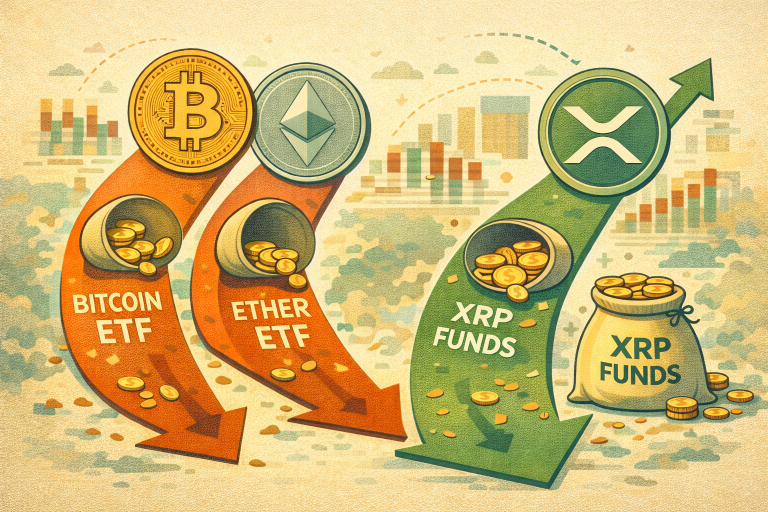
While the pace of selling moderated compared with the sharp exits seen late last week, capital continued to flow out of major Bitcoin and Ether products, underscoring fragile sentiment as markets head into year-end.
Bitcoin and Ether ETFs remain under pressure
On Monday, December 29, US-listed spot Bitcoin ETFs recorded $19.3 million in net outflows, extending a losing streak that dominated much of the prior week.
As per data from Farside Investors, spot Ether ETFs followed a similar pattern, posting $9.6 million in net redemptions.
The data suggest that, although the scale of withdrawals has slowed from the heavy sell-offs seen on Friday, December 26, investors remain reluctant to add exposure.
Date
IBIT
FBTC
BITB
ARKB
BTCO
EZBC
BRRR
HODL
BTCW
GBTC
BTC
Total
29 Dec 2025
(7.9)
5.7
0.0
(6.7)
(10.4)
0.0
0.0
0.0
0.0
0.0
0.0
(19.3)
26 Dec 2025
(192.6)
(74.4)
0.0
0.0
0.0
0.0
0.0
0.0
0.0
(8.9)
0.0
(275.9)
24 Dec 2025
(91.4)
(17.2)
(13.3)
(9.9)
0.0
(5.1)
0.0
(8.0)
0.0
(24.6)
(5.8)
(175.3)
23 Dec 2025
(157.3)
(15.3)
(5.7)
0.0
0.0
0.0
0.0
0.0
0.0
(10.3)
0.0
(188.6)
22 Dec 2025
6.0
(3.8)
(35.0)
(21.4)
0.0
0.0
0.0
(33.6)
0.0
(29.0)
(25.4)
(142.2)
Data from Farside Investors.
Among issuers, Fidelity emerged as the lone exception. Its Bitcoin and Ether products—FBTC and FETH—were the only funds to record net inflows at the start of the week.
In contrast, larger issuers, including BlackRock and Invesco, continued to see capital exit their crypto offerings.
The cautious start capped a difficult month for both Bitcoin and Ether ETFs.
Throughout December, spot Bitcoin products have faced sustained selling pressure as market volatility and year-end portfolio adjustments weighed on demand.
December marks heavy monthly outflows
Over the course of the month, spot Bitcoin ETFs shed more than $1.1 billion in net outflows.
The sharpest single-day withdrawal occurred on December 15, when investors pulled $357.7 million from the funds.
While there were intermittent days of inflows later in the month, they proved insufficient to reverse the broader downward trend.
Spot Ether ETFs mirrored that pattern. Products tracking the second-largest cryptocurrency posted approximately $612 million in net outflows during December.
The largest drawdown also came on December 15, when $224.8 million exited Ether ETFs, followed closely by another significant wave of selling on December 16.
In a report published last week, blockchain analytics firm Glassnode said the 30-day moving average of net flows into US spot Bitcoin and Ether ETFs has remained negative since early November.
According to the firm, the data point to muted participation and a broader contraction in crypto market liquidity heading into the end of the year.
XRP ETFs buck the trend
While Bitcoin and Ether products struggled, spot XRP ETFs in the United States continued to attract steady capital despite choppy market conditions.
According to data from SoSoValue, spot XRP ETFs recorded $8.44 million in net inflows on Monday, extending their inflow streak to 29 consecutive days.
Cumulative inflows into XRP ETFs have now reached $1.15 billion since launch, with total net assets standing at about $1.24 billion.
That resilience has persisted even as XRP prices and the broader crypto market came under pressure during December.
While inflows moderated from the outsized surges seen earlier in the month—when daily additions ranged between $30 million and more than $40 million—XRP funds continued to post consistent gains into the final week of the year.
In total, XRP ETFs attracted roughly $478 million in net inflows during December.
The post Bitcoin, Ether ETF outflows persist into year-end as XRP funds defy broader trend appeared first on Invezz
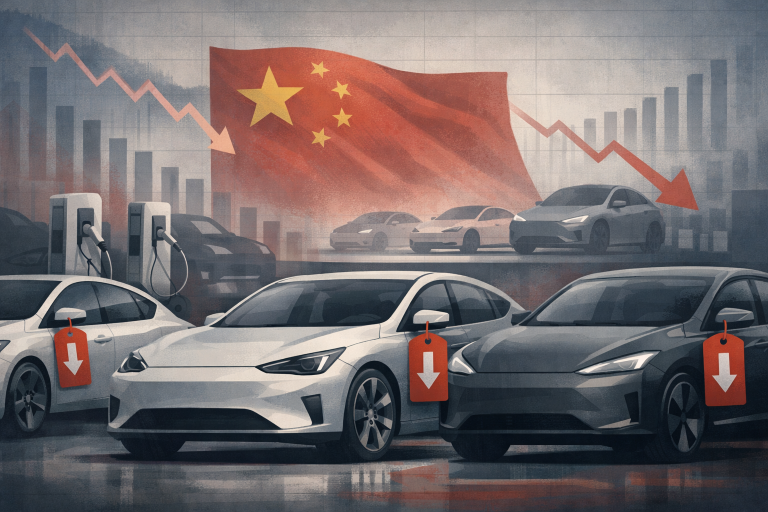
China’s electric vehicle (EV) boom is losing momentum in 2025, with sales declining across major players and analysts warning that the intense price war is likely to persist.
While overall adoption remains high, slowing domestic demand, rising market concentration, and shifting policy support are reshaping the world’s largest auto market.
Sales dip as competition intensifies
Data from the China Passenger Car Association shows that sales momentum weakened through most of the year.
Tesla’s China sales fell 7.4% year-on-year between January and November, while market leader BYD reported a 5.1% decline over the same period.
BYD’s slowdown was particularly pronounced in November, when passenger car sales dropped 26.5% from a year earlier.
In contrast, newer entrants posted rapid growth.
Models powered by Huawei software and vehicles from Xiaomi recorded sales increases of more than 90% in November, underscoring how competition is shifting toward tech-driven challengers.
The early wave of US-listed Chinese EV startups — Nio, Xpeng, and Li Auto — failed to make the top 10 sellers for the month, despite improvements in deliveries.
Market concentration has risen sharply.
The top 10 manufacturers now account for around 95% of China’s new energy vehicle market, compared with roughly 60% to 70% just two to three years ago, according to Citic CLSA.
Analysts expect further consolidation as buyers gravitate toward well-known brands amid mounting price pressure.
Price war set to continue
Aggressive discounting has become a defining feature of the market.
Autohome, a Chinese online auto platform, now lists vehicles by discount size, highlighting cuts such as a 432,000 yuan reduction on the Mercedes-Benz EQS EV and a 147,000 yuan cut on the Volvo XC70.
Paul Gong, head of China autos research at UBS, expects the price war to continue “for years.”
He also warned that policy changes could weigh on growth in 2026, with Beijing planning to re-impose a purchase tax and scale back trade-in subsidies.
UBS forecasts that China’s EV sales growth rate could roughly halve next year from around 20% in 2025.
Despite the slowdown, the market is already highly saturated.
New energy vehicles — including battery-electric and hybrid models — accounted for 59.4% of new passenger car sales in November, underscoring limited room for further rapid expansion at home.
Overseas expansion and foreign competition
Slowing domestic demand is pushing Chinese automakers to accelerate overseas expansion, where margins are often higher.
Geely said its EV exports quadrupled in the first half of the year, helping drive total vehicle exports to 184,000.
The company has entered markets such as Australia and Vietnam and expanded its footprint to around 90 countries, while opening factories in regions including Egypt, the Middle East, and Indonesia.
BYD is also scaling its international presence, with a new factory in Hungary set to ramp up production in 2026.
The company exported more than 131,000 cars in November alone.
Analysts expect Chinese manufacturers and battery makers to intensify competition in Europe, bringing pressure closer to US automakers and Tesla.
Foreign brands remain committed to China despite the challenges.
Volkswagen has formed joint ventures with Xpeng and Horizon Robotics and operates its largest R&D center outside Germany in Hefei.
In the first three quarters of 2025, Volkswagen delivered more than 17 million vehicles in China, up 8.5% year-on-year, far exceeding its deliveries in Western Europe.
China’s auto market remains lucrative but unforgiving. As one analyst noted, dominance can be fleeting, with leaders quickly forced to play catch-up in a market defined by rapid change and relentless competition.
The post China’s EV market slows as price war deepens and overseas push accelerates appeared first on Invezz