Category

Investing

Category

Escalating trade tensions, US President Donald Trump announced on Sunday that the US is considering raising tariffs on India unless New Delhi agrees to Washington’s demands to reduce its purchases of Russian oil, following the latest round of inconclusive trade talks.

“(Prime Minister Narendra) Modi is a good guy. He knew I was not happy, and it was important to make me happy,” Trump told reporters aboard Air Force One, according to a Reuters report.

In response to a query concerning India’s procurement of Russian oil, Trump stated: 

They do trade, and we can raise tariffs on them very quickly.

Tariff threat over Russian oil purchases

The trade relationship between the US and India remains strained. 

Following months of tense negotiations, the US had previously escalated economic pressure by doubling import tariffs on Indian goods to 50% last year. 

This punitive measure was directly in response to India’s continued and significant purchases of Russian oil, a move the US views with disapproval amid geopolitical tensions.

Fears that strained US-India trade relations could further postpone a trade deal led to a reaction in Indian markets on Monday, with the information technology stock index dropping approximately 2.5% to a one-month low.

According to Republican Senator Lindsey Graham, a close associate who was traveling with Trump, the reduction in Indian oil imports was aided by US sanctions targeting Russian oil companies and increased tariffs on India.

Graham supports a bill that would levy tariffs of up to 500% on countries, including India, that persist in purchasing Russian oil.

“If you are buying cheap Russian oil, (you) keep Putin’s war machine going,” he was quoted as saying in the Reuters report. 

We are trying to give the President (the) ability to make that a hard choice by tariffs.

Existing tariffs and market reaction

Graham stated that India was now purchasing “substantially less Russian oil” primarily due to Trump’s actions.

However, trade experts caution that New Delhi’s measured strategy could potentially undermine its standing.

According to Ajay Srivastava, founder of the Global Trade Research Initiative (GTRI), Indian exports are already subject to a 50% tariff in the US, with 25% of that levy being related to the purchase of Russian crude oil.

Indian refiners have reduced imports in the wake of sanctions, but purchasing has not ceased completely, placing India in a “strategic grey zone.”

Srivastava argued that “ambiguity no longer works,” demanding that India take a clear position on Russian oil. 

He cautioned that even if India completely stops buying Russian oil, US pressure might continue, potentially shifting to other trade issues. He also warned that increasing tariffs could result in significant export losses.

Strategic grey zone

India adopted a cautious diplomatic position following the US’ capture of Venezuelan President Nicolas Maduro on Saturday.

Separately, New Delhi called for dialogue without specifically mentioning Washington.

India’s exports to the US saw a jump in November, despite high tariffs.

However, shipments overall dropped by over 20% between May and November 2025. 

In an effort to secure a trade agreement with Washington and address US concerns, the government in New Delhi has requested that refiners provide weekly reports detailing their purchases of Russian and American oil.

Despite at least three conversations between Modi and Trump since the tariffs were implemented, and a meeting between India’s commerce secretary and US trade officials last month, the trade talks remain unresolved.

The post Trade war fears mount as Trump pushes India to cut Russian oil imports appeared first on Invezz


Oil prices reacted to the recent US arrest of Venezuelan President Nicolas Maduro by focusing on the long-term potential for increased supply, suggesting the market is anticipating a smooth power transition rather than immediate disruptions, according to an ING Group report.

Developments over the weekend have sent shockwaves globally, as the US arrested Venezuelan President Nicolas Maduro and flew him to the US to face criminal charges related to drug trafficking. 

This comes amid a recent period where the Trump administration has adopted an increasingly hawkish position toward Venezuela.

“We won’t speculate on the exact reasons behind the decision by the US administration to remove Maduro, but clearly, it has potentially significant implications for the oil market,” Warren Patterson, head of commodities strategy at ING Group, said in the report. 

It leaves only further supply uncertainty for the oil market, something the market has faced plenty of over the last year.

2026 oil market outlook remains intact

“The short-term implication for the market really depends on what kind of transition in power we see in Venezuela,” Patterson said. 

A messy, prolonged transition clearly raises the short-term risk of supply disruptions, according to Patterson. 

However, Vice President Delcy Rodríguez has currently assumed control.

Although her initial rhetoric was defiant, it seems to be changing, with statements now suggesting cooperation between Venezuela and the US. 

Conversely, a smooth transition, particularly with a government more open to working with the US, would likely create more market downside.

This development heightens the prospect of the US ending its blockade on Venezuelan-sanctioned oil tankers, according to the ING report.

This move could potentially lead to lower oil prices in the short term and might also set the stage for further sanctions relief in the future.

A disorderly transition could jeopardise approximately 900,000 barrels per day of oil supply.

The majority of this volume is destined for China, with US refiners importing a smaller portion, specifically just under 150,000 barrels a day.

“While losing this supply would provide some upside to our current forecasts, a well-supplied market means the upside is likely limited,” Patterson said. 

For now, developments over the weekend have not led ING Group to change its view on the oil market for 2026.

We still expect a well-supplied market to weigh on prices and continue to forecast Brent to average $57/bbl over 2026.

Potential supply increases

Despite possessing substantial oil reserves, Venezuela’s oil production remains relatively low, averaging slightly over 900,000 barrels per day in 2025, which accounts for less than 1% of global consumption. 

This significant drop in domestic oil supply over the past two decades is attributed to several factors: the expropriation of domestic assets from foreign oil companies, pervasive resource mismanagement, and economic sanctions. 

For context, Venezuela’s oil production was nearly 3 million barrels per day in the early 2000s, but it had fallen below 2.4 million barrels per day by 2015, and the rate of decline has accelerated since then, according to the ING report.

While Venezuelan oil production has the potential for a large recovery, any significant increase will likely require several years, as the process will not be a quick one, according to the report.

“We will need to see significant investment in Venezuela’s oil infrastructure, following years of neglect,” Patterson said. 

For this investment to succeed, foreign oil companies must agree to invest in the domestic industry.

However, this will be challenging, as both ExxonMobil and ConocoPhillips had their assets in Venezuela expropriated in 2007.

Despite US sanctions, Chevron is the sole American oil company permitted by a special US government licence to continue operations in Venezuela.

Heavy crude availability is likely to increase

The US historically relied on Venezuela’s heavy crude oil as a significant feedstock for US Gulf Coast refineries.

In the early 2000s, US imports of crude oil from Venezuela were nearly 1.3 million barrels per day.

Imports declined to just over 500,000 barrels per day by 2018, and the average for the first ten months of 2025 was under 150,000 barrels a day.

Refiners are seeking heavier grades of crude oil, so any increase in supply from Venezuela would be a welcome development, according to Patterson.

This poses risks for other major suppliers that provide US refiners with heavier grades of crude oil, Patterson added

The US heavily relies on Canada as a major source for its heavy crude oil supply.

Clearly, we could see West Canada Select differentials coming under pressure in the longer term if we see meaningful supply increases from Venezuela in the years ahead.

The post Venezuela crisis unlikely to disrupt oil supply, Brent forecast remains at $57/bbl, ING Group says appeared first on Invezz

Shares in Chevron surged in premarket trading on Monday after the surprise removal of Venezuelan leader Nicolás Maduro over the weekend fuelled optimism that US oil companies could regain broader access to the country’s vast crude reserves.

Chevron stock was up about 7.8% before the opening bell, reflecting investor expectations that a change in government could ease long-standing operational constraints in one of the world’s most oil-rich nations.

ConocoPhillips also climbed sharply, rising nearly 9% to $105.02, as markets speculated that other US producers could eventually return.

The rally followed a dramatic military operation early Saturday that ended Maduro’s rule, an event President Donald Trump said would open the door for American energy companies to re-enter Venezuela after years of strained relations with Washington.

Speaking at a press conference at his Mar-a-Lago resort, Trump said the removal of Maduro would allow US companies to help rebuild Venezuela’s broken oil infrastructure while generating profits for the country.

“We’re going to have our very large United States oil companies, the biggest anywhere in the world, go in, spend billions of dollars, fix the badly broken infrastructure, the oil infrastructure, and start making money for the country,” he said.

The move marks what could be a pivotal moment for global energy companies.

The last comparable opening of a major oil producer occurred in Iraq, where auctions for oilfields attracted multibillion-dollar bids about six years after the US-led invasion in 2003.

Chevron uniquely placed among US majors

Chevron is currently the only major US oil company operating in Venezuela and is the country’s largest foreign investor.

Analysts at JP Morgan said an easing of restrictions under a new government could allow Chevron to expand operations and lift Venezuelan oil production, which has been crippled by years of mismanagement and underinvestment.

Chevron currently operates through joint ventures under a special licence issued by the Trump administration.

Venezuela is producing around 900,000 barrels of oil a day this year, according to industry estimates, with Chevron responsible for roughly one-third of that output.

Production had plunged to as low as 665,000 barrels per day in 2021, down from a peak of 3.7 million barrels per day in 1970, before staging a modest recovery in 2024.

According to Francisco Monaldi, director of the Latin America Energy Program at Rice University’s Baker Institute in Houston, Chevron is best positioned to benefit immediately from any opening.

However, other US oil companies, he said, are also likely to watch developments closely before committing capital.

“The company that probably will be very interested in going back is Conoco, because they are owed more than $10 billion, and it’s unlikely that they will get paid without going back into the country,” Monaldi said.

Exxon Mobil could also return, though it is owed less than ConocoPhillips, he added.

“Exxon, Conoco and Chevron, the three of them are not going to be worried about investing in heavy oil, given that it’s very much needed in the United States and that they have less focus on decarbonization,” Monaldi said in a Reuters report.

European companies may be more hesitant to invest in the prolific Orinoco Belt, he added.

Industry blindsided by military action

Despite Trump’s public encouragement, the Financial Times reported that the three US oil majors have greeted calls for renewed investment with caution.

Concerns include Venezuela’s history of expropriations, lingering political instability and the enormous sums required to restore output.

An industry insider told the Financial Times that executives at Exxon Mobil, Chevron and ConocoPhillips were blindsided by the US military action that led to Maduro’s removal.

“None of the industry players that have the capital and the expertise to invest in Venezuela were advised or consulted prior to either the removal of Maduro or the president making his statements,” the insider said.

Chevron said in a statement on Saturday that its immediate focus was on the safety of its employees and the integrity of its assets in the country.

The company and its joint ventures employ around 3,000 people in Venezuela.

Even with political change, significant hurdles remain

Western energy companies are drawn to Venezuela’s abundant and relatively low-cost resources, but analysts say any meaningful surge in investment will depend on political stability and credible assurances on contract enforcement.

Further complicating matters, Venezuela owes Exxon Mobil, ConocoPhillips and Chevron billions of dollars in unpaid joint-venture costs and arbitration awards.

Settling these liabilities is widely seen as a prerequisite for renewed large-scale investment.

Even if political, legal and financial obstacles are resolved, developing new oil and gas projects would take years.

Rapidan Energy estimates that Venezuelan production could rise by up to 200,000 barrels per day in the first year after Maduro’s ouster and potentially reach 2 million barrels per day within a decade under its most optimistic scenario.

Broader economic rebuild needed

José Ignacio Hernández, a law professor and consultant at Aurora Macro Strategies, said oil companies remain interested in Venezuela’s reserves but will not rush back without broader reforms.

“Oil companies always want oil, and Venezuela has a lot of it,” he said in a Wall Street Journal report.

“But they need political stability, which requires more than just removing Maduro. The situation is still ongoing.”

Orlando Ochoa, a Caracas-based economist and visiting fellow at the Oxford Institute for Energy Studies, described the scale of the challenge facing any new government.

Tens of thousands of trained energy professionals have left the country, and infrastructure has fallen into disrepair.

In comments reported by the Wall Street Journal, Ochoa said Venezuela would need a comprehensive economic stabilisation plan, changes to local laws to limit state overreach, restructuring of roughly $160 billion in debt and the settlement of outstanding arbitration cases to attract foreign investment.

“What the US needs to do is to implement a form of a Marshall Plan,” Ochoa said. “This is about much more than coming into the oil and gas sector just to extract crude from the ground.”

The post Chevron shares jump as Maduro’s fall puts US oil major in pole position for Venezuela oil appeared first on Invezz

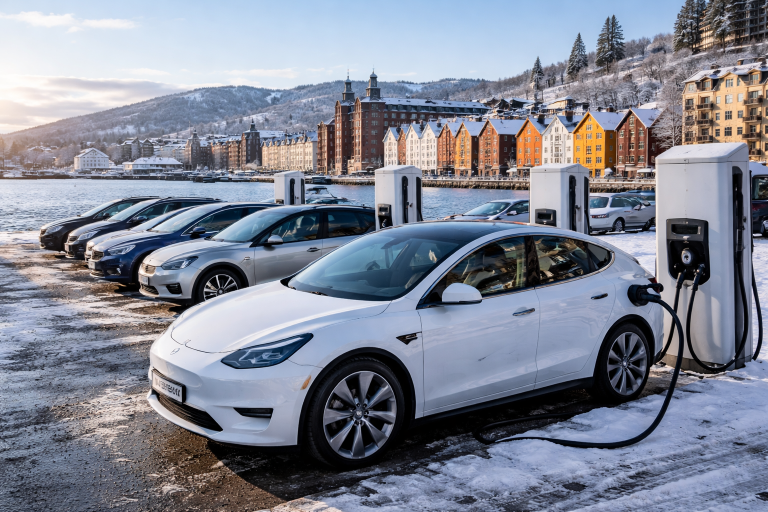
Norway moved within striking distance of effectively eliminating gasoline and diesel cars from its new car market after electric vehicles accounted for nearly all new registrations last year, reinforcing the country’s position as the world’s leading adopter of EVs.

Data published on Friday by the Norwegian Road Traffic Information Council, known as OFV, showed that 95.9% of all new cars registered in 2025 were fully electric.

The figure rose to 98% in December alone, highlighting a powerful year-end surge in demand.

The annual share was sharply higher than the 88.9% recorded at the end of 2024, underscoring the pace at which the Nordic country is closing in on its long-stated ambition to phase out internal combustion engine vehicles.

Record volumes driven by policy and timing

Norway registered a record 179,550 new passenger cars in 2025, a 40% increase from the previous year and the highest annual total ever recorded in the country, according to OFV.

The jump broke the previous record set in 2021.

OFV director Geir Inge Stokke described 2025 as an exceptional year for the market, pointing to the impact of long-running government policy and recent tax decisions.

“We see the effect of long-term and targeted electric car policy, and how specific tax decisions have immediate effects on the market,” Stokke said in a statement.

He added that a rush of purchases toward the end of the year was partly driven by an upcoming change to value-added tax rules from January 1, 2026, prompting many buyers to bring forward their decisions and secure an electric car before the deadline.

Tesla bucks European slump in Norway

Norway’s near-total electrification of new car sales has also produced sharply different outcomes for automakers compared with the rest of Europe, particularly for Tesla.

While Tesla registrations fell steeply in several major European markets in December, they surged in Norway, confirming a pattern that has seen the US carmaker thrive in Europe’s most EV-friendly country even as its broader regional market share erodes.

In France, Europe’s third-largest car market after Germany and Britain, Tesla registrations slumped 66% in December to 1,942 vehicles, according to data from French auto body PFA.

For 2025 as a whole, Tesla registrations in France fell 37%.

In Sweden, Tesla registrations dropped 71% in December to 821 vehicles, contributing to a 70% decline over the full year, based on figures from Mobility Sweden.

By contrast, Tesla registrations in Norway jumped 89% in December from a year earlier to 5,679 vehicles.

The brand captured more than 19% of the Norwegian market in 2025, setting a new annual sales record as it benefited from a market where almost all new car purchases are electric.

Decades of incentives shape consumer behaviour

Experts say Norway’s global lead in EV adoption is no accident but the result of decades of consistent policymaking.

Government support for electric vehicles began as early as the 1990s, long before most other countries considered large-scale electrification of transport.

In 2017, Norway set a target to end sales of new internal combustion engine cars by 2025, the most ambitious timeline of any country.

While petrol and diesel vehicles have not been entirely eliminated, the latest figures suggest the target has been all but achieved.

Adam Rodgers, global business development director at charging company Easee, said Norway’s adoption rate reflects a carefully structured incentive programme designed to smooth the transition for consumers.

“Norway’s world-leading EV adoption rate is the result of a long-term and well-structured incentive programme that focuses on creating a seamless transition,” Rodgers said in a report published by EV Magazine after Norway reached a 96.9% EV market share in January 2025.

Financial and practical advantages combine

Norway’s approach has combined financial incentives with everyday benefits that made electric cars attractive beyond environmental considerations.

Measures included reduced import duties between 1990 and 2022 and exemptions from VAT for many years, significantly lowering the upfront cost of EVs compared with conventional cars.

The absence of a large domestic car manufacturing industry also played a role.

Without a powerful automotive lobby to protect legacy jobs, policymakers faced fewer obstacles in pushing forward aggressive regulations, unlike in countries such as Germany, the UK or the United States.

Practical incentives further strengthened the case for EV ownership.

Electric car drivers have benefited from access to bus lanes, reduced tolls and preferential parking, making EVs not just cheaper to run but often more convenient in daily use.

A clean grid and charging advantage

Norway’s electricity system has also been a decisive factor.

More than 90% of the country’s power production comes from hydropower, often generating surplus electricity that can be used for vehicle charging.

Most Norwegians are able to charge their vehicles at home rather than relying on public infrastructure.

A 2022 study by the Norwegian EV Association found that around three-quarters of EV owners live in detached homes, making home charging easier.

Consultancy LCP has estimated that 82% of EVs in Norway are charged at home, though the share is lower in dense urban areas.

The government has also invested heavily in public charging networks.

Norway now has the highest number of public fast chargers per capita in the world, with many capable of charging an EV battery from zero to 80% in about 20 minutes.

Costs, critics and contradictions

The scale of Norway’s incentives has not been without controversy.

Bjorne Grimsrud, director of the Oslo-based transport research institute TOI, has said the measures have been costly, even if affordable for a wealthy country.

The government previously collected around 75 billion kroner a year from car-related taxes and tolls, a figure that has since been roughly halved, Grimsrud told Deutsche Welle last year.

Some lawmakers have also questioned the fairness of EV incentives, arguing they disproportionately benefit higher-income households and may come at the expense of other sustainable transport options such as walking, cycling and public transit.

Norway’s broader climate role has also drawn scrutiny.

Despite its green credentials at home and a target of carbon neutrality by 2030, the country remains a major oil and gas producer, creating a tension between its domestic transport policies and its reliance on fossil fuel revenues.

The post How Norway engineered world’s highest electric vehicle adoption rate appeared first on Invezz

Luxury goods companies are facing renewed pressure on profitability after a sharp rise in discounting during 2025, as consumers increasingly question the value of high-end products following years of aggressive price increases.

Industry data shows that as much as 40% of luxury goods were sold at discounted prices last year, undermining margins across the sector, said a FT report.

According to consultancy Bain and Italian luxury industry association Altagamma, around 35 to 40% of luxury products were sold at knockdown prices in 2025, up by at least five percentage points compared with a decade earlier.

This growing reliance on discounts has pushed industry margins to their lowest level in 15 years, excluding the Covid-19 period, amid a broader slowdown in demand for designer goods ranging from shoes to handbags.

Consumers are increasingly choosing outlet stores over full-price purchases in boutiques, signalling a shift in buying behaviour.

While some discounting also occurs in luxury brands’ own stores, it remains less common for top-tier labels that have historically sought to tightly control pricing and brand positioning.

“When consumers step back from paying full price, it is less a sign of frugality and more a clear message that the price-to-value equation in luxury has drifted out of balance,” said Claudia D’Arpizio, Bain’s global head of luxury.

Post-pandemic price hikes test consumer tolerance

Luxury groups raised prices sharply during the post-pandemic sales boom, helping to boost profitability in the short term.

According to Bain, prices on many luxury products are now between 1.5 and 1.7 times higher than they were in 2019.

However, the industry’s pipeline of new hit products has thinned, making it harder for brands to justify these elevated price points.

The growing reliance on discounts presents a challenge for an industry that has spent years trying to reduce its exposure to wholesale and discounted sales channels to retain control over how products are priced and presented.

Industry buyers are already adjusting their strategies in response.

“My customers are turning to contemporary brands or emerging designers, where the fashion content is high but the price point is lower than the big luxury names. So that’s where I’m putting more budget,” said a buyer at a big European department store in the report.

Luxury houses have recently introduced a new generation of creative directors at brands including Gucci, Chanel, and Dior, a move that some believe could inject fresh energy into collections.

The same buyer said the changes should bring “new energy” to high-end design houses, but cautioned that the new designers still face a challenge.

“The early signs in terms of creativity are promising [but] we’ll have to see if it’s enough to justify the cost,” the buyer said, adding that the new arrivals still needed time to settle in before being able to build momentum behind so-called hero products.

Margins retreat as costs rise and spending tightens

The heavy discounting and slowing demand have taken a visible toll on profitability. Bain estimates that margins on personal luxury goods have fallen back to levels last seen in 2009.

Average operating margins peaked at 23% in 2012 and stood at 21% in 2021, but are expected to decline to around 15 to 16% in 2025.

Rising costs and the continued need to invest in marketing have added to the strain.

Several major luxury groups have responded by cutting costs and rethinking their global footprints.

Kering, the owner of Gucci and Saint Laurent, has been one of the sector’s weaker performers in recent years and is conducting a portfolio review under new chief executive Luca de Meo.

The group is looking to cut costs and scale back its retail network.

Market leader LVMH has also taken steps to rein in spending, including reducing marketing blitzes, cutting travel budgets, and closing underperforming stores, particularly in China.

At the same time, it has continued to invest in high-profile projects such as a large Shanghai flagship store shaped like a cruise ship, which opened last year.

Chanel reduced marketing spending and slowed hiring in China during 2025, the FT reported.

LVMH said it had “controlled non-priority costs and continued to invest in brand desirability, for example, with projects that surprise people just like The Louis did in Shanghai”.

There are tentative signs of stabilisation in China after two difficult years.

Sales of jewellery and luxury experiences, including travel and dining, have remained relatively resilient.

“After the shopping spree era, experiences and emotions have become the true engine of luxury growth,” D’Arpizio said.

The post Luxury brands face profit squeeze as discounting soars and shoppers question value appeared first on Invezz

The US captured Venezuela President Nicolás Maduro in a dramatic military operation that shocked global markets and threw investors into reassessment mode.

Explosions were reported in Caracas early Saturday morning, followed by President Trump’s announcement that Maduro had been captured and flown out of the country to face narco-terrorism and weapons charges.

The operation, which Trump called “brilliant,” marks the most significant geopolitical event of the young year, and Wall Street is scrambling to understand whether this is a contained regime change or the start of broader instability.​

How Venezuela crisis could impact key Wall Street sectors

The immediate concern for investors centers on energy.

Venezuela sits atop the world’s largest proven oil reserves: 303 billion barrels, roughly 20% of global supplies.

Despite this staggering wealth, the country currently produces only about 1 million barrels per day, down from historical peaks due to decades of mismanagement and US sanctions.

That production matters because 67% of Venezuela’s oil is heavy crude, a unique grade that US Gulf Coast refineries are specifically built to process.

Disruptions to Venezuelan supply can’t simply be replaced by lighter grades from elsewhere, as they cost more.​

Here’s the investor takeaway: Oil prices initially spiked on geopolitical risk, with analysts expecting Brent crude to trade between $62–$65 per barrel in the short term.

However, the impact may prove muted because Venezuelan exports were already crippled by prior US sanctions and blockades.

The country exported only around 700,000-800,000 barrels daily in November, a fraction of what it once shipped.

So while markets will price in a risk premium, the actual supply shock is smaller than headlines suggest.​

For now, however, the uncertainty dominates.​

Beyond oil, defense contractors may see a modest tailwind.

Geopolitical escalation historically lifts stocks of military suppliers, though the Venezuela operation itself was presented as surgical and concluded.

Broader emerging-market equities and bonds face headwinds: uncertainty over Venezuela could prompt capital flight from the region, pressuring other Latin American assets as investors de-risk.

Navigating investment risks and opportunities in 2026’s geopolitical climate

For most portfolios, direct Venezuela exposure is minimal; the economy is largely isolated and non-functional.

But geopolitical uncertainty affects you indirectly through commodities and sentiment.

First, diversify into safe havens. Gold and precious metals are already rallying as investors flee risk.

A modest allocation to gold (5–10% of your portfolio) provides insurance against further geopolitical shocks throughout 2026.​

Second, don’t panic-sell energy stocks. While oil price volatility will persist, any sustained disruption to supplies could actually support energy valuations later in 2026.

Instead, rebalance. If energy has outperformed in your portfolio, trim positions, not because of Venezuela specifically, but to lock in gains.

Third, monitor Trump’s signals. His press conference at Mar-a-Lago will clarify whether the US intends to ease sanctions on Venezuelan assets and pursue investment, which would stabilise markets.

The next 24-48 hours are critical; if the Venezuelan military fractures or instability spreads, expect sharper volatility across equities and commodities.​

This is a geopolitical event, not an immediate investment crisis. The investors are advised to stay diversified, hold steady, and watch for clarity from Washington.

The post Venezuela coup and Wall Street waves: are your investments at risk in 2026? appeared first on Invezz

BitMine stock price will be in the spotlight this week as the ongoing Ethereum rebound coincides with a key vote on boosting the number of authorized shares in the near term. The BMNR stock ended the week at $31.20, up from last week’s low of $27.

BitMine shareholder to vote on increasing shares to 50 billion

The BMNR stock price will likely be highly volatile in the coming days as the shareholders vote on authorizing more shares. They will determine whether to boost the outstanding shares from 500 million to 50 billion.

In a statement, Tom Lee noted that the new fundraising will enable it to have selective at-the-money (ATM) and capital raising opportunity over time.

At the same time, he noted that the new authorization will enable opportunistic deals such as mergers and acquisitions (M&A). Most importantly, he noted that the new fundraising will enable the company to execute future share splits as he expects that the Ethereum price will continue rising in the long term.

However, critics have pointed to some major holes in Lee’s argument. First, analysts argue that the new share expansion will be too much, considering that it is nearing its goal of its Ethereum accumulation strategy.

It has bought 4.1 million tokens so far and now holds about 3.4% of the ETH supply. As such, it needs to buy 1.6% of the supply, which is smaller than what it has bought so far. At the current price, the company needs to authorize 190 million more shares.

Second, analysts noted that the share split argument is vague as Lee argued that it will happen when Ethereum surges, potentially to $250,000, an event that will happen many years later.

Finally, there are concerns that the company’s market net-asset value (mNAV), which has slumped to 0.93. Increased dilution when the stock is trading below NAV is relatively risky as we have seen with other companies like Michael Saylor’s Strategy, which is selling shares worth billions a month.

Ethereum price technical analysis suggests more upside 

ETH price chart | Source: TradingView 

Meanwhile, technicals suggest that Ethereum price has more upside in the coming weeks. It has formed a double-bottom pattern at $2,766, its lowest level in December last year. Its neckline is at $3,475, its highest level on December 10.

A double-bottom is one of the most common bullish reversal signs in technical analysis. The token is also about to move above the Supertrend indicator. It has also moved above the 50-day moving average, while the Crypto Fear and Greed Index has moved to the neutral level.

Therefore, the token will likely continue rising as bulls target the next key resistance level at $3,475. A move above that level will point to more gains, potentially to the psychological level at $4,000. 

BMNR stock price technical analysis 

BitMine stock chart | Source: TradingView 

The daily timeframe chart shows that the BMNR stock price has crashed in the past few months, moving from a high of $160 in July last year to the current $30.

A closer look shows that the stock has remained below all moving averages and the Supertrend indicator, which is a highly bearish sign. However, like Ethereum, the stock has formed a double-bottom pattern with a neckline at $42.

Therefore, the stock will likely rebound this week, potentially to the next key resistance level at $42. A move above that level will be the psychological point at $50.READ MORE: Here’s why BitMine stock price is ripe for a strong comeback

The post BMNR stock forecast as BitMine shareholders votes on increasing share count appeared first on Invezz

The JPMorgan NASDAQ Equity Premium Income ETF (JEPQ) had a strong performance last year as it jumped to a record high of $59. It has risen in the previous three consecutive years, with its assets under management (AUM) rising to over $32 billion. 

Similarly, the NEOS Nasdaq 100 High Income ETF (QQQI) rose to a record high of $55, up by nearly 50% from its lowest level in April last year. So, which is a better ETF to buy between JEPQ and QQQI?

What is the JEPQ ETF?

JEPQ is the second-biggest covered call ETF with over $32 billion in assets. Its goal is to give investors exposure to the blue-chip Nasdaq 100 Index, while giving them monthly dividends.

The fund, which has an expense ratio of 0.35% and a dividend yield of 9.54%, is much higher than what US bonds are offering today. 

JEPQ achieves this goal by using the covered call strategy, which involves buying stocks in the index and then writing its call options. A call option gives an investor a right but no obligation to buy an asset at a certain price. 

It executes the options strategy by writing equity-linked notes (ELN) and pocketing the premium. This premium normally increases in periods of high volatility. It has an expense ratio of 0.35%.

What is the NEOS Nasdaq-100 High Income ETF (QQQI)?

The QQQI ETF is a similar one to JEPQ in that it aims to generate dividend and stock returns by investing in companies in the Nasdaq 100 Index. It invests in these companies and then sells out-of-the-money call options on the Nasdaq-100 Index. It generates its returns by reinvesting dividends from its equity investments and the call premiums. 

The fund benefits from using options that are treated as Section 1256, which are treated better tax-wise. It also uses the tax-loss harvesting approach to reduce the final taxes paid to the government. 

QQQI vs JEPQ ETF: which is a better buy?

Covered call ETFs, which are commonly known as boomer candy funds, have become popular in the past few years. This growth is driven by their high dividend yields, and chances are that the higher demand will continue as the Fed slashes interest rates.

JEPQ is a much cheaper fund than QQQI as its expense ratio stands at 0.35%, lower than QQQI’s 0.68%. This ratio means that a $10,000 investment in these funds will charge $35 and $68 a year. This difference can add up over time. 

READ MORE: Nasdaq 100 Index and QQQ ETF top laggards in 2025 revealed

However, history shows that the QQQI is able to offset the fee difference by its performance. For example, data compiled by Seeking Alpha shows that its total return in the last 12 months was 18.6%, higher than JEPQ’s 15.1%.

QQQI vs JEPQ vs QQQ | Source: Seeking Alpha

QQQI’s performance is primarily because of its approach, which focuses on a data-driven options approach to target high monthly income. This makes it more volatile but has a higher upside potential. JEPQ, on the other hand, is usually more stable and less volatile. 

To be clear: while the QQQI ETF is better than JEPQ, it is worth noting that investing in QQQ offers a better return. As the chart above shows, the straightforward Nasdaq 100 ETF has a better performance. Its total return was 20%, a trend that has been going on in years.

The post Love the blue-chip JEPQ ETF? QQQI might be a good alternative appeared first on Invezz

Tesla reported a second consecutive annual decline in vehicle sales, and while the market initially appeared unfazed, selling pressure mounted as investors digested the weaker delivery numbers amid a shifting narrative around the company’s future.

The electric-vehicle maker delivered 418,227 vehicles in the fourth quarter, slightly below Wall Street expectations of around 423,000 units.

Although investors had braced for an even softer figure closer to 415,000, the relief was short-lived.

Tesla stock reversed early gains to trade down approximately 1% near $445, while the broader market also lost momentum, with the S&P 500 and Dow Jones Industrial Average turning lower.

Quarterly and full-year deliveries show contraction

The fourth-quarter result underscores a clear slowdown in Tesla’s core automotive business.

The company delivered roughly 497,000 vehicles in the third quarter of 2025 and about 496,000 vehicles in the fourth quarter of 2024, highlighting a sequential and year-on-year decline.

For the full year, Tesla sold 1,636,129 vehicles, down from 1,789,226 in 2024.

The company’s best annual performance remains 2023, when it delivered 1,808,581 vehicles.

The 2025 outcome confirms that Tesla has now recorded two consecutive years of falling annual deliveries.

The fourth-quarter drop had been widely anticipated. The federal government ended the $7,500 electric-vehicle purchase tax credit in September, effectively raising the upfront cost of EVs in the US.

That policy change also pulled demand forward into the third quarter, when Tesla posted a company record 497,099 deliveries.

European sales pressure deepens

Tesla’s challenges have been particularly visible in Europe. In France, the region’s third-largest car market after Germany and Britain, Tesla registrations—often used as a proxy for sales—fell 66% in December to 1,942 vehicles, according to data released by industry body PFA.

For the full year, registrations in France declined 37%.

Sweden saw an even sharper contraction. Tesla registrations dropped 71% in December to 821 vehicles, according to Mobility Sweden, and fell 70% over the full year.

These declines come despite Tesla rolling out cheaper versions of its Model Y and Model 3 across Europe, a strategy that had been expected to revive demand.

So far, those pricing adjustments have failed to meaningfully reverse the downturn.

Tesla’s European slowdown has been unfolding since late 2024, driven by intensifying competition from both established automakers and new entrants, an ageing vehicle lineup, and protests linked to CEO Elon Musk’s public praise of European right-wing political figures. Together, these factors have weighed on brand perception in several Western and Northern European markets.

Up to November, Tesla’s market share across Europe, Britain and the European Free Trade Association slipped to 1.7%, down from 2.4% in the same period a year earlier.

Beyond car sales

Predicting Tesla’s stock reaction to delivery declines has become increasingly difficult, as investors, in recent times, have appeared less focused on near-term vehicle volumes.

With deliveries now reported, investor attention is turning back to Tesla’s robotaxi business, launched in Austin, Texas, in June with safety monitors in the front passenger seat.

Musk has suggested those monitors could be removed in the future, a potential milestone that investors are increasingly viewing as central to Tesla’s longer-term valuation.

The post Tesla stock erases early gains: why investors turned sour on Q4 deliveries appeared first on Invezz

Nvidia stock (NASDAQ: NVDA) surged roughly 3% on Friday as investors positioned ahead of the company’s pivotal CES keynote on January 5 and amid growing excitement about Chinese H200 demand.

The broader Nasdaq composite also strengthened, with the tech sector leading the market as traders returned from the New Year break.

The rally underscores how quickly sentiment can shift when artificial intelligence catalysts align with supply-demand dynamics favouring the chipmaker.​

AI momentum and CES positioning lift tech names

The timing of Nvidia stock rise makes strategic sense.

Jensen Huang will deliver the opening keynote address at CES on January 5, a venue that has become the company’s most important annual stage for showcasing AI breakthroughs and setting the tone for the year ahead.

Historically, Nvidia uses CES to elaborate on product roadmaps, highlight partnerships, and address investor concerns about growth trajectories and competitive positioning.

Last year, Huang unveiled robotics platforms and autonomous driving capabilities, signaling how Nvidia’s ambitions extend beyond data-center chips.​

The holiday liquidity dynamic also matters.

Between Christmas and New Year, trading volumes thin significantly, amplifying moves in heavily-traded mega-cap tech stocks.

A 3% gain on modest volume can telegraph stronger conviction once full trading resumes.

Analysts point out that holiday positioning, where portfolio managers adjust allocations for year-end and lock in tax losses, creates windows for concentrated buying interest in momentum names like Nvidia.​

Beyond the calendar, the CES event creates a catalyst for options traders and hedge funds that have large positions ahead of significant news.

Nvidia stock: These factors underpin optimism

The more fundamental driver of the rally is the explosive demand from China.

Reports that Chinese technology firms, including ByteDance, Alibaba, and others, have placed orders for more than 2 million H200 chips represent an extraordinary backlog.

Nvidia currently holds only 700,000 units in inventory, creating a supply-demand imbalance worth billions in potential revenue if Beijing approves the shipments and Nvidia can coordinate production through TSMC.​

The pricing alone underscores the urgency.

At roughly $27,000 per H200 chip, with eight-chip modules priced around 1.5 million yuan ($215,000), a single order of 2 million units implies $54 billion in gross sales.

Even with Nvidia’s cost structure, that margin opportunity has attracted fresh analyst attention.

Additionally, initial shipments are expected to arrive before the Lunar New Year in mid-February 2026, creating concrete near-term catalysts for headlines and management commentary.

Nvidia’s shift to Blackwell production and the pending introduction of next-generation Rubin chips also provide multi-year visibility.

Analysts have increasingly upgraded 2026 revenue forecasts, projecting that Nvidia could exceed $100 billion in annual sales by fiscal 2027.

That growth trajectory, combined with 70%+ gross margins on data-center chips, justifies valuations around current levels for investors comfortable with geopolitical execution risk around China approvals.

The key risk: Beijing’s approval of H200 imports remains uncertain despite the Trump administration’s export authorisations.

Any regulatory delay or reversal would deflate the optimism driving today’s rally.

The post Nvidia stock jumps over 3% today: what’s driving early-2026 rally? appeared first on Invezz