Category

Investing

Category

Meta Platforms Inc. said it has removed almost 550,000 accounts in Australia to comply with the new rules. The action covers multiple Meta-owned platforms and was disclosed in a company blog post outlining its initial response to the legislation.

Australia’s decision to bar children from mainstream social media is moving from legislation to large-scale enforcement.

Less than a month after the law came into force, the impact is already visible across major platforms operating in the country.

Meta said it removed about 330,000 under-16 users from Instagram, 173,000 from Facebook, and 39,000 from Threads between December 4 and December 11.

Australia’s minimum age ban formally took effect on December 10, though Meta began enforcement a week earlier.

The Albanese government is expected to publish data this week showing how many young Australians were removed across all affected platforms.

Meta questions effectiveness of the ban

In an update released overnight, Meta argued that the ban was not achieving the government’s stated aim of improving youth safety and wellbeing.

The US-based company said the policy risks isolating vulnerable teenagers and pushing them toward less regulated online spaces.

Meta also criticised the age-verification approaches being used to enforce the law, describing them as inconsistent.

The company questioned the underlying rationale of the legislation.

“The premise of the law, which prevents under-16-year-olds from holding a social media account so they aren’t exposed to an ‘algorithmic experience,’ is false,” Meta said in a blog post.

“Platforms that allow teens to still use them in a logged-out state still use algorithms to determine content the user may be interested in – albeit in a less personalised way that can be appropriately tailored to a person’s age.”

Despite its objections, Meta said it would continue to comply with Australian law.

Government aims and regulatory penalties

Australia passed its social media minimum age laws in 2024, positioning itself as one of the world’s most aggressive regulators of youth access to social platforms.

The legislation is designed to shield children from targeted algorithms and harmful content.

Under the law, companies face fines of up to A$50 million if they fail to take “reasonable steps” to prevent under-16-year-olds from holding accounts.

The rules apply to a broad list of platforms, including Facebook, Instagram, Snapchat, TikTok, X, YouTube, Reddit, Twitch, Threads, and Kick.

The eSafety Commission, which oversees enforcement, has warned that additional platforms could be added if they meet the criteria for inclusion.

However, the framework includes exemptions for services where gaming, health, or education is the predominant use.

Platforms can adopt a range of methods to verify users’ ages, including government-issued identification, facial age estimation, and age inference technologies.

Meta urged the Australian government to work more closely with technology companies on alternative solutions rather than relying on blanket bans.

“We call on the Australian government to engage with industry constructively to find a better way forward, such as incentivising all of industry to raise the standard in providing safe, privacy-preserving, age-appropriate experiences online, instead of blanket bans.”

The post Meta deletes 550,000 accounts as Australia enforces child social media ban appeared first on Invezz


The Dow Jones Index futures retreated by over 250 points as investors reflected on major events, including the latest subpoena on the Federal Reserve and the upcoming corporate earnings and consumer inflation numbers. It retreated to $49,258, down from the all-time high of $49,500. 

Dow Jones Index futures slip as concerns on the Federal Reserve’s independence remains

The Dow Jones Index futures retreated as investors remained concerned about the independence of the Federal Reserve. In a statement, Jerome Powell, the Fed chair, said that the bank had received a subpoena from the Justice Department. 

Powell said that he would fight back, noting that the potential lawsuit was because of his reluctance to cut interest rates, as Donald Trump has pushed him to do. He has received support from Senator Thom Tillis, who said that he will not vote to advance any Fed nominee unless the pursuit ended. 

On the positive side, the United States, while not perfect, has a rule of law, meaning that the Justice Department will need to justify its actions to the court system. And as we saw in the Lisa Cook case, chances are that the Fed will prevail. 

The new development came two days after the Bureau of Labor Statistics (BLS) published the latest US jobs data. This report showed that the economy added 55k jobs as the unemployment rate retreated to 4.4%.

The bureau will next release the December consumer inflation report. Economists polled by Reuters expect the data to show that the headline Consumer Price Index (CPI) dropped to 2.5% in December. Core inflation, which excludes the volatile food and energy prices, remained unchanged at 2.6%.

These numbers will help the Fed when delivering its interest rate decisions this year. Economists expect the bank will leave interest rates unchanged in this month’s meeting.

Corporate earnings ahead

The other catalyst for the Dow Jones Index this week will be the upcoming corporate earnings from the biggest companies in the United States.

Top banks like Goldman Sachs, Morgan Stanley, JPMorgan, and Wells Fargo will publish their financial results. Other top firms to watch will be popular names like Delta, BlackRock, State Street, and Taiwan Semiconductor, and JB Hunt Transport.

Wall Street analysts believe that American companies will publish strong financial results in this earnings season. The average estimate is that companies in the S&P 500 Index will record an earnings growth of 8.3%, continuing the winning streak that has been going on in the past ten quarters.

Geopolitics factors to impact American stocks 

The Dow Jones Index will also react to the ongoing geopolitical issues, especially the protests in Iran. In a statement, Donald Trump continued to threaten Iran’s leaders of a potential strike in the country as the death toll rise to over 500 people.

The deterioration of the situation in the Middle East will have an impact on American stocks because of the impact of the energy markets. Brent crude oil jumped to $63.45, while the West Texas Intermediate (WTI) jumped to $60.

Dow Jones Futures technical analysis 

Dow Jones chart | Source: TradingView

The daily timeframe chart shows that the Dow Jones futures retreated from the all-time high of $49,870 to the current $49,483. It has remained above all moving averages.

At the same time, the MACD and the Relative Strength Index (RSI) have continued moving sideways. Therefore, the index will likely be volatile as bulls maintain the momentum. A move above the all-time high of $49,870 will confirm the bullish outlook and point to more gains, potentially to the psychological level at $50,000.

The post Stock market today: Why Dow Jones Index futures are falling appeared first on Invezz

The S&P 500 Index and its ETFs, like the SPY and VOO, will have a highly volatile week as investors react to several potential catalysts, including macro data, geopolitical events, and earnings.

The index, which tracks the biggest companies in the United States, was trading at a record high of $6,965.

Federal Reserve DoJ subpoena

One of the key catalysts for the S&P 500 Index and its ETFs, like the SPY and VOO, is the happenings at the Federal Reserve and its independence.

In a statement, Jerome Powell said that the bank received subpoenas from the Justice Department, which threatened a criminal indictment.

The events related to a Congressional testimony that Jerome Powell gave regarding the renovations at the bank.

However, the reality is that the new threat is due to the ongoing pressure on the bank to cut interest rates. Donald Trump has called for aggressive rate cuts since he became president.

As such, he may use the potential indictment as a pretext for firing Powell. Last year, he used a lawsuit by the Justice Department to fire Lisa Cook, a decision that was temporarily stopped by the court.

Geopolitical events such as Iran protests

Another potential catalyst for the S&P 500 Index is the ongoing protests in Iran, which could lead to the regime’s downfall.

According to Bloomberg, military leaders have briefed Donald Trump on possible strikes.

Trump has also continued to warn the regime about potential actions as the protests continue.

As a result, data on Polymarket show that odds of Ayatollah Khamenei being out as the Supreme Leader by January 31st rose to 21%. Odds of him being out by December 31st have soared to 60%.

Similarly, the odds that the country’s president, Masoud Pezeshkian, will be out by December 31st rose to 60%.

Corporate earnings

The S&P 500 Index and its ETFs will also react to the upcoming earnings season, which will start this week, with big banks like JPMorgan, Wells Fargo, BNY, Bank of America, Citigroup, Morgan Stanley, and Goldman Sachs publishing their results.

Other top companies that will release their numbers this week are BlackRock, State Street, PNC, Charles Schwab, and Delta Air Lines.

A report compiled by FactSet shows that the average estimate is that the earnings growth for the S&P 500 Index is 8.3%, which would mark the tenth consecutive quarter of earnings growth.

In reality, the final earnings growth is often 5% to 6% higher than the estimates. As such, the index’s growth will likely be 13%.

American companies will likely continue the strong earnings this year as the impact of Donald Trump’s tariffs eases and inflation continues falling.

US macro data 

The other key catalyst for the S&P 500 Index and its ETFs, like SPY and VOO is that the US will publish the latest inflation and retail sales data.

The Bureau of Labor Statistics (BLS) will publish the December consumer inflation report on Tuesday and the producer price index on Wednesday.

Economists expect the data to show that inflation remained above 2.5% in December.

However, there are rising odds that inflation will continue easing as gasoline fell to a multi-year low and mortgage rates continued their downward trend.

SCOTUS decision on Donald Trump’s tariffs 

The S&P 500 Index will also react to the closely-watched Supreme Court decision on the legality of Donald Trump’s tariffs on goods imported from other countries.

This decision was expected to happen on Friday last week. Analysts now expect the bank to deliver it on Wednesday this week.

Odds are that the court will rule that these tariffs were illegal, a move that would boost the stock market.

However, Trump has other tools to use and achieve the same result over time.

S&P 500 Index strong technicals 

SPX Index chart | Source: TradingView

The S&P 500 Index has also formed strong technicals that may lead to more gains over time.

It has moved above the Supertrend indicator and formed an inverted head-and-shoulders pattern, a common bullish continuation sign. 

Therefore, it is likely that the index will continue rising and move to the key resistance level at $7,000 this week.

The post Top 6 catalysts for the S&P 500 Index, VOO, and SPY ETFs this week appeared first on Invezz

Xpeng Inc. is preparing the ground for a potential stock market debut of its flying car business, reported Bloomberg, citing sources.

This will mark a fresh step in the Chinese electric vehicle maker’s push beyond traditional automobiles.

The company has quietly begun work on a possible initial public offering of its aerial mobility unit in Hong Kong, according to a Bloomberg report.

The move comes as China accelerates policy support for its low-altitude economy, an emerging sector that includes flying taxis, drones, and other airborne technologies.

For Xpeng, the plan highlights how its core car business is increasingly being positioned as a base to support more experimental transport ventures.

Banks appointed

Xpeng has hired JPMorgan Chase & Co. and Morgan Stanley to work on preparations for an IPO of its flying car unit, reported Bloomberg.

The banks have been selected to advise on a listing of Xpeng Aeroht in Hong Kong.

The report said the unit has filed confidentially for a share sale that could take place as soon as this year. The discussions remain private and subject to change, with deliberations ongoing around timing and structure.

Listing plans evolve

Experts said that last year, banks had already been invited to pitch for roles on a potential Xpeng Aeroht listing in either Hong Kong or the US.

The current preparations suggest Hong Kong is emerging as the preferred venue, although the final decision has not been confirmed.

The confidential nature of the filing means details such as valuation, deal size, and cornerstone investors have not been disclosed.

Strategy beyond cars

Xpeng has been working to strengthen its core automotive operations while also investing in frontier technologies.

The company is expanding its presence in extended-range hybrids and scaling up its autonomous driving software, aiming to establish a profitable base business that can support longer-term innovation.

That strategy underpins the development of its flying car unit, which has recently been rebranded internationally as Aridge.

The business is seen as well placed to benefit from China’s low-altitude economy drive, which focuses on commercial uses of airspace close to the ground, including flying taxis and delivery drones.

Manufacturing and funding

Xpeng Aeroht operates a 120,000 square metre intelligent flying car factory in Guangzhou. The facility is designed to eventually produce one aircraft every 30 minutes once it reaches full capacity.

The unit’s first mass-produced flying vehicle is scheduled for customer delivery in late 2026.

The flying car business is part-owned by Xpeng and its chairman and chief executive officer, He Xiaopeng.

It has previously raised external capital, including a $150 million funding round completed in 2024.

Xpeng’s shares have risen 69% over the past 12 months, giving the company a market capitalisation of about $19 billion, according to available data.

The post Xpeng prepares Hong Kong IPO for flying car unit as China backs air mobility appeared first on Invezz

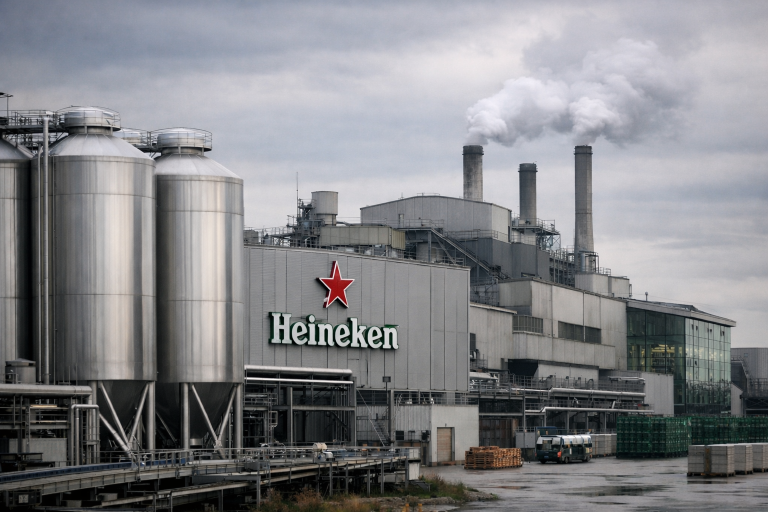
Heineken’s share price fell more than 4% on Monday after chief executive Dolf van den Brink said he would step down at the end of May, marking a leadership change at a difficult juncture for the world’s second-largest brewer.

Van den Brink, a company veteran who joined Heineken as a management trainee in 1998 and has led the group for six years, will leave as the brewer struggles with weakening demand, shifting consumer preferences and mounting investor pressure.

The company said it would begin the process of appointing a successor, while Van den Brink will remain in place until May 31.

In a statement, Van den Brink said Heineken had “reached a stage where a transition in leadership will best serve the company in further executing its long-term ambitions”, adding that he would remain fully focused on delivering the strategy until his departure.

Brewer faces slowing demand and market headwinds

Brewers globally have found it difficult to drive higher beer sales, with hopes of a recovery repeatedly derailed by factors ranging from unfavourable weather to political uncertainty.

Heineken has also slipped behind some peers on cost efficiency and shareholder returns, adding to concerns about its competitive position.

Under Van den Brink, Heineken launched a series of measures to rein in costs, including a plan announced in 2021 to cut around 8,000 jobs.

The company also pushed into alcohol-free and low-alcohol products as consumers in many markets cut back on spending on booze.

Despite these efforts, the brewer’s shares have come under pressure as top-line growth has remained elusive.

Alongside its third-quarter results in October, Heineken cut its volume guidance for the second time this year and said adjusted earnings would land at the lower end of its previous forecast.

The company now expects full-year volumes to decline, having earlier projected steady volumes in July and growth at the start of the year.

Heineken has pointed in particular to weak performance in the Americas, where subdued consumer sentiment, trade uncertainties and inflationary pressures have weighed on sales and profitability.

Analysts back strategy but expect weak end to the year

A series of disappointing results and shrinking market share have prompted some analysts to question whether the brewer’s challenges can be blamed solely on tough market conditions.

RBC Capital Markets said the departure was not unexpected given Heineken’s underperformance relative to peers over several years.

While Van den Brink was appointed in June 2020 with high expectations, the broker said he had failed to deliver on them.

“We believe Heineken is now doing the right thing for its business, with improved expectations management and capital allocation, but execution remains unconvincing,” RBC analysts said.

“Still, Heineken’s strategy remains the right one,” they said.

JP Morgan described the timing of Van den Brink’s departure as surprising, given Heineken’s recent reaffirmation of financial targets alongside new investment and savings plans.

The bank expects a weak end to the year for the brewer, noting that the global beer market remained weak, though not deteriorating, in the fourth quarter.

Separately, Exane BNP Paribas downgraded the stock to “neutral” from “outperform”, citing what it sees as overly optimistic consensus expectations for like-for-like sales growth in 2026.

Board backs strategy but seeks new leadership

The leadership change comes as it prepares to implement the next phase of its EverGreen strategy.

Supervisory Board chairman Peter Wennink said the focus would be on bringing the strategy to life through disciplined execution, adding that the board agreed this was the right moment to start the succession process to secure strong leadership for the future.

Van den Brink will remain available in an advisory capacity for eight months from June 1, the company said.

The post Heineken shares fall as CEO to step down; analysts mixed on strategic outlook appeared first on Invezz

Every trading day, three-four or sometimes five-letter stock tickers move steadily up and down on screens.

Behind those simple symbols sit the shifting emotions of millions of investors, ranging from hope to fear.

Some tickers, however, carry a story.

From Southwest Airlines’ LUV to Harley-Davidson’s HOG and Ferrari’s RACE, certain stock symbols have long stood out.

Yet few investors stop to consider the thought that went into crafting them, especially when many companies simply draw dominant letters from their names, such as Nvidia’s NVDA or Apple’s AAPL.

Invezz takes a closer look at some of the most unusual stock tickers in US market history and asks whether creativity in naming has any connection to performance.

Southwest Airlines (NYSE: LUV)

“Southwest has been in LUV with our Customers from the very beginning,” the airline says in its company history.

The theme runs deep.

In its early years, flight attendants wore hot pants and knee-high go-go boots, served “love potions” (drinks) and “love bites” (peanuts) to passengers, even as employees issued tickets from machines the airline dubbed “Love Machines.”

The symbolism traces back to Southwest’s first flight on June 18, 1971, which departed from Dallas Love Field to San Antonio and Houston.

When the airline listed its shares on the New York Stock Exchange in 1977, LUV was a natural choice.

Over time, the ticker came to reflect not just branding flair but also founder Herb Kelleher’s egalitarian philosophy and rejection of rigid class distinctions.

That ethos extended to features such as open seating, a long-standing practice the airline has only recently decided to end.

Harley-Davidson (NYSE: HOG)

Harley-Davidson motorcycles have been called “hogs” for decades, a nickname rooted in the company’s racing past.

In the 1920s, Harley’s factory racing team, known as the Wrecking Crew, adopted a piglet as its mascot.

After victories, riders would take a lap with the pig perched on the fuel tank.

Fans and journalists soon began referring to the team as the Harley Hogs, a name that eventually became synonymous with the brand and later its stock ticker.

Brinker International (NYSE: EAT)

For Brinker International, owner of restaurant chains such as Chili’s Grill & Bar and Maggiano’s, the ticker EAT is widely believed to have been personally chosen by company founder Norman Brinker when Chili’s went public in 1984.

The symbol directly reflects the company’s core business and remains one of the market’s more literal tickers.

Dave & Buster’s Entertainment (NASDAQ: PLAY)

Dave & Buster’s blends casual dining with arcade-style gaming, making PLAY an apt representation of its business model.

The company was formed in 1982 when founders Dave Corriveau and Buster Corley merged a restaurant and an arcade they operated across the street from each other in Arkansas.

When the company went public in 2014, PLAY neatly captured its identity as a destination built around leisure and entertainment.

Ferrari (NASDAQ: RACE)

Ferrari’s ticker reflects its origins in motorsport rather than luxury road cars.

Enzo Ferrari began his career running Scuderia Ferrari as Alfa Romeo’s racing arm before founding Auto Avio Costruzioni in 1939.

Racing remains central to the company’s identity through its Formula One team, making RACE a concise summary of its heritage.

Other memorable tickers include Petco Health and Wellness’ WOOF, Canopy Growth’s WEED and Cedar Fair’s FUN, each injecting personality into an otherwise technical marketplace.

What’s in a ticker: do quirky tickers actually impact performance?

NYSE rules limit tickers to three letters, while Nasdaq allows up to five, yet not all companies make imaginative use of the space.

Stock symbols date back to the first ticker tape machines of the 19th century, when heavily traded companies were given single-letter identifiers such as T, X and F, still used today by AT&T, US Steel and Ford.

While few investors buy shares solely because of a clever ticker, some academic research suggests creativity may matter.

A 2006 study by psychologists at Princeton University found that stocks with ticker symbols that are easier to pronounce often post stronger performance in the days immediately following their market debut.

Follow-up research from Pomona College in 2019 reinforced those findings, showing that clever and memorable tickers tend to outperform, in part because they stick more easily in investors’ minds.

“There’s evidence that having a company name and ticker that investors like, that’s easy to process, is valuable,” says Russell Jame, associate professor of finance at the University of Kentucky, in a USA Today report.

“It generates more trading in the firm, so that improves the stock liquidity and it also results in a larger breadth of ownership and, ultimately, higher valuation ratios.”

As one investment adviser put it, a ticker is ultimately an extension of a company’s brand. Even in markets driven by fundamentals, a little imagination can still leave a lasting impression.

The post From LUV to HOG to RACE: do quirky stock tickers influence performance? appeared first on Invezz

Gartner stock price has crashed in the last 12 months, moving from a high of $584 in February to the current $246. Its market capitalization has crashed from over $45 billion to $18.25 billion today. It has also formed a bearish pattern, pointing to more downside. 

Gartner stock price has formed a risky pattern

The weekly timeframe chart shows that the IT stock crashed from a high of $584 to the current $246 as co333ncerns about artificial intelligence replacing its business continued.

This chart shows that the stock formed a death cross pattern, which happens when the 50-week and 200-week moving averages cross each other. It is one of the most common bearish continuation patterns in technical analysis.

The stock has moved below the Supertrend indicator, and most importantly, it has formed a bearish flag pattern, which is shown in orange. This pattern is characterized by a long vertical line and a consolidation.

Therefore, the most likely scenario is where the IT stock will continue falling as sellers target the key support level at $200, down by about 20% below the current level.

IT stock price chart | Source: TradingView 

Garner is at risk of AI disruption 

The Gartner stock price has plunged in the past few months as concerns about AI disruption continue. Analysts believe that the company’s research business may be disrupted as some AI models can come up with them.

READ MORE: Archer Aviation stock: Is this eVTOL giant a good buy this year?

However, the reality is companies will still need independent reports because of its expertise and the human element. It is also seeing more demand for help with AI. The company’s conferences and consulting services will also continue seeing resilient growth.

The most recent results showed that Gartner’s revenue rose by 2.7% in the third quarter to $1.5 billion. However, its net income dropped by 92% to over $35 million, while its operating free cash flow dropped by nearly 50% to $299 million.

Most of its revenue came from its insights segment. Its conferences business made $74.6 million from $75.6 million, while its consulting segment made $123.6 million from $127.6 million.

Wall Street analysts believe that the company’s business will continue struggling in the coming quarters. Data compiled by Yahoo Finance shows that the company’s revenue will be $1.76 billion, up by 1.89% YoY. This revenue growth will bring the annual revenue to $6.49 billion, up from 3% from the same period last year.

Analysts then expect the company’s revenue will come in at $6.7 billion, up by 3.36% YoY. They expect the earnings per share (EPS) to normalize this year, with the earnings per share rising to $13.47.

Gartner has become a bargain. Its forward price-to-earnings ratio has dropped to 19.2 from the sector median of 25.60 and its five-year average of 35. 

Therefore, fundamentally, the company will likely continue doing well, which may lift its outlook. As such, chances are that its will drop in the near term and then bounce back in the longer term. This explains why the current price is lower than the average estimate of $283.

READ MORE: Joby Aviation stock forms a rare pattern: why it may surge in 2026

The post Gartner stock forms an alarming pattern: will it rebound it? appeared first on Invezz

Tesla stock (NASDAQ: TSLA) climbed 1.74% on Friday, driven by renewed optimism surrounding the company’s Cybercab production timeline and Full Self-Driving acceleration.

The move caps a volatile week for the EV giant as Wall Street increasingly views Tesla not as a traditional automaker but as an emerging leader in artificial intelligence and autonomous mobility.

The developments mark a narrative shift that has triggered multiple analyst price target hikes with meaningful upside potential.​

The robotaxi and autonomy inflection point

Tesla is entering a critical execution phase for its autonomous vehicle ambitions.

The company confirmed that Cybercab production will begin in April 2026 at its Gigafactory Texas facility, with CEO Elon Musk claiming the manufacturing process will achieve a groundbreaking 10-second cycle time per vehicle.

This is a rate typically associated with consumer electronics assembly rather than traditional automotive manufacturing.

This methodology, if achieved, could theoretically enable output of two to three million units annually.​

The robotaxi service, which launched in Austin in June 2025, is expanding to multiple cities throughout 2026.

Tesla’s Full Self-Driving program has accumulated data from roughly three million customer vehicles that have logged over seven billion autonomous miles by early January.

On January 8, Musk announced that FSD requires 10 billion miles of safe driving data before unsupervised autonomy deployment.

Tesla stock: The analyst price targets

Wedbush Securities (Dan Ives): The most bullish public call comes from the global head of technology, who maintains a $600 base case and $800 bull case for Tesla stock, representing 35% to 81% upside from current levels.

Ives argues that 2026 represents a “monster year” for Tesla, with robotaxi commercialization potentially generating significant incremental revenue by 2030.​

Mizuho Securities Recently upgraded Tesla with a $530 price target on December 16, praising the company’s neural network expansion and FSD acceleration timeline.​

Piper Sandler: Maintains an overweight rating with a $500 price target reaffirmed on January 8, citing Tesla’s autonomous vehicle leadership and potential energy storage business expansion.​

These analyst upgrades reflect a structural revaluation of Tesla’s business model.

Rather than viewing the company’s delivery challenges as a negative, bulls argue it signals Tesla’s deliberate pivot away from low-margin EV commodity production toward high-margin autonomous services and energy infrastructure.

This transition could unlock significantly higher profitability by 2027–2028.​

The near-2% gain on Friday signals investor appetite for this narrative, though execution risk remains substantial.

Cybercab production delays, Full Self-Driving regulatory hurdles, or slower-than-expected robotaxi scaling could quickly reverse sentiment.

Tesla’s full-year 2025 earnings, expected January 28, 2026, will provide the first major test of management credibility on autonomy claims.​

The post Tesla stock surges nearly 2% today: here’s why analysts see more upside appeared first on Invezz

Investors are cheering SoundHound AI Inc. (NASDAQ: SOUN) this morning after the company’s impressive show of agentic artificial intelligence (AI) capabilities at the CES 2026.

At the annual trade show, the voice AI specialist announced a new partnership with “TomTom” as well, that made Oppenheimer analysts issue a positive note in its favour on Friday.

Despite these positive developments, SoundHound stock remains down about 40% versus its 52-week high.

SoundHound stock is the leading voice AI name

In their research note, Oppenheimer analysts dubbed SoundHound a “leader” in the voice AI space.

Importantly, the firm’s dominance is already being reflected in numbers.

SOUN has already more than doubled its revenue in the trailing 12 months – but analysts believe it’s poised to replicate that performance in 2026 as well.  

In fact, SoundHound may be one of the fastest top-line growers in software this year, Oppenheimer told clients in its latest report.

The investment firm’s bullish remarks arrive shortly after SOUN demonstrated new AI capabilities at the CES 2026, which enables vehicles to make reservations and perform other “complex tasks”, without human input.

SOUN stock is worth owning in 2026 also because the company has much more cash than debt – positioning it ideally for continued strategic investments.

How TomTom partnership helps SOUN shares

SoundHound’s new partnership with “TomTom” is a strategic win that notably bolsters its footprint in automotive and navigation technology.

By integrating its advanced voice AI with the Dutch multinational’s mapping and location services, SOUN is promising smarter in-car experiences: hands-free navigation, real-time traffic insights, and seamless voice-driven commands.

For investors, this signals a clear path to monetisation in a high-growth sector, which helps explain Oppenheimer’s constructive view on SoundHound shares.

“SOUN is a well-run business, strategically positioned to support voice AI monetisation initiatives across vertical and enterprise IT systems,” its analysts wrote.

Note that SoundHound AI Inc. does not currently pay a dividend, though.

SoundHound isn’t inexpensive to own in 2026

Despite aforementioned positives, however, Oppenheimer analysts “agreed” that SOUN shares are not inexpensive to own at a price-to-sales (P/S) multiple of nearly 30 currently.

That’s primarily why they maintained their “market-perform” rating on the voice AI firm today.

Still, valuation alone shouldn’t deter believers. High-growth software companies often command premium multiples – and SoundHound’s fast-growing revenue, strong balance sheet, and strategic partnerships suggest the company can justify its valuation.

For believers in the voice AI story, SOUN remains attractive as it continues to prove real-world monetisation opportunities across automotive and enterprise IT.

While near-term volatility is possible, the firm’s leadership position and cash-rich profile make it a compelling hold for those betting on artificial intelligence-driven disruption.

Investors could also take heart in the fact that the consensus rating on SoundHound also currently sits at “buy,” with the mean target of about $16 indicating potential upside of another 35% from here.

The post SoundHound may be ‘one of software’s fastest top-line growers’ in 2026 appeared first on Invezz

Nvidia stock has remained largely range-bound for several months despite strong demand for its artificial intelligence chips, and the company is now making a notable executive hire as it looks to reinvigorate investor enthusiasm.

Shares of the chip maker were down 0.2% at $184.65 in early trading on Friday. The stock has been on a rollercoaster ride this session.

The stock fell 2.2% in Thursday’s session and is down about 1% over the past three months, a period marked by heavy scrutiny over competition, valuation and the sustainability of AI-related spending.

Nvidia names first chief marketing officer

Nvidia has hired Alison Wagonfeld, a senior marketing executive from Google, as its first chief marketing officer.

Wagonfeld is set to join the company in late January, according to a post she shared on LinkedIn.

Wagonfeld spent nearly a decade at Google, where she most recently led marketing for the company’s cloud computing business.

In her post announcing the move, she framed the transition as a shift between two leaders in artificial intelligence.

“I’m thrilled to be moving from one AI leader to another at such a transformational time. Google and NVIDIA share a strong partnership, and we look forward to continued collaboration,” Wagonfeld wrote.

According to a report by The Wall Street Journal, Wagonfeld will report directly to Nvidia chief executive Jensen Huang, and her appointment will consolidate marketing responsibilities that had previously been spread across multiple executives.

The creation of a dedicated chief marketing officer role marks a structural change for Nvidia as it seeks to sharpen its messaging amid intensifying competition and heightened investor expectations.

Competition concerns weigh on shares

One reason Nvidia’s stock has struggled to gain momentum in recent months has been investor concern about competition from large customers and rivals, including Google’s internally developed Tensor Processing Units.

Those chips are designed to reduce reliance on third-party suppliers for certain AI workloads.

Signs of closer cooperation rather than outright rivalry between Nvidia and Google may help ease some of those concerns.

Wagonfeld’s move, combined with ongoing partnerships between the two companies, could be interpreted by investors as evidence that Nvidia remains deeply embedded in the AI infrastructure ecosystem.

Still, the market reaction has so far been muted, reflecting broader uncertainty over how quickly new growth drivers will translate into incremental earnings.

Analyst raises target, sees AI capex surge

Despite the recent stock softness, optimism among some analysts remains intact.

Mizuho analyst Vijay Rakesh raised his price target on Nvidia to $275 from $245 in a research note on Friday, reiterating an Outperform rating.

Rakesh estimates that large US technology companies will increase their artificial intelligence capital expenditure by 32% this year, taking total AI-related spending to about $540 billion.

He expects Nvidia to benefit disproportionately from that trend, forecasting revenue growth of 51% for Nvidia in fiscal 2027. He also projects Broadcom revenue growth of 53% in 2026.

“We expect the AI trade to remain intact in 2026, and see AI accelerators unit shipments growing 36% after 2025 grew 34% year-over-year as demand accelerates with Hyperscalers, Neoclouds, Enterprise/Sovereign all continuing to invest in generative AI,” Rakesh wrote.

China developments add complexity

Nvidia’s shares also came under pressure on Thursday after reports related to China.

Bloomberg reported that Chinese authorities will allow imports of Nvidia’s H200 AI chips, a development that initially appeared positive for the company.

However, Reuters said Nvidia has revised payment terms for Chinese customers amid ongoing trade uncertainty. T

he new conditions reportedly include requiring upfront payment, prohibiting order cancellations and preventing changes to system configurations once orders are placed.

Despite the apparent progress on market access, Nvidia shares dropped more than 2.5% on Thursday.

During CNBC’s “Morning Meeting,” Jim Cramer attributed the decline in part to profit-taking, noting that the stock had rallied more than 10% from its mid-December lows heading into the session.

The post Nvidia stock remains rangebound: buy, sell or hold? appeared first on Invezz