Category

Editor’s Pick

Category

The post Notcoin (NOT) Price Prediction 2026, 2027 – 2030: Is NOT Set for a Gradual Comeback? appeared first on Coinpedia Fintech News

Story Highlights

  • The live price of Notcoin (NOT) is  $ 0.00036014.
  • Notcoin may trade between $0.020–$0.060 in 2026, with $0.20 possible by 2030 if support holds and adoption strengthens steadily.
  • NOT remains in consolidation, with key support at $0.00030. A slow recovery could push prices toward $0.060 in 2026 and higher long term.

With the first two months of 2026 already behind us, Notcoin’s price outlook is now being shaped by how the market behaves during this early phase of the year. After an intense period of volatility following its initial surge, NOT has settled into a quieter zone where price movement has slowed, and expectations have reset.  This phase is common for tokens that experience early popularity. 

From a broader perspective, Notcoin’s long-term potential depends on whether it can maintain relevance beyond its early momentum. Community-driven tokens that survive their initial cycle often transition into slower, more structured recovery phases rather than quick rebounds. Early 2026 is therefore less about acceleration and more about foundation-building.

CoinPedia’s Notcoin Price Prediction

Coinpedia’s price prediction for Notcoin (NOT) depends on the current price structure and long-term participation potential. Notcoin could reach $0.0600 by the end of 2026 if it continues holding key support and regains intermediate resistance levels. Looking further ahead, steady adoption and favorable market conditions could support a move toward $0.20 by 2030.

Year Potential Low ($) Potential Average ($) Potential High ($)
2026 0.020 0.038 0.060

Notcoin (NOT) Price March 2026 Outlook

As March approaches, Notcoin’s price action remains defined by stability rather than expansion. The $0.00030–$0.00035 range has emerged as a key support zone, where selling pressure has consistently eased. As long as NOT holds above this area, the risk of deeper downside remains limited, and price is likely to continue moving sideways.

On the upside, initial resistance is located near $0.00060, followed by a broader recovery zone between $0.0010 and $0.0015. These levels have capped price during previous attempts and will likely require time and steady participation to overcome. March is unlikely to deliver a sharp breakout. Instead, its importance lies in whether Notcoin can maintain its base and slowly build higher structure, setting the stage for recovery later in the year.

Notcoin (NOT) Price Prediction 2026

The broader 2026 outlook for Notcoin focuses on whether the token can move from stabilization into a slow recovery phase. If market conditions improve and interest returns to community-driven projects, Notcoin could benefit from renewed participation. Tokens that endure early volatility often see their next phase unfold gradually, supported by consistency rather than speculation.

From a price-structure perspective, reclaiming the $0.010–$0.015 range would signal that NOT has exited its long consolidation phase. Above this zone, historical resistance becomes thinner, allowing room for further upside. Under favorable market conditions, Notcoin price could reach around $0.0600 by the end of 2026. This move would represent a recovery from deeply discounted levels rather than a short-lived spike. A more conservative scenario would see NOT trading between $0.025 and $0.040 for much of the year before attempting higher levels.

Notcoin Crypto Price Prediction 2026 – 2030

Year Potential Low ($) Potential Average ($ Potential High ($)
2026 0.020 0.038 0.060
2027 0.035 0.055 0.080
2028 0.060 0.095 0.140
2029 0.110 0.160 0.190
2030 0.150 0.180 0.200

Notcoin (NOT) Price Prediction 2026

In 2026, Notcoin price could project a low price of $0.020, an average price of $0.038, and a high of $0.060.

Notcoin Price Prediction 2027

As per the Notcoin Price Prediction 2027, Notcoin may see a potential low price of $0.035. The potential high for Notcoin price in 2027 is estimated to reach $0.080.

Notcoin (NOT) Price Forecast 2028

In 2028, Notcoin price is forecasted to potentially reach a low price of $0.060 and a high price of $0.140.

Notcoin Crypto Price Prediction 2029

Thereafter, the Notcoin  (Notcoin) price for the year 2029 could range between $0.110 and $0.190.

Notcoin (NOT) Price Prediction 2030

Finally, in 2030, the price of Notcoin is predicted to remain steady and positive. It may trade between $0.150 and $0.200.

Notcoin Price Prediction 2031, 2032, 2033, 2040, 2050

The long-term projection assumes Notcoin sustains relevance in enterprise blockchain use cases, with growth moderating over time as the asset matures.

Year Potential Low ($) Potential Average ($) Potential High ($)
2031 0.18 0.25 0.32
2032 0.22 0.45 0.45
2033 0.30 0.80 0.65
2040 1.60 2.50 3.50
2050 5.00 8.50 12.00

Notcoin (NOT) Price Prediction: Market Analysis?

Year 2026 2027 2030
Changelly $0.045 $0.065 $0.110
CoinCodex $0.050 $0.075 $0.150
WalletInvestor $0.060 $0.090 $0.180
Never Miss a Beat in the Crypto World!

Stay ahead with breaking news, expert analysis, and real-time updates on the latest trends in Bitcoin, altcoins, DeFi, NFTs, and more.

FAQs

What is the Notcoin price prediction for 2026?

Notcoin may trade between $0.020 and $0.060 in 2026, with average prices near $0.038 if it holds support and regains momentum.

What is the price prediction for Notcoin in 2027?

In 2027, Notcoin may range roughly from $0.035 at lows up to $0.080 at highs, reflecting gradual recovery potential.

How much will Notcoin be worth in 2030?

By 2030, Notcoin could reach around $0.150–$0.200 if adoption grows and market conditions remain supportive.

Is now a good time to buy Notcoin?

Buying Notcoin now may suit long-term holders if you believe in its future adoption, but volatility remains high with risk of sideways action.

What long-term price outlook does Notcoin have?

Long term, Notcoin’s value depends on adoption and relevance; strong recovery could see levels above $0.20 and beyond over years.

The post Who Dumped $5B in Bitcoin as Israel Strikes Iran? Binance and Wintermute Wallets Flagged Again appeared first on Coinpedia Fintech News

Nearly $5 billion in Bitcoin left major exchange wallets in just 30 minutes on Saturday, right as the US and Israel launched joint strikes on Iran under what the Pentagon is calling Operation Epic Fury.

Arkham Intelligence data captured it in real time. Binance’s hot wallet led with 15,944 BTC ($1.05 billion). Bybit followed at $897 million, Bitfinex at $814 million, then Kraken, Coinbase, Wintermute, and FalconX each pushing hundreds of millions out within the same window.

Over 154,000 traders were liquidated. Total losses reached $522 million in 24 hours.

Operation Epic Fury Sparks Regional Chaos

Israeli Defense Minister Israel Katz confirmed a “preemptive strike” on Iran. President Trump followed with a Truth Social video, stating the US had begun “major combat operations.”

Iran fired back. The IRGC confirmed strikes on Al Udeid Air Base in Qatar, the US Navy’s Fifth Fleet in Bahrain, and military sites in Kuwait and the UAE. Explosions hit Dubai and Abu Dhabi, where one person was killed by debris from intercepted missiles. The UAE shut its airspace.

Same Wallets, Same 30-Minute Window

Saturday’s sell-off echoes a pattern now seen three times.

On October 10, 2025, on-chain analysts flagged that Wintermute moved $700 million into Binance hours before $19 billion in leveraged longs were wiped out in 90 minutes. That crash coincided with Trump’s 100% tariff announcement on China. Two weeks ago, another $2.5 billion in BTC was sold within 30 minutes, again traced to Binance, Coinbase, and Wintermute wallets.

Wintermute CEO Evgeny Gaevoy previously dismissed the October accusations, calling it a “flash crash on mega leveraged market on illiquid Friday night driven by macro news.”

Former CFTC regulator Salman Banaei took a different view: “Whether you love or hate crypto, there should be an investigation by regulators into Oct 10, 2025.”

No exchange has commented on today’s outflows.

How Low Can Bitcoin Fall?

Bitcoin is now 49% below its October 2025 all-time high of $126,000. The Crypto Fear & Greed Index is now at 14.

Key support sits at $63,100. A break below opens the path to $60,000, where Deribit’s largest put position holds over 5,200 BTC in open interest.

Also Read: Is the Crypto Bottom In? Jane Street Sued and 2 More Signals Flagged

History suggests a bounce. After Iran’s April 2024 missile strike, BTC fell to $61,000 and recovered to new highs. After Israel’s June 2025 strikes on Iranian nuclear sites, BTC dropped to $103,000 before climbing above $125,000 by October.

But this market was already fragile going in. US spot Bitcoin ETFs flipped to net sellers this month, according to CryptoQuant. The next moves are currently unknown.

The post Crypto Market Crash Today As War Fears Rise: Are PAX Gold and Tether Gold the Safer Bets? appeared first on Coinpedia Fintech News

As the crypto market crash today deepens amid rising global war tensions, geopolitical instability, and macroeconomic uncertainty, risk assets are once again under pressure. Bitcoin and altcoins have slipped into the red, while volatility across traditional markets continues to rise. In this environment, capital is rotating away from high-risk assets and into defensive, value-preserving instruments. 

Gold has historically played this role and now, tokenized gold assets like PAX Gold (PAXG) and Tether Gold (XAUT) are stepping into the spotlight, surged more than 5% during the day. Backed 1:1 by physical gold and traded on crypto rails, these assets are emerging as safe-haven alternatives inside the digital asset ecosystem. 

A closer look at their charts suggests that this rotation may be more than just a short-term hedge.

PAX Gold (PAXG) Price Analysis: Bullish Continuation Signals Strength

PAX Gold (PAXG) has remained resilient despite broader market weakness, continuing to respect a rising trend structure on the daily chart.

After a sharp upside move earlier in the cycle, PAXG entered a controlled consolidation phase, forming a bullish flag-like structure above its ascending trendline. PAXG price action has remained firmly above key moving averages, indicating that selling pressure is limited and dips are being absorbed quickly.

Notably, each pullback has produced higher lows, a classic sign of sustained demand. As long as PAXG holds above trend support, the structure favors trend continuation rather than reversal, with upside strength closely tied to ongoing geopolitical and macro risks.

The immediate support zone aligns near $5000-$5100, near the rising trendline zone. Until PAXG holds the zone, the bullish structure remains intact. On the other hand, a clean break above the $5600 zone would confirm a breakout and open the door toward the $6000 mark.

Tether Gold (XAUT) Price Analysis: Higher Highs Point to Defensive Accumulation

Tether Gold (XAUT) is displaying a nearly identical technical posture, reinforcing the broader safe-asset rotation narrative. Tether Gold chart shows XAUT trending within a well-defined ascending channel, with price consolidating just below recent highs. Pullbacks remain shallow, and the market continues to print higher lows, a signal that buyers are stepping in early rather than waiting for deeper corrections.

Momentum indicators remain constructive, while price continues to trade comfortably above medium- and long-term moving averages. This suggests that the current consolidation is not distribution, but positioning ahead of potential continuation, especially if global risk conditions worsen. XAUT’s price behavior reflects stability rather than speculation, aligning with its role as a digital proxy for physical gold during times of heightened uncertainty.

The immediate support zone for XAUT aligns near $5100-$5200, which has repeatedly attracted buyers. A loss of this level would shift momentum neutral and increase downside risk. While a break above $5500-$5600 zone could push XAUT toward $5800-$6000 in the short term.

Why Gold-Backed Tokens Are Gaining Attention Now

Unlike most crypto assets, PAXG and XAUT are not driven by speculative narratives. Their value is anchored to physical gold, making them attractive during periods when confidence in risk assets erodes. With war headlines, inflation concerns, and macro uncertainty dominating sentiment, investors appear to be using tokenized gold as a bridge between traditional safe havens and the crypto ecosystem, preserving value without fully exiting digital markets.

Bottom Line

The crypto market crash today is forcing investors to reassess risk exposure. While volatility continues to weigh on Bitcoin and altcoins, PAX Gold and Tether Gold are emerging as relative outperformers, supported by strong chart structures and safe-haven demand. As long as global uncertainty remains elevated, PAXG and XAUT are likely to stay in focus, not as speculative plays, but as defensive assets offering stability inside a turbulent market.

The post Tokenized Gold Safe Haven 2026: Crypto’s Weekend Panic Exposes the Pressure Valve appeared first on Coinpedia Fintech News

Tokenized Gold Safe Haven 2026 isn’t just a catchy phrase infact it’s the plot twist in a brutal weekend for crypto especially. When news of U.S. and Israeli strikes on Iran broke on a Saturday, traditional markets were closed. Stocks? Shut. Bonds? Offline. Crypto? Wide awake and blinking red. And so it became the global pressure outlet.

Weekend Panic Unleashed

Here’s how it played out. With no access to equities or Treasuries, investors needing instant safety dumped the most liquid assets available, yes that cryptocurrencies for you. It wasn’t philosophical. It was practical. Sell first, ask questions later.

In just few hours, coinglass shows over $460 million in intraday liquidation and coinmarketcap showed total market cap dropping from $2.26 trillion to $2.21 trillion vanished. That’s not a dip. That’s a trapdoor.

Bitcoin fell roughly 3.8%, tagging a local low near $63,308. Ethereum dropped harder, down between 4.5% and 6.5%, trading near $1,835. Higher-beta names like Solana and XRP slid even deeper, with some declines stretching past 10% as traders fled risk.

Leverage Domino Effect

But the selling wasn’t purely emotional. It was mechanical. Many traders were leaning long. When prices dipped, exchanges started liquidating those leveraged bets. Forced selling triggered more forced selling. The classic cascade. Within minutes, what began as caution morphed into a full-blown leverage flush.

And despite the “digital gold” narrative, institutional players treated crypto like a tech stock under fire. They sold it and rotated into the U.S. dollar and physical gold both of which surged.

Tokenized Gold Takes Stage

This is where Tokenized Gold Safe Haven 2026 becomes more than a headline. As volatility ripped through altcoins, capital rotated into tokenized metals. By late February 2026, tokenized gold’s market cap alone surged. That’s not theoretical demand. That’s actual repositioning.

On centralized exchanges like Binance, leading gold-backed tokens such as PAX Gold (PAXG) and Tether Gold (XAUt) saw sharp volume activity. PAXG trading volume on OKX spiked dramatically during a recent 24-hour window as tensions intensified.

Critical Levels Ahead

Now attention shifts to structural support. The $60,000–$63,000 range is seen as critical for Bitcoin. If it holds, recovery isn’t off the table. If it cracks, things could snowball.

Historically, war-driven flash crashes in crypto often form local bottoms once the shock fades. There’s also the so-called “springboard effect,” where markets rebound hard after forced liquidations exhaust sellers.

The post “The Biggest Question for Crypto”: Sam Bankman-Fried Triggers AI Payments Debate appeared first on Coinpedia Fintech News

Sam Bankman-Fried, the convicted FTX founder serving a 25-year sentence for wire fraud and conspiracy, posted a thread on X asking what he called “the biggest question for crypto”: will AI use it?

SBF argued that AI models like ChatGPT and Claude need compute, and traditional finance cannot serve them.

“How do they KYC? They have no passport, address, social security number, or even name,” he wrote, calling crypto the natural fit because it is “already digital” and “permissionless.”

The community was not interested in the philosophy. One user responded, “I just want to know how someone can be serving time for Wire Fraud gets access to the internet.”

Why Is SBF Still Posting From Prison?

Federal inmates are barred from social media access. SBF’s X account bio states posts are “posted through a proxy” This is not new. A simple “gm” tweet in September 2025 sent FTX’s token FTT surging 30%.

He has since used the account to praise the CLARITY Act, argue FTX was solvent at collapse, and file for a new trial on February 10, 2026. Trump has confirmed he will not consider a pardon.

Read More: SBF Demands New Trial, Claims Biden’s DOJ Silenced Key FTX Witnesses

The AI and Crypto Debate

This same week, Stripe co-founder John Collison predicted a “torrent” of AI agentic commerce running on stablecoins. Coinbase launched Agentic Wallets built on the x402 protocol, designed to let AI agents transact in USDC without human approval.

At NEARCON 2026, Bitwise CEO Hunter Horsley called AI “an unstoppable freight train” and said public blockchains stand to be “an unmitigated benefactor” of AI adoption.

Not Everyone Thinks Crypto Is Ready

Hussein Faraj, NuGenesis Chief Expansion Officer, pushed back sharply.

“Crypto as it exists today is structurally corrupted,” he wrote. “It has no meaningful governance, no enforceable accountability, no fraud controls.”

Faraj argued AI needs “deterministic, programmable, compliant payment rails,” stable digital currencies, and regulated settlement. “That’s Web3 infrastructure. Not crypto,” he added.

Haun Ventures general partner Diogo Monica offered a different counter.

“You are telling me that a superhuman intelligence cannot use the current payment rails, the current credit cards… to pay for things and to figure it out on their own,” he said.

This Might Interest You: Goldman Sachs, Coinbase, CFTC Chair Join Trump’s World Liberty Forum as CLARITY Act Eyes April Deadline

What Comes Next

Stripe, Coinbase, and MoonPay are already building AI agent payment infrastructure. The question now is whether crypto matures fast enough to serve autonomous systems before traditional finance adapts.

The post Elizabeth Warren Slams World Liberty Financial Bank Charter as Corruption Scandal appeared first on Coinpedia Fintech News

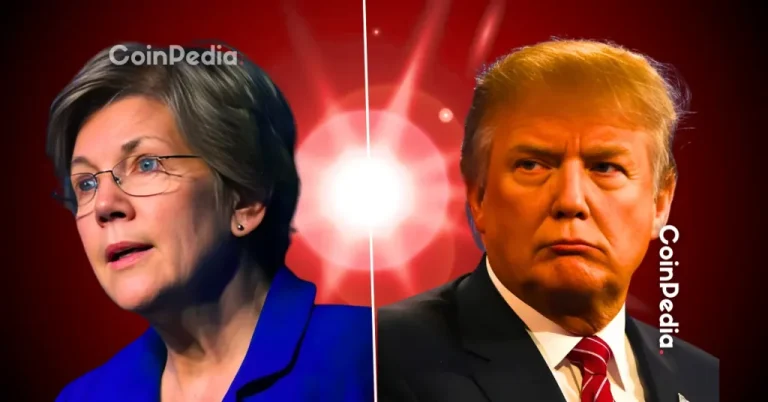
U.S. Senator Elizabeth Warren has strongly opposed World Liberty Financial’s plan to get a national bank charter. She called it a serious corruption issue linked to President Donald Trump. 

The issue has sparked new concern about crypto rules, foreign investment, and political influence in the digital finance industry.

World Liberty Financial Bank Charter Application Faces Scrutiny

According to the filing on February 23, 2026, World Liberty Financial applied for a national trust bank charter through the Office of the Comptroller of the Currency (OCC). 

The crypto firm, linked to Donald Trump and his family, plans to issue a dollar-pegged stablecoin called USD1 and offer digital asset custody services.

During a Senate Banking Committee hearing, Warren questioned OCC Comptroller Jonathan Gould over the approval process. She warned that granting the charter could create serious conflict-of-interest concerns if a president-linked company gains federal banking authority.

The firm is connected to Donald Trump Jr., Eric Trump, and other partners, with Trump listed as co-founder emeritus. 

If approved, the charter would allow the company to operate under federal oversight similar to other national trust banks.

$500 Million UAE Investment Raises National Security Concerns

Warren also highlighted a reported $500 million investment tied to Aryam Investment 1, a vehicle linked to Sheikh Tahnoon bin Zayed Al Nahyan of the United Arab Emirates. 

Reports suggest the investor acquired a 49% stake in World Liberty Financial shortly before Trump’s inauguration.

As per the reports, nearly $187 million from the transaction flowed to Trump family entities. Warren argued that such foreign financial ties raise national security and transparency questions. She demanded full disclosure of anyone owning 10% or more of the company.

OCC Defends Review Process

Comptroller Gould defended the OCC’s review process, stating that applications are evaluated under standard regulatory procedures, not political pressure. He said the only political pressure he had felt came during the hearing itself.

The final decision on the bank charter may carry major implications for both crypto markets and political accountability.

Meanwhile, World Liberty Financial’s WLFI token has fallen nearly 30% over the past month and is currently trading around $0.1145. 

The post Minnesota Moves to Ban Crypto ATMs appeared first on Coinpedia Fintech News

Minnesota legislators introduced House File 3642, a bill that would ban the placement and operation of all cryptocurrency kiosks, physical crypto ATMs, across the state by prohibiting anyone from installing or running them. The proposal also calls for repealing existing rules that regulate kiosk licensing, require disclosures, set transaction limits, and govern consumer protections, effectively dismantling the current legal framework. Supporters say the ban aims to reduce scams tied to these machines, while critics worry it could limit access to digital currency services for residents

The post Ethereum Price Analysis: Whale Accumulation and Rising Volatility Put ETH at Crossroads appeared first on Coinpedia Fintech News

Ethereum is once again at a critical juncture. After a strong rebound, ETH price is trading near $2,100, posting sharp short-term gains while on-chain and derivatives data flash mixed but powerful signals. On one side, large whales are stacking ETH aggressively. On the other, volatility has expanded to levels last seen nearly a year ago.

This combination often precedes major price expansion, but direction is rarely obvious upfront. With buyers and sellers both becoming more active, Ethereum now sits at a crossroads where the next move could define the near-term trend.

Whale Accumulation: Big Money Is Making Its Move

Whale activity shows a clear shift in behavior among large Ethereum holders. One high-profile wallet recently swapped 240 $BTC (worth over $16 million) into $ETH, signaling a direct rotation from Bitcoin into Ethereum. 

That same whale then borrowed $36 million in USDT from Aave to buy an additional 17,000+ $ETH at an average price near $2,083. The liquidation price for this leveraged position sits around $1,705, well below current market levels, indicating strong confidence in ETH holding higher ground.

In another development, a separate whale withdrew 20,000 ETH (roughly $38 million) from Binance and Deribit within a short window. Large exchange withdrawals of this scale typically reduce near-term selling pressure and often point toward longer-term holding or strategic positioning. Taken together, these moves suggest whales are not hedging risk, they are leaning into Ethereum as volatility rises.

On-Chain Data Signals Calm Has Already Ended

Ethereum’s 30-day realized volatility has climbed sharply, reaching its highest level since March 2025. This signals that ETH has transitioned from a period of relative calm into a high-activity phase, where price ranges expand and momentum builds. Such volatility spikes usually occur:

  • Near major structural support or resistance
  • During capital rotation between large-cap assets
  • Ahead of trend acceleration rather than trend exhaustion

Despite the volatility jump, ETH continues to consolidate above $2,000, implying that buyers are absorbing supply instead of capitulating. This balance between aggressive positioning and controlled price behavior often acts as the final compression before expansion.

Ethereum Price Analysis: Is a Big Breakout Rally Ahead?

Ethereum’s price analysis highlights a pattern the market has seen before, right before major upside moves. According to the analysis, ETH is holding above a long-term ascending support trendline on the monthly chart, a structural level that has guided Ethereum’s biggest rallies in the past. This is not a short-term signal, but a macro support line that has repeatedly acted as a base for sustained bullish phases.

The key observation is that Ethereum is testing this trendline without breaking down, even as volatility rises. Instead of sharp sell-offs, price is consolidating near the $2,000–$2,100 zone, suggesting that buyers are absorbing pressure rather than exiting positions. Historically, when Ethereum has respected this trendline, most notably in 2020, it didn’t just bounce briefly. Price transitioned into a strong upward cycle. If this structure continues to hold, the broader setup favors expansion rather than exhaustion.

While short-term fluctuations are expected, the bigger picture suggests Ethereum is building strength at a critical level, not weakening. For now, this trendline remains the line that separates consolidation from the next major move.

Final Thoughts

For now, Ethereum price sits at a crossroads. Whale accumulation, leveraged positioning, and rising volatility all point to an important inflection point. While short-term pullbacks remain possible, the broader data suggests that smart money is preparing for expansion rather than exit.

The direction will likely be decided not by headlines, but by how price reacts around $2,000 support and $2,200 resistance in the coming sessions. One thing is clear: Ethereum’s next move is unlikely to be small.

The post Telegram Wallet Launches DeFi Vaults With Up to 18% APY on BTC, ETH, and USDT appeared first on Coinpedia Fintech News

Telegram’s crypto wallet just went from a simple send-and-receive tool to a full DeFi gateway. Wallet in Telegram has rolled out on-chain yield vaults through its self-custodial TON Wallet, letting Bitcoin, Ethereum, and USDT holders earn returns directly inside the app.

The top USDT strategy delivers a blended APY of up to 18%, powered by Re7’s DeFi strategy. ETH and BTC vaults are also live, though their yields are variable and no specific rates were shared.

Three protocols run the backend. Morpho, a lending network sitting on over $10 billion in deposits, provides the infrastructure. TAC, an EVM execution layer, brings wrapped Ethereum (wETH) and Coinbase-wrapped Bitcoin (cbBTC) into the TON network. Re7 handles risk management and curates the yield strategies.

TON’s Pivot Away From Tap-to-Earn

The timing here matters. After the tap-to-earn gaming craze flooded Telegram with mini-apps in 2024, user interest dropped off fast once the token reward hype cooled. The TON ecosystem has been searching for a reason to keep people engaged.

This vault launch looks like the answer. Two weeks ago, Wallet in Telegram added cross-chain deposits through MoonPay, allowing users to fund their TON Wallet with crypto from Ethereum, Solana, Tron, and other major chains. Now those users have somewhere to deploy that capital.

Andrew Rogozov, founder and CEO of The Open Platform and Wallet in Telegram, said, “With Vaults in TON Wallet, we are bridging the gap between sophisticated DeFi protocols and hundreds of millions of users.”

“Access to self-custodial vault strategies for ETH, BTC and USDT directly within TON ecosystem is a massive step toward making decentralized finance truly universal,” he added.

.article-inside-link {
margin-left: 0 !important;
border: 1px solid #0052CC4D;
border-left: 0;
border-right: 0;
padding: 10px 0;
text-align: left;
}

.entry ul.article-inside-link li {
font-size: 14px;
line-height: 21px;
font-weight: 600;
list-style-type: none;
margin-bottom: 0;
display: inline-block;
}

.entry ul.article-inside-link li:last-child {
display: none;
}

  • Also Read :
  •   ‘Don’t Embarrass Yourself’: Haseeb Qureshi Fires Back in Dragonfly Capital Feud on X
  •   ,

What Users Should Know Before Depositing

The vaults are self-custodial, so users keep control of their assets. But the 18% APY on USDT is a blended rate from Re7’s strategy, not a fixed guarantee. Returns shift based on market conditions and strategy performance.

BTC and ETH vaults carry the same variable structure. No fixed numbers were announced for either.

What’s Next for Telegram’s Crypto Wallet

Wallet in Telegram plans to let users deposit native BTC and ETH directly, with automatic conversion to cbBTC and wETH once inside TON Wallet.

The platform currently has over 150 million registered users, positioning it as one of the largest crypto wallet operations tied to a messaging app.

Never Miss a Beat in the Crypto World!

Stay ahead with breaking news, expert analysis, and real-time updates on the latest trends in Bitcoin, altcoins, DeFi, NFTs, and more.

FAQs

What is Wallet in Telegram’s new DeFi vault feature?

It’s a self-custodial feature that lets BTC, ETH, and USDT holders earn on-chain yield directly inside Telegram’s TON Wallet app.

Is Telegram’s TON Wallet self-custodial?

Yes. Users keep control of their private keys and funds, meaning assets stay in their custody, not Telegram’s.

Can users deposit native BTC and ETH into TON Wallet?

Soon. Telegram plans native BTC and ETH deposits with automatic conversion into wrapped assets inside the TON ecosystem.

The post Is the Crypto Bottom In? Jane Street Sued and 2 More Signals Flagged appeared first on Coinpedia Fintech News

The crypto market just staged one of its strongest single-day recoveries in weeks. Bitcoin surged from $63,000 to above $68,000, altcoins posted double-digit gains, and nearly $400 million in short positions were liquidated in 24 hours.

In a recent video analysis, crypto analyst Dan Gambardello connected three signals behind the move: the Jane Street lawsuit, historically oversold RSI levels, and macro indicators most traders are ignoring.

Jane Street Sued Over Terra Insider Trading

Terraform Labs’ estate filed a lawsuit against Jane Street, alleging the trading firm used insider information to profit from the $40 billion TerraUSD collapse in 2022. According to the suit, Jane Street sold its UST holdings on May 7, 2022, just hours before the stablecoin lost its peg.

What caught Gambardello’s attention was the timing. The day after the lawsuit dropped, the recurring “10 AM manipulation” pattern that traders had been tracking for months reportedly stopped. BTC jumped $2,000 and $120 million in shorts were liquidated.

He was clear that this is conspiracy-level speculation, not a confirmed thesis. Jane Street has called the allegations “baseless” and “desperate.”

Bitcoin RSI Drops to Lowest Level in History

Bitcoin’s weekly RSI has dropped to around 25.6, the most oversold reading in BTC’s entire history. The only two times it fell below 30 before were January 2015 near $200 and December 2018 near $3,500. Both came right before cycle bottoms.

But Gambardello warned against jumping to conclusions. In 2022, a similar oversold signal appeared, but the actual bottom came months later.

“Don’t sit here and be so certain the bottom is in. Time to go 10x, 20x, right? We’ll track that journey as it happens, but manage your risk,” he said.

Also Read: Bitcoin Bear Market Bottom or Another Leg Down? 5 Signals That Will Decide

Is This the Start of Altcoin Season?

XRP gained 7%, ADA surged 12%, LINK jumped 13%, and ETH climbed 9%. The OTHERS/BTC chart is sitting at record oversold levels, and the MACD line has crossed above the signal line for the first time in months.

That said, BTC dominance still has not broken down. The Altcoin Season Index is at 35, well below the 75 mark needed to confirm an altseason.

Gambardello also pointed to the Russell 2000 mirroring 2015-2017 pre-breakout structure, a pattern that has historically lined up with altcoin bull runs. PMI data arriving Monday could be the next macro trigger.

This Might Interest You: Altcoins Outperform Bitcoin After Supreme Court Tariff Ruling: Altcoin Season Starting?

What Crypto Holders Should Watch Next

Bitcoin is currently trading at $68,190. The Jane Street legal battle continues, PMI data lands Monday, and whether this bounce turns into a real reversal comes down to follow-through.

“We are, in my opinion, nowhere near the top of the move, even though maybe it looks like it,” Gambardello said.