Category

Editor’s Pick

Category

The post Bitcoin vs. Gold: Can BTC Surpass Gold? Experts Weigh In appeared first on Coinpedia Fintech News

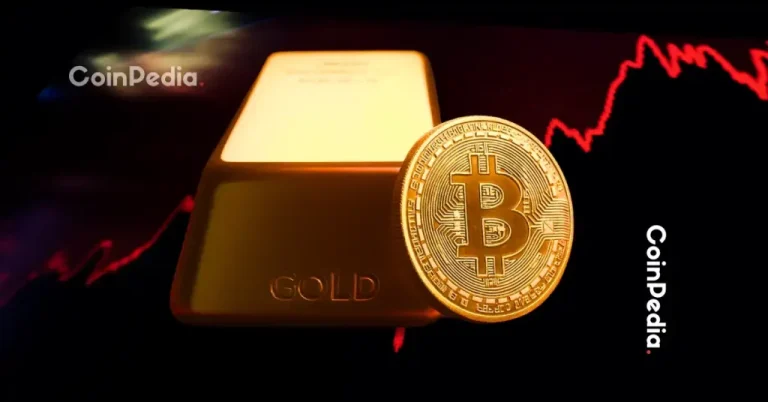
Gold has jumped more than 70% this year and is now trading near a new record high of $4,406. The rally is being driven by expected interest rate cuts and rising global tensions. At the same time, Bitcoin has been falling compared to gold. Bitcoin is now trading below $87,000, almost 29% down from its recent peak. 

This growing gap has left many traders wondering whether Bitcoin can recover and eventually move ahead of gold again.

Gold Still Dominates Safe-Haven Status

For centuries, gold has been the top choice to store value. Recently, many countries and large institutions have rushed to buy gold as global tensions rise, inflation fears grow, and investors expect interest rate cuts. 

Gold is widely seen as a safe place to park money during uncertain times. Because of this strong demand, gold prices have surged more than 70% this year, reaching new record levels above $4,400 per ounce.

In contrast, Bitcoin has faced more selling pressure, with its value down roughly 29% from its peak and trading range-bound for weeks.

Why Bitcoin’s Supply Works Differently Than Gold

Gold supply increases slowly each year. When gold prices rise, miners are encouraged to dig deeper, use more machines, and extract more gold. This extra supply slowly enters the market and helps cool prices over time.

Bitcoin works in a completely different way.

Bitcoin has a fixed supply of only 21 million coins. No matter how high the price goes, no new Bitcoin can be created beyond this limit. Every four years, Bitcoin goes through a halving event that cuts the number of new coins entering the market in half. This makes Bitcoin harder to obtain as time passes.

Because of this design, rising demand does not increase Bitcoin’s supply.

Bitcoin could hit $1.5 million in 18 years

Meanwhile, a crypto researcher, David, offers a mathematical calculator using very conservative assumptions:

  • Gold grows about 2% per year
  • Bitcoin’s market value doubles every four years

Under these slow estimates, Bitcoin could match gold’s total value in about 18 years. That would place Bitcoin near a $30 trillion market cap, or roughly $1.5 million per coin.

This is not hype. It is basic math based on supply rules.

.article-inside-link {
margin-left: 0 !important;
border: 1px solid #0052CC4D;
border-left: 0;
border-right: 0;
padding: 10px 0;
text-align: left;
}

.entry ul.article-inside-link li {
font-size: 14px;
line-height: 21px;
font-weight: 600;
list-style-type: none;
margin-bottom: 0;
display: inline-block;
}

.entry ul.article-inside-link li:last-child {
display: none;
}

  • Also Read :
  •   U.S. Economy Beats Expectations, But Peter Schiff Warns of a Deeper Financial Crack
  •   ,

Bitcoin vs Gold: What the Chart Is Showing

The Bitcoin-to-gold ratio chart shows how Bitcoin performs compared to gold over time. Right now, this ratio is moving inside a falling wedge pattern, which is often seen before a trend reversal.

Even more important, momentum indicators like RSI and MACD are showing bullish divergence. This means selling pressure is slowing, even though prices remain low. In simple terms, Bitcoin is losing strength less quickly against gold, which often happens before a rebound.

This setup suggests Bitcoin may be forming a base rather than collapsing further.

Never Miss a Beat in the Crypto World!

Stay ahead with breaking news, expert analysis, and real-time updates on the latest trends in Bitcoin, altcoins, DeFi, NFTs, and more.

FAQs

Why is gold outperforming Bitcoin right now?

Gold benefits from rate-cut expectations and geopolitical risk, while Bitcoin faces short-term selling pressure and weaker demand from risk-averse investors.

Can Bitcoin still overtake gold in the long term?

Yes. Bitcoin’s fixed 21 million supply and halving cycles mean long-term demand growth could eventually push its value beyond gold’s market cap.

What does the Bitcoin-to-gold ratio indicate for investors?

The ratio shows Bitcoin’s performance versus gold. Current chart patterns suggest Bitcoin may be stabilizing and preparing for a potential rebound.

The post SEC Uncovers $14M Crypto Scam That Lured Investors Through WhatsApp Groups appeared first on Coinpedia Fintech News

U.S. regulators have cracked down on a large crypto scam that used social media and messaging apps to lure unsuspecting investors. The Securities and Exchange Commission (SEC) has charged seven entities for allegedly running a coordinated scheme that siphoned more than $14 million from retail investors across the United States.

According to the SEC, the operation wasn’t built around real crypto trading at all. Instead, it relied on trust-building tactics, fake platforms, and misleading promises designed to exploit people looking for investment opportunities online.

How the Scam Reached Victims

The scheme reportedly ran from early 2024 through January 2025 and began with targeted ads on popular social media platforms. These ads encouraged users to join exclusive “investment clubs” that promised education, AI-powered trading strategies, and consistent returns.

Once users joined, communication shifted to WhatsApp group chats. Inside these groups, scammers posed as experienced financial professionals, gradually building credibility and confidence. Members were shown polished messages and so-called AI-generated trading tips, creating the illusion that the group had access to advanced investment tools.

Fake Platforms and False Profits

As trust grew, victims were instructed to open accounts on what appeared to be legitimate crypto trading platforms named Morocoin, Berge, and Cirkor. The SEC says these platforms were completely fake. No real trading activity ever took place, despite claims that the services were licensed and government-approved.

To deepen the deception, the groups promoted bogus security token offerings linked to fictitious companies. Investors believed they were participating in early-stage crypto opportunities when, in reality, their money was simply being funneled away.

.article-inside-link {
margin-left: 0 !important;
border: 1px solid #0052CC4D;
border-left: 0;
border-right: 0;
padding: 10px 0;
text-align: left;
}

.entry ul.article-inside-link li {
font-size: 14px;
line-height: 21px;
font-weight: 600;
list-style-type: none;
margin-bottom: 0;
display: inline-block;
}

.entry ul.article-inside-link li:last-child {
display: none;
}

  • Also Read :
  •   Crypto Hack: CertiK Warns After $2.3 Million Stolen Fund Sent To Tornado Cash
  •   ,

The Trap Tightens During Withdrawals

Problems surfaced when investors tried to withdraw their funds. Instead of processing withdrawals, the scammers demanded additional “fees” or charges, claiming they were required to unlock profits or complete transactions. These extra payments only increased investor losses, with no chance of recovery.

The SEC alleges that the stolen funds were moved overseas through a network of bank accounts and crypto wallets, making recovery even more difficult.

SEC Warns of a Growing Trend

The regulator described the case as a textbook example of an “investment confidence scam,” a tactic that is becoming increasingly common in the digital asset space. SEC officials emphasized that fraudsters are exploiting social media, private group chats, and the hype around AI and crypto to appear legitimate.

Alongside the charges, the SEC issued a fresh warning urging investors to be cautious of unsolicited investment advice, especially in messaging apps. The agency advises verifying anyone offering investment opportunities through official channels like Investor.gov.

The case serves as a reminder that if an investment opportunity relies heavily on private chats, guarantees quick profits, or asks for extra fees to access funds, it’s often a major red flag.

Never Miss a Beat in the Crypto World!

Stay ahead with breaking news, expert analysis, and real-time updates on the latest trends in Bitcoin, altcoins, DeFi, NFTs, and more.

FAQs

What is an investment confidence scam in crypto?

It’s a scam where fraudsters build trust over time using fake success stories and guidance, then persuade victims to invest on bogus platforms.

Are legitimate crypto investments promoted through private group chats?

Rarely. Legitimate firms don’t rely on WhatsApp or Telegram groups for investments or pressure users with time-limited offers.

What are common red flags of fake crypto platforms?

Guaranteed returns, no verifiable license, withdrawal fees, unclear ownership, and pressure to reinvest are strong warning signs.

What should investors do if they suspect a crypto scam?

Stop sending funds immediately, document all interactions, and report the case to regulators or cybercrime authorities promptly.

The post HashKey Capital Secures $250M for New Multi-Strategy Crypto Fund appeared first on Coinpedia Fintech News

Despite tighter liquidity and a more selective market environment, HashKey Capital has just made an interesting move.

The Asia-based digital asset investment firm has announced the first close of its fourth fund at $250 million.

Here’s everything to know.

HashKey Capital Raises $250M

The fund, officially named HashKey Fintech Multi-Strategy Fund IV, exceeded expectations at its first close and is targeting a final size of $500 million. HashKey said the commitments came from a mix of global institutions, family offices, and high-net-worth individuals, though specific investors were not disclosed.

The timing stands out. Market makers have pulled back since October’s major liquidation event, and on-chain data shows continued outflows from Bitcoin and Ether ETFs. While short-term capital is retreating, HashKey’s latest fund suggests institutions are still backing crypto’s long-term infrastructure story.

“With $250 million in new capital, we are uniquely positioned to capture the massive growth occurring in emerging markets,” said Deng Chao, CEO of HashKey Capital. “These regions are the true testing grounds for blockchain’s real world applications.”

.article-inside-link {
margin-left: 0 !important;
border: 1px solid #0052CC4D;
border-left: 0;
border-right: 0;
padding: 10px 0;
text-align: left;
}

.entry ul.article-inside-link li {
font-size: 14px;
line-height: 21px;
font-weight: 600;
list-style-type: none;
margin-bottom: 0;
display: inline-block;
}

.entry ul.article-inside-link li:last-child {
display: none;
}

  • Also Read :
  •   IMF Praises El Salvador for Its 4% GDP Growth in 2025 Amid Its Bitcoin Accumulation Plan
  •   ,

Focus on Infrastructure and Real-World Use Cases

Fund IV will follow a multi-strategy investment approach, combining public-market exposure with liquidity-generating crossover opportunities and selective private investments.

The focus will be on blockchain infrastructure, scalable platforms, and projects built for mass adoption.

HashKey’s track record adds weight to the raise. Since launching in 2018, the firm has grown to manage over $1 billion in assets and has invested in more than 400 blockchain projects globally. Its first fund delivered a distributed-to-paid-in ratio of over 10x, reflecting strong historical returns.

What’s Next for HashKey?

HashKey Capital’s fund announcement also comes just days after HashKey Holdings made its trading debut on the Hong Kong Stock Exchange (HKEX) following a $206 million initial public offering.

Looking ahead, HashKey’s leadership sees the next phase already forming.

“As we look toward 2026, the convergence of AI, blockchain, and institutional finance is creating unprecedented opportunities,” said Dr. Xiao Feng, Founder of HashKey Group.

Never Miss a Beat in the Crypto World!

Stay ahead with breaking news, expert analysis, and real-time updates on the latest trends in Bitcoin, altcoins, DeFi, NFTs, and more.

FAQs

How could this fund raise affect crypto startups and builders in Asia and emerging markets?

It increases the pool of patient capital available for teams building core infrastructure rather than short-term token projects. This can extend runway, support scaling, and reduce reliance on speculative funding cycles.

Does this development have any regulatory or market credibility implications?

Yes. HashKey’s alignment with regulated markets, including Hong Kong’s evolving digital asset framework, reinforces the perception that compliant crypto investment vehicles are gaining traction.

What should the market watch next after this first close?

Attention will likely shift to how quickly HashKey reaches its $500 million target and where initial capital is deployed. Early investments may signal which sectors institutions see as most resilient through 2026.

The post Why Were Coinbase and Gemini Blocked in the Philippines? appeared first on Coinpedia Fintech News

Crypto access in the Philippines is getting tighter, and this time, even major global exchanges aren’t spared.

As of Tuesday, Coinbase and Gemini are no longer accessible across several Philippine internet service providers, according to user reports and independent confirmations. The blocks follow a government order tied to a wider push against unlicensed crypto platforms operating in the country.

Coinbase, Gemini Blocked

The move came after the National Telecommunications Commission (NTC) directed ISPs to restrict access to around 50 online trading platforms flagged by the Bangko Sentral ng Pilipinas (BSP) for operating without authorization.

In its statement, the NTC said the directive followed a formal request from the central bank to disable websites and applications of unlicensed Virtual Asset Service Providers. The BSP did not release a full list of affected platforms, but regulators made it clear the goal is enforcement, not warnings.

Officials say the action is meant to protect users and ensure financial stability, citing Section 902-N of the Manual of Regulations for Non-bank Financial Institutions, updated under BSP Circular No. 1206.

Binance Was the First – Now the Net Is Wider

Coinbase and Gemini aren’t the first exchanges caught in the crackdown.

In December 2023, Philippine regulators gave Binance a 90-day compliance window to meet local requirements. When that period expired, the NTC ordered ISPs to block Binance on March 25, 2024. The country’s Securities and Exchange Commission later asked Apple and Google to remove Binance’s app from their stores.

After the ban, the SEC said it could not endorse ways for Filipinos to retrieve their funds.

More recently, the SEC identified 10 unlicensed exchanges, including OKX, Bybit, and KuCoin, as operating without approval.

Regulated Platforms Move In as Rules Tighten

While access to unlicensed exchanges shrinks, regulated players are expanding.

Local exchange PDAX recently partnered with payroll firm Toku, allowing remote workers to receive salaries in stablecoins and convert them to pesos without wire fees.

Meanwhile, digital bank GoTyme, working with U.S. fintech Alpaca, has rolled out in-app crypto services covering 11 digital assets.

The post Chainlink Price at a Crossroads: Why LINK Is Struggling Near $12 appeared first on Coinpedia Fintech News

The crypto markets are becoming choppy nowadays as the prices of most of the tokens are heading towards their local support range. Meanwhile, the Chainlink (LINK) price is trading near the $12 zone, extending a broader downtrend that has been in place since October. While volatility has cooled, the chart shows that LINK is not stabilising yet. Instead, price action suggests sellers remain in control, with rallies failing to reclaim key resistance levels. The market is now approaching a critical decision point that could define LINK’s next move.

On the daily chart, LINK continues to print lower highs and lower lows, a classic bearish structure. Every rebound attempt over the past two months has stalled below prior support zones, which have now turned into resistance. This behaviour signals distribution rather than accumulation.

The sharp breakdown in October was followed by weak recovery attempts, showing that buyers have not stepped in aggressively. Until this structure changes, the broader trend remains tilted to the downside.

The $12–$12.20 area is the most important level on the chart right now. Volume has remained relatively low, suggesting a lack of strong demand. If buyers were in control, the chart would show stronger bounces and follow-through. Instead, price is compressing near the level, increasing the risk of a breakdown. 

What happens next?

A clean daily close below $12 would likely trigger another leg lower rather than a temporary dip. Below this level, the next demand zone sits near $11.90–$11.50, where buyers previously stepped in. Such a move would not indicate panic but a continuation of the existing trend. In weak market conditions, altcoins like LINK tend to follow momentum rather than reverse abruptly.

Besides, to invalidate the bearish setup, the price must reclaim $12.80–$13.30 and hold above it. This zone marks previous support that repeatedly capped recent rallies. A breakout above it, supported by rising volume, would signal that sellers are losing control.

Without this reclaim, upside moves are likely to be sold into rather than extended.

LINK’s weakness also reflects broader market conditions. With Bitcoin and Ethereum consolidating and liquidity thinning, capital is rotating away from higher-beta altcoins. In such phases, tokens with weaker structure tend to underperform until market confidence returns. This makes patience critical for traders, as early dip-buying often leads to poor risk-reward setups.

Collectively, Chainlink is not collapsing, but it is clearly failing to reclaim structure. The $12 level is acting as a pressure point, and the lack of strong buying interest keeps downside risks elevated. Until the LINK price reclaims key resistance at $15 with volume growth, the trend may remain sideways to lower.

The post Can Bitcoin Price Beat Its 2024 Christmas High of $94,000 This Festival Season? appeared first on Coinpedia Fintech News

Bitcoin is struggling to regain momentum this Christmas, trading below the $90,000 mark despite the festive mood in the market. There are hopes for a holiday rally amid the bearish price action.

At the time of writing, Bitcoin closed near $86,935, slightly lower after failing to hold recent gains. Thin holiday trading volumes, ETF outflows, and a large options expiry have all added pressure on the world’s largest cryptocurrency.

How Bitcoin Performed at Christmas in Recent Years

Bitcoin’s Christmas performance has varied sharply over the past three years:

  • 2023: $43,665
  • 2024: $94,120

Last year’s Christmas rally to above $94,000 set a high bar. This year, Bitcoin is well below that level, raising questions about whether another festive breakout is possible.

Why Bitcoin Is Stuck Below $90,000

Bitcoin has been consolidating in a tight range between $85,000 and $90,000 throughout December. Analysts say low liquidity during the holidays has reduced strong price moves in either direction.

ETF-related selling and a major options expiry have also limited upside momentum. However, from a technical perspective, signals are mixed.

On the weekly chart, Bitcoin is still showing signs of a broader correction. A bearish divergence remains active, showing weakness could continue unless the trend changes.

However, shorter timeframes tell a slightly more positive story. On the three-day chart, a small bullish divergence has formed. This often means a short-term bounce or sideways movement rather than a strong rally.

Source: TradingView

Bitcoin continues to bounce between clear levels:

  • Support: $85,000 to $86,000
  • Resistance: $92,000 to $94,000

The $90,000 level has now turned into strong resistance, with multiple rejections over the past week.

Can Bitcoin Rally During Christmas?

Bitcoin looks oversold in the short term and could attempt a move back toward $90,000 to $91,000, where liquidity is building. If buying pressure increases, a brief Christmas bounce is possible.

However, failure to hold current support could send Bitcoin down toward $82,000, especially if broader market sentiment weakens.

The post Is XRP Price Losing Key Support? Why the $1.50 Level Is Back in Focus appeared first on Coinpedia Fintech News

Crypto market volatility is slowly gaining strength, as the prices of tokens have been ranging within a predefined range. Currently, the markets are experiencing significant upward pressure while top cryptos like Bitcoin remain accumulated within a range, and Ethereum is failing to sustain above $3000. Meanwhile, the top fifth crypto, XRP price, has also maintained a steep bearish trend and is likely to find lows below $1.8 in the coming days. 

With XRP showing signs of weakness after failing to hold above key support levels, is this just a slip of momentum, as the price does not appear to be gearing for a sharp breakdown? If yes, then there is an increased risk of a deeper pullback if support continues to weaken.

Is XRP Price Heading to $1.5?

On the daily chart, XRP price is trading within a clear descending channel, marked by lower highs and steady selling pressure. Each bounce attempt has stalled below the descending trendline, showing that sellers remain active on rallies. This type of structure usually signals continuation rather than reversal, especially when price struggles to reclaim previous support zones. 

The $1.78–$1.80 range has emerged as an important near-term support. XRP is currently hovering just above this level, but the reaction has been weak. There is no strong expansion in volume, suggesting buyers are cautious rather than aggressive.

Momentum indicators are also flashing caution. The RSI is hovering near the 40 level, which typically reflects weak momentum rather than oversold conditions. This suggests there is still room for downside before buyers feel forced to step in. At the same time, On-Balance Volume (OBV) continues to trend lower, indicating sustained distribution. This shows that capital is slowly exiting rather than accumulating at current prices.

If XRP loses the $1.78 support, the next major demand zone sits near $1.50. This level previously acted as a strong base and could attract buyers again if tested. A move toward $1.50 would not signal panic but rather a continuation of the current corrective trend.

Here’s When the XRP Price Could Trigger a Rebound

XRP is not breaking down aggressively, but it is losing ground slowly. That is often more dangerous for late buyers than sudden volatility. Until price reclaims structure, the chart favors caution rather than dip-buying. For any meaningful trend reversal, XRP must reclaim the $2.00–$2.10 zone and hold above the descending trendline. This move would need to be supported by rising volume and improving momentum indicators.

The post No More Crypto Tax for Arizona? New Bills Signal Big Change appeared first on Coinpedia Fintech News

Arizona lawmakers are back with a proposal that could remove state taxes on cryptocurrency altogether.

State Senator Wendy Rogers has introduced a set of bills and a constitutional resolution that aim to change how Arizona treats digital assets, from everyday crypto transactions to blockchain infrastructure.

If approved, the move would place Arizona among the most crypto-friendly states in the U.S. when it comes to taxation.

Huge moves! Here’s what you should know.

Arizona Pushes to Exempt Crypto From State Taxes

The effort centers on SB 1044, a bill that would exempt virtual currency from taxation under Arizona law.

The proposal defines virtual currency as “a digital representation of value that functions as a medium of exchange, a unit of account and a store of value other than a representation of the United States dollar or a foreign currency.”

To lock in that change, Rogers also filed SCR 1003, a resolution that would amend Arizona’s constitution to explicitly exclude digital assets from property tax. Unlike regular legislation, this measure would need approval from voters in the November 2026 general election.

Together, the two measures aim to remove much of the tax burden tied to holding, using, or earning crypto at the state level.

Protection for Blockchain Node Operators

A third proposal, SB 1045, focuses on blockchain infrastructure. The bill would prevent cities, counties, and towns from imposing “a tax or fee on a person that runs a node on blockchain technology.”

This measure could move forward through the state legislature without a public vote, making it the most immediate of the three proposals.

.article-inside-link {
margin-left: 0 !important;
border: 1px solid #0052CC4D;
border-left: 0;
border-right: 0;
padding: 10px 0;
text-align: left;
}

.entry ul.article-inside-link li {
font-size: 14px;
line-height: 21px;
font-weight: 600;
list-style-type: none;
margin-bottom: 0;
display: inline-block;
}

.entry ul.article-inside-link li:last-child {
display: none;
}

  • Also Read :
  •   US Crypto Staking Tax Rules Face Pushback as Lawmakers Eye Changes by 2026
  •   ,

For node operators and mining firms, local taxes and fees are often cited as a major cost factor. Removing them could make Arizona more attractive for companies deciding where to expand or set up operations.

Part of a Larger Crypto Policy Shift

Arizona’s move comes as states across the U.S. test different approaches to crypto regulation and taxation. While Texas has pushed forward with a strategic Bitcoin reserve, other states like Ohio and New York have explored narrower tax changes.

At the same time, lawmakers in Washington have floated a bipartisan discussion draft aimed at aligning crypto taxes with traditional financial assets, signaling growing momentum around modernizing digital asset tax rules at the federal level.

Rogers’ proposals stand out because they aim to eliminate state-level crypto taxes rather than adjust them.

The path ahead is still uncertain. A similar Bitcoin reserve bill backed by Rogers was vetoed earlier this year by Governor Katie Hobbs, and voter approval remains a major hurdle.

Still, Arizona has now placed itself at the center of the growing debate over how digital assets should be taxed – and whether states should compete to attract the next wave of crypto infrastructure.

Never Miss a Beat in the Crypto World!

Stay ahead with breaking news, expert analysis, and real-time updates on the latest trends in Bitcoin, altcoins, DeFi, NFTs, and more.

FAQs

How would the proposals affect crypto holders in Arizona?

If approved, residents could hold, trade, or earn crypto without paying state taxes on their digital assets.

When could these crypto tax changes take effect?

Legislation could pass through the state, but the constitutional amendment requires voter approval in November 2026.

The post Chainlink Whales Are Loading Up Quietly, Is LINK Heading to $46? appeared first on Coinpedia Fintech News

Chainlink (LINK), a leading blockchain oracle network, has been under pressure for weeks, dropping nearly 7%. But, while LINK trades near its lower range, large investors appear to be buying silently. 

At the same time, long-term charts are showing a familiar pattern that has led to big rallies in the past. Popular crypto analyst Bitcoinsensus hints Link price to hit $46 soon.

Whales Step In as Exchange Supply Drops

Recent on-chain data shows that Chainlink whales are actively withdrawing tokens from exchanges. On 22nd Dec 734,000 LINK tokens worth over $9 million were moved off Binance, a sign of accumulation rather than selling pressure.

At the same time, LINK supply on exchanges has dropped to its lowest level since 2020.

This usually means large holders are not selling. Instead, they are moving coins into private wallets, often a sign of long-term confidence rather than short-term trading.

Another strong development for Chainlink is the launch of the first U.S. spot Chainlink ETF. Grayscale converted its existing Chainlink Trust into an ETF, now trading on NYSE Arca under the ticker GLNK

So far, the total net inflow has reached about $58.3 million, while net assets under management stand near $74.25 million. 

However, data from SoSoValue shows that around $2 million flowed into Chainlink ETFs on December 22, 2025. This shows steady investor interest, even during periods of low market activity.

.article-inside-link {
margin-left: 0 !important;
border: 1px solid #0052CC4D;
border-left: 0;
border-right: 0;
padding: 10px 0;
text-align: left;
}

.entry ul.article-inside-link li {
font-size: 14px;
line-height: 21px;
font-weight: 600;
list-style-type: none;
margin-bottom: 0;
display: inline-block;
}

.entry ul.article-inside-link li:last-child {
display: none;
}

  • Also Read :
  •   Ethereum Price Struggles, Top Analysts Predict ETH To Rally To $5K
  •   ,

Despite rising whale activity and growing ETF interest, Chainlink’s price continues to move sideways around the $12–$12.5 range

Meanwhile, Crypto analyst Bitcoinsensus highlighted that, on the weekly chart, LINK is still trading within a long-term upward channel. At the moment, the price is hovering near the lower boundary of this channel, an area that has repeatedly acted as a strong base during past market cycles.

This time, the long-term chart points toward a possible move near $46.

Never Miss a Beat in the Crypto World!

Stay ahead with breaking news, expert analysis, and real-time updates on the latest trends in Bitcoin, altcoins, DeFi, NFTs, and more.

FAQs

What is the price prediction for Chainlink in 2026?

Chainlink price prediction for 2026 suggests LINK could trade between $35 and $55, with an average price near $50 under bullish conditions.

How much will 1 Chainlink be worth in 2030?

By 2030, 1 Chainlink could be worth between $85 and $195, depending on adoption, market cycles, and long-term crypto growth.

Is Chainlink a good long-term investment?

Chainlink is considered strong long term due to its real-world utility, oracle dominance, institutional adoption, and expanding cross-chain ecosystem.

What factors influence Chainlink price predictions?

LINK price is driven by oracle demand, CCIP adoption, staking growth, institutional interest, crypto market cycles, and global liquidity trends.

The post Why Crypto Is Falling Today — And Why Raoul Pal Says This Dip Matters appeared first on Coinpedia Fintech News

Global crypto markets fell today, with Bitcoin and altcoins trading lower. Bitcoin slipped below $88,000 after briefly moving above $90,000 earlier in the day. Ethereum also dropped back under $3,000, while most large-cap altcoins traded in the red.

One of the drivers of the decline is the upcoming expiry of more than $28.5 billion worth of Bitcoin and Ethereum options on Deribit later this week. This is the largest options expiry in the exchange’s history and represents over half of its total open interest.

Such large expiries often increase short-term volatility as traders adjust or roll positions. Additionally, the $96,000 level is Bitcoin’s “maximum pain” point, where options sellers benefit most, while heavy put interest around $85,000 could pull prices lower if selling pressure increases.

Adding to the pressure, U.S. spot Bitcoin ETFs recorded net outflows of about $142 million on December 22.

Broader market indicators also point to stress. The Crypto Fear and Greed Index fell to 29, firmly in the “fear” zone. Altcoin dominance momentum, measured by monthly RSI, has dropped to an all-time low, showing weak appetite for riskier tokens.

.article-inside-link {
margin-left: 0 !important;
border: 1px solid #0052CC4D;
border-left: 0;
border-right: 0;
padding: 10px 0;
text-align: left;
}

.entry ul.article-inside-link li {
font-size: 14px;
line-height: 21px;
font-weight: 600;
list-style-type: none;
margin-bottom: 0;
display: inline-block;
}

.entry ul.article-inside-link li:last-child {
display: none;
}

  • Also Read :
  •   No More Crypto Tax for Arizona? New Bills Signal Big Change
  •   ,

Raoul Pal Says Dip Zone Is Forming

Despite the pullback, Raoul Pal, founder of Real Vision, said he believes the market is entering a buying zone rather than a new downtrend.

Pal said crypto was hit hard as liquidity was temporarily withdrawn from the system, exposing excessive leverage. However, he said that prices are now stabilizing around prior lows, a pattern that often means a base forming.

Looking ahead, Pal expects a surge in global liquidity once year-end funding pressures ease and policy conditions loosen, arguing that investors do not need to catch the exact bottom to benefit from the next move higher.

“Crypto reacts first when liquidity tightens, and it recovers first when liquidity returns,” he said, adding that the current weakness fits that pattern.

Never Miss a Beat in the Crypto World!

Stay ahead with breaking news, expert analysis, and real-time updates on the latest trends in Bitcoin, altcoins, DeFi, NFTs, and more.

FAQs

Why is the crypto market down today?

Crypto markets fell due to large Bitcoin and Ethereum options expiry, ETF outflows, and low investor sentiment causing short-term volatility.

Why did Bitcoin and altcoins fall today?

Prices dropped as traders adjusted positions around major options expiry, combined with weak market demand and ETF outflows.

Is this market pullback a buying opportunity?

Experts see potential buying zones as prices stabilize and liquidity returns, suggesting the dip could form a base for recovery.

What should investors expect before year-end?

Once funding pressures ease and liquidity returns, crypto often rebounds first, making timing the exact bottom less critical.