Author

Browsing

The post Crypto News Today [LIVE] Updates On Dec 15, 2025 appeared first on Coinpedia Fintech News

December 15, 2025 12:38:59 UTC

XRP Price Today Tests Key Support as ETF Demand and Ripple News Boost Outlook

XRP is down 1% in the past 24 hours, trading near $1.99. A break below the $1.96 support could trigger further downside, while holding above this level may open the path toward the next resistance at $2.35. On the fundamentals side, momentum remains strong as XRP prepares to launch as wXRP on Ethereum, Solana, Optimism, and HyperEVM, with more chains planned. Adding to the bullish backdrop, Ripple Labs received a bank charter from the OCC, and US spot XRP ETFs saw over $100 million in inflows last week, with total inflows nearing $1 billion since launch.

December 15, 2025 12:36:48 UTC

Ripple Makes NYT Front Page as SEC Eases Crypto Enforcement

Ripple Labs appeared on the front page of The New York Times on December 15, 2025, as the paper reported a shift in the U.S. SEC’s approach toward crypto enforcement. According to the report, the SEC has eased enforcement actions and reduced penalties, including moves related to Ripple. The article highlights a broader pullback by the regulator, signaling a notable change in how U.S. authorities are handling major crypto firms.

December 15, 2025 12:34:42 UTC

Visa Launches Stablecoins Advisory Practice

Visa has launched a Stablecoins Advisory Practice aimed at helping banks, fintechs, and enterprises design and implement stablecoin strategies. The new service will support use cases such as cross-border payments and B2B transactions, as Visa deepens its expansion into the stablecoin ecosystem and digital payments infrastructure.

December 15, 2025 11:56:43 UTC

Japan to Begin $534B Stock Sell-Off

The Bank of Japan is preparing to gradually sell its massive ¥83 trillion ($534 billion) ETF holdings starting next month. Regulators plan an ultra-slow pace of ¥330 billion per year to avoid market shocks. At this rate, the historic exit strategy could stretch over 100 years, marking one of the slowest and largest unwind plans in financial history. Markets will be closely watching for any early impacts on liquidity and asset prices.

December 15, 2025 11:56:43 UTC

Bitcoin at a Crossroads Amid Mixed Signals

$BTC faces a critical juncture as experts and institutions diverge on its next move. Peter Brandt warns that the parabolic structure is broken, signaling potential for a deeper correction. Meanwhile, Grayscale views the current phase as consolidation ahead of a possible new all-time high in 2026. With rising leverage and major macro events on the horizon, traders are reminded that patience and positioning matter more than predictions in such uncertain markets.

December 15, 2025 11:55:38 UTC

Key Crypto Market Events to Watch This Week

This week is packed with potential market movers. On Monday, the Fed conducts a $7B T-bill purchase, followed by key US macro data on Tuesday. Wednesday brings a Fed president speech, while jobless claims are due Thursday. The week wraps up with Japan’s rate decision on Friday. With liquidity and policy signals lining up back to back, market reactions this week could set the tone for the near term.

December 15, 2025 11:48:08 UTC

Bitcoin Macro Alert: Japan Rate Hike Raises Risk Flags

Japan is set to hike interest rates by 25 bps on December 19, a key macro event for Bitcoin. As the largest holder of US debt, tighter Japanese policy could drain global liquidity, strengthen the dollar, and pressure risk assets. Historically, similar moves saw BTC drop 22% (Mar ’24), 31% (Jul ’24), and 32% (Jan ’25). If history repeats, a move toward $70K is a real risk, making this a major stress test for Bitcoin.

December 15, 2025 11:41:46 UTC

Smart Trader wyzq.eth Books $100K Profit on RAVE Trade

Smart trader wyzq.eth fully exited $RAVE around 17 hours ago, locking in profits of over $100,000. He initially invested $120,000 to buy 553,000 RAVE at an average price of $0.22, before selling the entire position for about $220,000 at an average of $0.40. The trade delivered an estimated 83% gain in a short period.

December 15, 2025 11:41:46 UTC

BingX User Base Doubles to 40M as Trading Volume Surges

Crypto exchange BingX announced that its global user base surpassed 40 million in 2025, marking nearly 100% year-over-year growth. The platform also reported peak daily trading volume above $26 billion. BingX said the growth was driven by its focus on AI-powered trading tools, upgrades to derivatives and spot trading, and continued investment in security, including 100% Proof of Reserves and a dedicated user protection fund.

December 15, 2025 11:39:34 UTC

Crypto Market Direction Unclear as Key Levels Come Into Focus

The total crypto market capitalization remains directionless after a firm correction, a move similar to what was seen in February 2025. This phase is not unusual. The current chart structure also resembles the post-COVID crash period, when prices paused, direction stayed unclear, and the market slowly ground higher. Key levels to watch are $3.2 trillion as resistance and $2.85 trillion as support. Meaningful trading activity is likely only after a break of either level.

December 15, 2025 11:36:59 UTC

Crypto ETP Inflows Jump as Bitcoin and Ethereum Lead

Digital asset ETPs recorded US$716 million in weekly inflows, pushing total assets under management to US$180 billion. Bitcoin led with US$552 million in inflows, while Ethereum followed with US$338 million. XRP and Chainlink also saw strong demand, attracting US$245 million and US$52.8 million, respectively. In contrast, Hyperliquid posted outflows of US$14.1 million, standing out as the laggard for the week.

December 15, 2025 11:35:48 UTC

Crypto ETP Inflows Jump as Bitcoin and Ethereum Lead

Digital asset ETPs recorded US$716 million in weekly inflows, pushing total assets under management to US$180 billion. Bitcoin led with US$552 million in inflows, while Ethereum followed with US$338 million. XRP and Chainlink also saw strong demand, attracting US$245 million and US$52.8 million, respectively. In contrast, Hyperliquid posted outflows of US$14.1 million, standing out as the laggard for the week.

December 15, 2025 07:20:44 UTC

Humidifi $WET Surges as It Lists on Upbit and Bithumb

$WET has been officially listed on Upbit (KRW, BTC, USDT markets) and Bithumb (KRW market), boosting its presence in Korea’s crypto scene. Following the Upbit listing, WET surged over 28% as trading activity spiked. On Bithumb, trading is scheduled to start at 6:30 PM KST on December 15, 2025, with deposits via Solana only. The dual listings highlight strong interest in WET, with traders closely watching post-listing price movements.

December 15, 2025 07:12:51 UTC

Wholecoiner Inflows to Binance Hit Lowest Levels Since 2018

Wholecoiner Bitcoin inflows to Binance are rapidly drying up. Recent data shows BTC deposits from this group have collapsed compared to previous years, signaling reduced selling pressure. The yearly average now stands near 6,500 BTC, a level not seen since 2018. This sharp slowdown suggests long-term holders are choosing to hold rather than sell, a trend that could support Bitcoin’s price stability in the current market environment.

December 15, 2025 07:04:50 UTC

North Korean Hackers Use Fake Zoom Calls to Steal Crypto: SEAL

The Security Alliance (SEAL) has warned that North Korean hackers are running daily crypto scams using fake Zoom meetings. Researcher Taylor Monahan said the attacks have already caused losses exceeding $300 million. The scams often begin with compromised Telegram accounts and trick victims into joining Zoom calls, where they are pushed to download malware. This malware then steals passwords, private keys, and crypto assets, putting users at serious risk.

December 15, 2025 06:21:23 UTC

Bitcoin Eyes Breakout as Bulls Battle Key $93K Resistance

Bitcoin is edging closer to a potential breakout, with bulls focusing on reclaiming the crucial $93,000 resistance level. While buyers are still struggling to push above this zone, repeated retests are gradually weakening the resistance. Price action continues to coil within a wedge pattern, signaling building pressure. A confirmed upside break could restore bullish momentum and open the door for a strong rally in the days ahead.

December 15, 2025 06:09:41 UTC

Bitcoin Price Today Pulls Back, but Long-Term Trend Still Intact

Bitcoin dipped during the Asian trading session as year-end liquidity continues to thin. However, the bigger picture remains constructive. BTC has returned to test its multi-year trendline, a level that has supported every major higher low since 2023. As long as this trendline holds, the move appears to be a healthy reset in momentum rather than a trend breakdown. Traders are now watching this key support closely.

The post This New $0.035 Crypto Is Earning Comparisons to Early Solana with Over 250% Growth, Investors Take Notice appeared first on Coinpedia Fintech News

Some analysts believe a new wave of early-stage projects is beginning to mirror the signals once seen during Solana’s breakout phase. Market commentators suggest that one altcoin priced at $0.035 is gaining attention for its fast growth and expanding user base. Early investor sentiment indicates that the pattern forming around this project resembles the type of early momentum that pushed Solana into the spotlight. With interest rising quickly, many investors are taking notice.

Mutuum Finance (MUTM) 

Mutuum Finance (MUTM) is developing a lending and borrowing protocol that uses two connected markets to support different user needs. The first is the P2C system. Users deposit assets into a shared liquidity pool and receive mtTokens as proof of their position. These mtTokens grow in redeemable value as borrowers repay interest. A user depositing ETH would receive mtETH that becomes redeemable for more ETH as interest accumulates. This creates a clear APY model tied to real activity.

The second environment is the P2P system, where borrowers post collateral and choose loan terms. Lenders browse open requests and select which ones they want to fund. Borrow rates change based on utilization. Stable rates lock at the start of the loan. LTV rules keep positions safe. Lower-volatility assets like ETH and stablecoins can reach higher LTV ranges near 75%, while more volatile assets stay closer to 35% or 40%.

Liquidations occur if collateral value drops too far. Liquidators buy discounted collateral and repay part of the borrower’s debt. This keeps the protocol balanced and helps prevent losses during market swings. These mechanics are part of why some analysts compare MUTM’s early structure to Solana’s early technical advantage. Both projects focus on practical systems rather than hype.

Presale Traction and Expanding Community

Mutuum Finance has shown fast and steady growth during its early stages. The token began at $0.01 in early 2025 and now is priced at $0.035 in presale, marking a rise of more than 250%. At the official launch price of $0.06, Phase 1 participants are positioned for close to 500% growth once the demand trend continues.

The project has raised $19.30M so far. A total of 18,400 holders have joined, and 820M tokens have been purchased. Out of the 4B total supply, 1.82B tokens, or 45.5%, are reserved for the presale. Analysts say this structure helps create strong token distribution before mainnet and testnet stages begin.

Demand has increased during each phase. Phase 6 is now more than 97% allocated, and Phase 7 will introduce a price step of nearly 20%. Traders following top cryptocurrencies and crypto predictions say this creates urgency because each phase increases the token’s value, giving early buyers a clear entry advantage.

The presale’s momentum has also been strengthened by daily activity incentives. Mutuum Finance operates a 24-hour leaderboard where the top contributor receives $500 in MUTM. This keeps user engagement high and encourages steady participation throughout the day.

V1 and Why This Matters for Price Forecasts

Mutuum Finance confirmed through its official X announcement that the V1 protocol will launch on Sepolia Testnet in Q4 2025. The V1 rollout includes the mtToken system, Liquidity Pool, Liquidator Bot and Debt Token, with ETH and USDT as the first supported assets.

Security has been another strong talking point. The project completed its CertiK audit with a 90/100 Token Scan score, and Halborn Security is performing a second code review. The team also introduced a $50K bug bounty to strengthen stability before launch.

Analysts say this level of security preparation is unusual for a project still in early stages. Because of this, some believe MUTM may deliver a strong run once borrowing activity begins. In a bullish scenario, projections show the token could climb several times above its current value if V1 adoption aligns with early presale momentum.

Stablecoin and Layer-2 Expansion

Mutuum Finance plans to introduce a stablecoin backed by loan interest generated inside the protocol. This gives the ecosystem another use case and increases liquidity for borrowers and suppliers. Analysts say internally backed stablecoins help strengthen retention and create deeper user engagement.

Layer-2 expansion is also part of the long-term roadmap. By moving to L2 networks, Mutuum Finance can reduce transaction fees and improve processing speed. Lending protocols rely on low fees to support high borrowing volume, making L2 support an important growth catalyst.

Together, these features help shape a broader ecosystem. A stablecoin improves liquidity, oracles ensure accurate pricing, mtTokens increase user incentives, and L2 scaling expands user access. Analysts following best crypto to buy now lists say this set of features gives MUTM a stronger long-term path than most early-stage altcoins, including many meme assets that depend only on sentiment.

For more information about Mutuum Finance (MUTM) visit the links below:

Website: https://www.mutuum.com

Linktree: https://linktr.ee/mutuumfinance

The post Big Week for Bitcoin as Major U.S Economic Events This Week appeared first on Coinpedia Fintech News

This week is lined up for the key U.S. economic events, including jobs data, CPI data, and a Fed speaker’s speech. These events could strongly impact Bitcoin and the overall crypto market.

The cryptocurrency market is already under pressure, with its total value falling from $4.1 trillion to approximately $3.05 trillion. Many traders are now watching this data closely, hoping positive news can ease the stress on prices.

Dec 16: US Unemployment Rate & NFP

On Tuesday, December 16, the US will release unemployment and Non-Farm Payrolls (NFP) data. Economists expect the economy to add only 50,000 jobs, much lower than in previous months.

Last month, job numbers crossed 200,000, and Bitcoin, Ethereum, XRP, and Solana fell 3% to 7% within a day. If jobs data beats expectations again, crypto prices could face fresh selling.

The US unemployment rate is also expected to rise to 4.5%, up from 4.4%. Higher unemployment could support markets, but strong job data may hurt crypto.

DEC 17: Fed Speakers Speech Lined Up

On Wednesday, December 17, several Federal Reserve officials will speak, including Chris Waller and Stephen Miran. Markets now see a 0% chance of a January rate cut, down from nearly 25% just one month ago.

Any hint of higher rates could push crypto lower, while softer comments may bring short-term relief.

DEC 18: CPI Data To Release 

On Thursday, the US will release the November Consumer Price Index (CPI) data. The Nov data suggests inflation could rise around 3%, with core inflation close to 2%. Meanwhile, prediction platform Polymarket shows a 90% chance CPI stays near 3%. 

In the last CPI release, inflation came in at 3%, lower than expected, helping Bitcoin bounce.

Dec 19: BOJ Rate Decision

On Friday, December 19, the Bank of Japan will decide whether to raise interest rates. Most markets expect a 25 basis point hike, and prediction platform Polymarket shows a 98% chance of this happening. A rate hike usually pulls money away from risky assets like crypto.

Some experts warn that the increase could be larger than expected. If that happens, global markets may react sharply. 

Meanwhile, crypto analyst Merlijn The Trader believes Bitcoin could fall 20–30% after December 19, possibly pushing prices below $70,000.

Bitcoin & Altcoin to Face Volatility Ahead

Looking ahead, if jobs and inflation data come in weak, crypto prices could bounce. But strong data and higher rates may trigger more selling.

Traders expect volatility to rise 1.5x to 2x above normal levels this week. Bitcoin and altcoins could move fast in either direction.

As of now, Bitcoin trades near $90,000, down almost 30% from its recent high of $126,000, showing just how sensitive crypto remains to economic news.

The post BingX Hits 40 Million Users, Doubles Growth in 2025 appeared first on Coinpedia Fintech News

BingX announced it hit 40 million global users in 2025, doubling last year’s count while reaching over $26 billion in peak daily volume. The exchange rolled out smart AI trading tools, enhanced spot and derivatives platforms, and strengthened security with full Proof of Reserves and a user protection fund. This rapid expansion highlights BingX’s strong position in the booming crypto trading world.

The post Canopy Introduces ‘Progressive Autonomy’: A New Framework That Makes Launching a Blockchain Easy appeared first on Coinpedia Fintech News

Canopy’s “Progressive Autonomy” model lets teams spin up sub-chains under shared validator security, then transition to full sovereign L1s without rebuilding infrastructure or raising a separate security budget.

Canopy, the company building a next-gen Layer 1 (L1) framework with the simplicity of a Layer 2 (L2), introduces Progressive Autonomy, a new deployment model built to make launching a blockchain dramatically easier while preserving full long-term sovereignty and value capture. The framework provides developers with a complete lifecycle: teams can launch as a sub-chain secured by Canopy’s validator network, customize their chain as it matures, and graduate to an independent L1 without rewriting core infrastructure or assembling a costly security budget.

Progressive Autonomy debuts at a time when the limitations of both L2 rollups and traditional L1 development increasingly constrain teams. Rollups have made deployment simple, but at the cost of centralized sequencers, governance-only tokens, fragmentation, and ecosystems that struggle to retain value. 

Sovereign L1s remain the only architecture that consistently captures long-term economics, but building one typically requires over a year of engineering, substantial upfront capital, and custom consensus development. Overall, this clunky and expensive process forces builders to make early trade-offs: either prioritize ease and sacrifice ownership, or pursue sovereignty at prohibitive cost.

Adam Liposky, CEO of Canopy, said:

“Teams were forced into a false choice between simplicity and sovereignty, so we built Canopy to remove that trade off. Sovereignty should mean developers control their network economics and capture value on their own rails. Progressive Autonomy lets teams launch fast, retain long term ownership of their chain, and build toward a future of hundreds of specialized sovereign sub chains owned by the communities behind them.”

The Progressive Autonomy model eliminates the compromises, ensuring that all chains launched on Canopy inherit shared restaked security from a growing network of professional validators, including more than 20 top-tier operators who already joined the platform’s Betanet. This gives new chains protection from day one, without relying on token inflation or external security markets. 

Validator sharing removes the need for early-stage projects to assemble and incentivize their own validator sets. This reduces both the time it takes to launch and the operational complexity that’s associated with the process. Canopy’s VM-less architecture enables developers to build in any language and tailor their execution environment as their application scales, without touching consensus or modifying the underlying network. 

When a project is ready, it can detach from Canopy’s shared security and transition into a full sovereign L1, carrying its history, state, community, and economics with it. The upgrade path preserves continuity for users and developers while granting teams complete control over governance, performance, and value capture. Canopy positions this as a structural shift for the industry. Rather than choosing between an L1 or an L2 at the start, teams can now naturally evolve from incubation to independence as their needs grow.

Andrew Nguyen, Co-Founder and CTO of Canopy, said:

“Progressive Autonomy allows developers to focus entirely on building useful, high-performing applications instead of wrestling with infrastructure. Our goal was to take the security and operational burdens away from the traditional L1 creation and make them completely invisible. When sovereignty becomes accessible, the entire ecosystem will expand and benefit mutually.”

Canopy’s Betanet is already live and supported by leading validators including PierTwo, Stakely, Rhino, Lavender Five, Nodes.Guru, Kingnode, Easy2Stake, and others, signalling early momentum for the shared security approach. The full mainnet launch is planned for 2026, following more than 18 months of development across the core protocol and supporting infrastructure.

About Canopy Network

Canopy makes launching a sovereign blockchain as simple as spinning up an app. Teams can deploy in days, own their network economics, and connect across chains without bridges or wrapped assets. Powered by NestBFT and layerless mesh security, Canopy provides shared protection and built-in atomic swaps for every chain on the network. Developers get predictable costs, fast deployment templates, and interoperability from day one.

Website | Twitter/X | Discord | Github

The post Visa Launches Stablecoin Advisory to Boost Digital Payments appeared first on Coinpedia Fintech News

Visa launched its Stablecoins Advisory Practice through Visa Consulting & Analytics to guide banks, fintechs, merchants, and enterprises on stablecoin strategies, tech setup, and rollout. Clients like Navy Federal Credit Union and VyStar use it for cross-border payments to volatile markets and B2B transactions, cutting costs and delays. With $3.5B in annual stablecoin settlement volume across 130+ programs in 40 countries, Visa positions stablecoins as a faster payment infrastructure.

Silver price refreshed its record high on Friday, proving that the rally was not just Fed-driven. With the persistent economic uncertainties and geopolitical risks, investors are seeking exposure in the white metal, which they expect to rally further. This sentiment has bolstered silver ETF inflows, with November marking its highest level since July. Besides, its industrial demand has surged at a time when the physical market is experiencing supply tightness.   

Silver price analysis beyond the Fed decision

The SLV ETF stock has been on a parabolic surge in recent weeks; refreshing its all-time high several times along the way. Notably, one of the key drivers of this spike has been expectations of an interest rate cut by the Federal Reserve. As such, it appeared likely that a hawkish guidance would ease the rallying while strengthening the US dollar. 

True to the financial markets’ expectations, the Fed cut interest rates by a quarter percentage point, bringing the lending rates to between 3.5% and 3.75%. This third reduction of the year came amid differing opinions among the policymakers with Jerome Powell terming the vote as “a close call”. 

While the central bank does not see a rate hike as being the base case for the coming months, its outlook is for one cut in 2026. According to Powell, it has done enough to help normalize the US labor market while allowing inflation to resume its decline towards the 2% target. 

Ordinarily, a hawkish tone from the Fed would weigh on silver prices. However, its movements after the FOMC statement have indicated that the rally is not merely Fed-driven. Instead, heightened demand and supply tightness in the physical market remain the primary drivers of the uptrend. 

Compared to gold’s price surge of about 60% ytd, silver price has more than doubled its value since the start of 2025. While gold has recorded stellar performance this year, investors have embraced the white metal as a preferred alternative for jewelry and investment. Its industrial demand has also surged from products like medical technology, solar panels, and EVs.

Besides, steady ETF inflows have bolstered the rally as investors expect economic uncertainties and geopolitical risk to sustain the precious metal’s safe-haven appeal. In November, silver ETF inflows hit the highest level since July at 15.7 million ounces. With this solid demand outlook, SLV silver ETF will likely extend its uptrend; at least in the short term.     

SLV ETF stock technical analysis

SLV ETF stock chart | Source: TradingView

On Wednesday, the iShares Silver Trust ETF extended gains from the previous session to hit a fresh record high of $566.07. Since retesting its 2012 levels about two weeks ago, the top silver ETF has recorded six fresh all-time highs as physical demand surges and supply tightens. 

A look at its daily chart indicates that the rallying has pushed the asset to the overbought territory at an RSI of 75. While a corrective pullback is expected in the near-term, the bulls have the chance to push SLV silver price higher as more buyers seek exposure. 

At its current level, further rallying will likely see it reach $57 and beyond as the bulls eye the crucial zone of $60. On the flip side, the expected healthy decline may have the silver ETF gain support at the previous resistance level of $53.29. A further pullback will likely activate the lower support along the short-term 25-day EMA at $49.47. 

The post SLV ETF stock analysis as silver prices momentum gains steam appeared first on Invezz

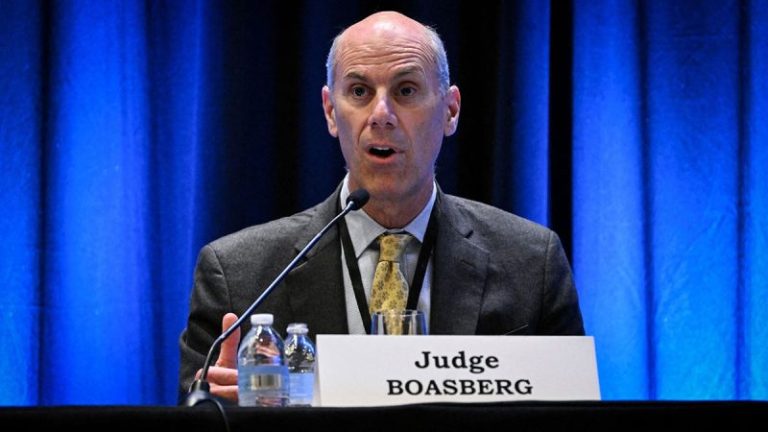
James Boasberg, the chief judge of the United States District Court for the District of Columbia and a Biden appointee, is a judicial disgrace. Boasberg’s recent rulings show he is unfit for the bench.

His repeated abuse of judicial power, whether undermining national security, releasing violent threats, or enabling unlawful surveillance, demonstrates a blatant disregard for the Constitution and a dangerous partisan agenda that disqualifies him from holding a lifetime appointment.

The time has come for the House of Representatives to do its job and impeach him.

The Constitution fixes the term of service for a judge as ‘during good Behaviour.’ The Constitution also dictates that impeachment is proper for ‘high crimes and misdemeanors.’  House Democrats in 2020 argued an official can get impeached for an abuse of power even without a statutory crime, setting an important precedent. The Constitution draws no distinction between the requirements for impeaching Executive Branch and Judicial Branch officials. What is good for the Executive Branch goose is just as good for the Judicial Branch gander, so the House should not hesitate to pursue a judicial impeachment.

Boasberg’s first act of misconduct occurred during a judicial conference. During the earliest stages of President Trump’s second term, Boasberg expressed the view to Chief Justice John Roberts that President Trump would not follow court orders. The President has not violated a court order. Boasberg’s claim had no basis and was plainly partisan. Boasberg baselessly told Chief Justice Roberts that Trump wouldn’t follow court orders, an unfounded partisan claim that undermines any expectation of impartiality.

Tren de Aragua is a barbaric international state-sponsored terrorist organization from Venezuela. MS-13 is an animalistic gang based in El Salvador.  Thousands of these gang members have come to the United States and perpetrated horrific acts. In March, the Trump administration deported hundreds of these barbarians to El Salvador, where they were sent to a maximum security prison. Boasberg issued a highly illegal and dangerous order directing the government to turn around planes as they were in international airspace, flying over the Gulf of America. In doing so, Boasberg exposed an ongoing military operation and gave an order that could have endangered Americans.

Why would we have security in place in the United States to deal with an unexpected influx of hundreds of dangerous terrorist, because some rabidly partisan judge just illegally opened his courtroom and stunningly attempted to sabotage an ongoing military operation? Rather, the security footprint was in El Salvador—hundreds of military, intel, and law-enforcement officials—where the terrorists were expected to land. There was also a serious risk to the personnel on the planes, given that they had a limited fuel supply and were in the middle of the Gulf of America. Boasberg showed a blatant disregard for these serious risks in issuing a highly illegal and dangerous order that he lacked jurisdiction to give.

The planes landed in El Salvador, and Boasberg began contempt proceedings. Even after a D.C. Circuit panel rejected his reasoning, Boasberg pressed ahead, ordering the administration to detail its deliberations that March day. The Justice Department is objecting, asserting that Boasberg is violating the foundational principle of separation of powers by having executive branch officials illegally divulge privileged internal discussions.

Moreover, Boasberg played a key role in Operation Arctic Frost—one of the most dangerous spy scandals in our history. Biden Special Counsel Jack Smith, a political scud missile sent to take out President Trump via lawfare with the full blessing of Biden and his Justice Department, subpoenaed the phone records of nearly a dozen U.S. senators. Boasberg issued a gag order preventing the phone companies from disclosing the information for a year. With no basis, he reasoned that disclosure could lead to destruction of evidence and witness intimidation. The relevant statute, 2 U.S.C. § 6628, explicitly requires disclosure to the Senate when such spying occurs. Boasberg now is attempting to weasel his way out of this jam, claiming that he did not know that Smith was seeking the senators’ records. Either Boasberg is lying, or he was an illegal rubber stamp who signed whatever Smith put under his nose. It is disgraceful, and Boasberg, citing the same separation-of-powers claim that the Justice Department is using in the contempt proceeding, refused to testify before the House Judiciary Committee last week.

Finally, Boasberg has shown a flippant concern for the security of President Trump. Nathalie Rose Jones is a deeply disturbed woman. She made a social media post threatening to disembowel President Trump. She admitted to the post when the Secret Service visited her. Then, Jones attended a protest and was spotted near the White House carrying a knife. Authorities arrested her, and even Democrat-appointed U.S. Magistrate Judge Moxila Upadhyaya, exercising the most basic level of common sense, ordered her held without bail. Then, Boasberg stepped in and overruled Upadhyaya, releasing Jones to go home with an electronic monitor.

Boasberg has not simply issued a ruling with which conservatives disagree. Boasberg instead has engaged in a pattern of impeachment-worthy behavior—extremely lawless and dangerous partisan rulings—that shows no signs of ending. He is bolder than ever, refusing to testify before Congress and proceeding merrily along with his absurd contempt vendetta. The House disgraced itself with two impeachments of President Trump. It is time for the House to redeem itself by bringing reason back to the impeachment process. Boasberg is a more-than-worthy candidate, and the House should impeach him before they go home for the year.

This post appeared first on FOX NEWS

The State Department is so far refusing to comment on a growing corruption crisis engulfing the Balkan nation of Albania — a vital U.S. ally in the region. 

Following an Albanian court’s decision to remove Deputy Prime Minister Belinda Balluku from her position on allegations she interfered in two construction bids, socialist Prime Minister Edi Rama took the issue to the country’s Constitutional Court, which on Friday reinstated her until a ‘final decision’ could be made, according to media reports.

The Special Anti-Corruption and Organized Crime Structure (SPAK) issued a criminal indictment against Balluku on Oct. 31, alleging that she had been improperly influenced in her decision to favor one company in a tender for the construction of a 3.7-mile tunnel in southern Albania, Reuters reported. SPAK delivered an additional charge for violating rules in a Tirana road construction project on Nov. 21, the date when Balluku was removed from office.

The day prior to her November court appearance, Balluku told the country’s parliament that the accusations against her constituted ‘mudslinging, insinuations, half-truths and lies.’

As the second member of Rama’s cabinet to face corruption accusations since 2023, her charges have drawn the ire of Rama opponents.

Agim Nesho, former Albanian ambassador to the U.S. and the United Nations, told Fox News Digital that Balluku’s case demonstrates ‘the Rama government shows no sign of assuming moral responsibility or allowing justice the space to act independently. Instead, it appears intent on shielding Ms. Balluku, portraying the judiciary’s actions as an attack on the executive.’

Tirana’s ex-ambassador to Washington argued that ‘influencing the Constitutional Court may be an attempt to set a protective precedent — one that could prove useful if investigators ever seek to involve Mr. Rama himself in their investigations.’

‘It’s becoming increasingly clear that the emperor has no clothes, Nesho said, adding that Rama’s rule has amounted to ‘state capture’ as the ‘lack of checks and balances has enabled a recurring system of corruption across multiple of his terms.’

Nesho also claimed that Balluku had pointed to broader involvement of the Rama government in decision-making. Former Deputy Prime Minister Arben Ahmetaj, who went on the run after coming under SPAK investigation, has likewise alleged that Rama ‘directed all key decisions on tenders, finances, and public assets,’ according to Nesho’s claims.

Ahmetaj’s accusations included allegations that Rama is involved with mafia bosses. Rama responded to these insinuations by saying Ahmetaj ‘should not be taken seriously. Albanian politics is not tainted by the mafia,’ Balkanweb reported.

The U.S. has funded efforts for judicial reforms in Albania to aid its efforts toward accession into the European Union by cutting down on corruption. However, those reforms have led to legal backlogs that have drawn frustration and violence from the public.

Nesho said that ‘it is hard to see how a government that behaves like a banana republic gains accession to the E.U.’ He said that ‘Albania is a living contradiction in terms of law and order.’ While Nesho says Rama’s opposition has been ‘decimated by ‘lawfare’ and the compromising of legal institutions,’ Rama remains in office despite ‘documented multi-billion-dollar corruption scandals, documented electoral thefts across multiple voting cycles, and, most concerning, documented links to international drug cartels like the Sinaloa Cartel.’

Allegations that Rama is linked to the Sinaloa Cartel emerged after the prime minister met with Sinaloa-connected Luftar Hysa, who is sanctioned by the U.S. Department of Treasury. Rama told an Albanian news outlet that he met with Hysa just once.

With Balluku’s removal, Nesho says that ‘public anger is directed not only at [her] but also at the irresponsible conduct of a regime that rules without accountability, abuses public property and finances, and faces no consequences despite society’s reaction.’ Nesho said many in the country have given the prime minister the nickname ‘Ramaduro,’ saying it’s ‘a direct comparison to the Venezuelan dictator Nicolás Maduro.’

Rama’s press office told Fox News Digital that it declined to comment on Nesho’s allegations against him.

In May 2021, the State Department sanctioned former Prime Minister Sali Berisha over corruption allegations, which forbade him from traveling to the U.S. Fox News Digital asked the State Department whether it had plans to issue similar sanctions against Balluku.

A State Department spokesperson told Fox News Digital, ‘We have no comment on ongoing legal matters.’

The U.S. Embassy in Tirana issued the same response to Fox News Digital when asked whether it would suspend Balluku’s visa as a result of her removal from office.

This post appeared first on FOX NEWS

The Trump administration’s latest offensive move against Venezuela, the seizure of a tanker carrying U.S.-sanctioned oil, has triggered predictable outrage from Venezuelan President Nicolás Maduro’s government. 

But behind the rhetorical fire, analysts say the regime has few practical ways to hit back without doing even more damage to itself.

Experts say that Maduro could target U.S. oil interests in Venezuela, but doing so would almost certainly inflict more pain on his own cash-starved regime than on the United States.

Maduro could also halt U.S.-chartered deportation flights, but again, would be harming his own interests, experts say. 

‘Venezuelans are just leaving the country because of the terrible conditions the regime has created,’ said Connor Pfeiffer, a Western Hemisphere analyst at FDD Action. ‘By having people come back, even if they’re on U.S. charter deportation flights, it kind of counters that narrative.’

Western oil firms have significantly decreased their presence in Venezuela, home to world’s largest proven oil reserves, in recent years due to sanctions. 

But U.S.-owned Chevron does still maintain a license to operate there, on the condition that the Maduro regime does not financially benefit from its operations. Instead, Chevron hands over to Maduro half of its oil production as payment, according to multiple reports.

‘Chevron’s operations in Venezuela continue in full compliance with laws and regulations applicable to its business, as well as the sanctions frameworks provided for by the U.S. government,’ a Chevron spokesperson told Fox News Digital.  

Imports of Venezuelan crude have declined to roughly 130,000 barrels per day (bpd) to 150,000 bpd in recent months, below the nearly 300,000 bpd seen under the prior petroleum licensing regime under the Biden administration. Most of Venezuela’s exports are now routed to Asia, with the bulk ultimately landing in China through intermediaries, according to data from Kplr. 

Despite that flow of crude, analysts say the idea of Caracas striking back at Chevron is more potent as a talking point than as a viable policy option.

Shutting down or seizing the company’s operations would instantly cut off one of the few lifelines still feeding Venezuela’s collapsing oil sector. It also would risk triggering a swift and politically difficult American response, including a full reinstatement of the sanctions relief the regime has quietly relied on.

Pfeiffer noted that the Maduro government has been ‘very supportive of Chevron continuing to operate’ because the arrangement provides tens of thousands of barrels a day of oil with minimal investment from Venezuelan-owned Petróleos de Venezuela, S.A. Other analysts say that reality sharply limits Maduro’s room to maneuver: any attack on Chevron would strike at his own revenue stream first.

Another theoretical lever — military or maritime escalation — is widely viewed as even less credible. Venezuela has taken delivery of small Iranian-built fast attack craft equipped with anti-ship missiles, a fact that has fueled speculation Maduro could threaten U.S. or allied vessels.

But Venezuela’s navy suffers from years of maintenance failures and lacks the ability to sustain operations against American forces deployed in the Caribbean. Any aggressive move at sea would almost certainly invite a U.S. military response the regime is in no position to absorb.

Diplomatically, Caracas could suspend remaining channels with Washington, or file legal challenges in U.S. courts or international forums. Yet previous efforts to contest sanctions-related seizures have gone nowhere, and Venezuela’s relationships in the hemisphere offer limited leverage. 

Regional bodies have little sway over U.S. sanctions law, and even supportive governments in Russia, China, or Iran are unlikely to intervene beyond issuing critical statements. Beijing, now the primary destination for Venezuelan crude, has economic interests at stake but few practical avenues to challenge U.S. enforcement actions.

Absent direct military strikes, cracking down on sanctioned oil exports is one of the most potent ways the U.S. can weaken the regime, according to Pfeiffer. 

‘This is one of his main sources of revenue keeping the regime afloat.’

This post appeared first on FOX NEWS